
Youbang · B2B Custom Silicone Manufacturing · Dongguan

Why Molded Silicone Clouds or Softens Under Boiling & 121–134 °C Steam Cycles

Infant sippy spouts, menstrual cups, and reusable respiratory mask seals undergo harsh thermal moisture shock—100 °C rolling boils in family kitchens or 121–134 °C pressurized steam autoclave cycles in clinics. When silicone turns cloudy white, feels sticky, or loses sealing compression after five washes, the culprit rarely lies in mold steel; it comes directly from peroxide catalyst residues, excessive mineral fillers, or skipped 200 °C × 4–6 hours oven post-curing.

Materials & Regulatory ComplianceUpdated

3 min readCompiled by Youbang Silicone Engineering Team

Key Sourcing Takeaways

  • White blooming haze in 100 °C boiled silicone almost always points to peroxide (DBPH) decomposition acids/alcohols or incompatible internal lubricants extracting under steam—switch to pure platinum addition-cured LSR or HCR.
  • Repeated pressurized 121–134 °C steam breaks incomplete polymer networks or drives low-crosslink parts soft: always complete 200 °C × 4–6 hours ventilated post-curing across 6 circulating ovens (keeping volatiles ≤0.5%) before sterilizer validation.
  • Measured Shore A shifts on properly post-cured pure platinum silicone typically hold within roughly ±3 Shore A across repeated boiling/steam tests, whereas under-cured or filler-heavy stocks lose snap force quickly.

100 °C Boil & 121–134 °C Steam Autoclave: Peroxide Haze vs. Platinum Cure Stability
100 °C Boil & 121–134 °C Steam Autoclave: Peroxide Haze vs. Platinum Cure StabilityEngineering process control benchmark · final tolerances confirmed per project CADProcess parameter window (verified per part CAD)Peroxide-Cured or Under-Baked Elastomer• By-product salts migrate in boiling water → white haze• Hydrolysis & low crosslink density soften lip stiffness• Odor, surface tack & yellow drift under 121–134 °C steam• Unsuited for repeated infant boiling or clinical autoclavingPlatinum Addition Cure + 200 °C × 4–6h Post-Cure• Zero peroxide residue keeps thin walls clear after boils• Ventilated 200 °C × 4–6h bake clears volatiles ≤0.5%• Holds Shore A within ±3A across steam autoclave runs• Verify color clarity & Shore stability via T1 boil checksPairing pure platinum gum with 200 °C × 4–6h baking prevents boiling haze and seal sag
Engineering process control benchmark · final tolerances confirmed per project CAD
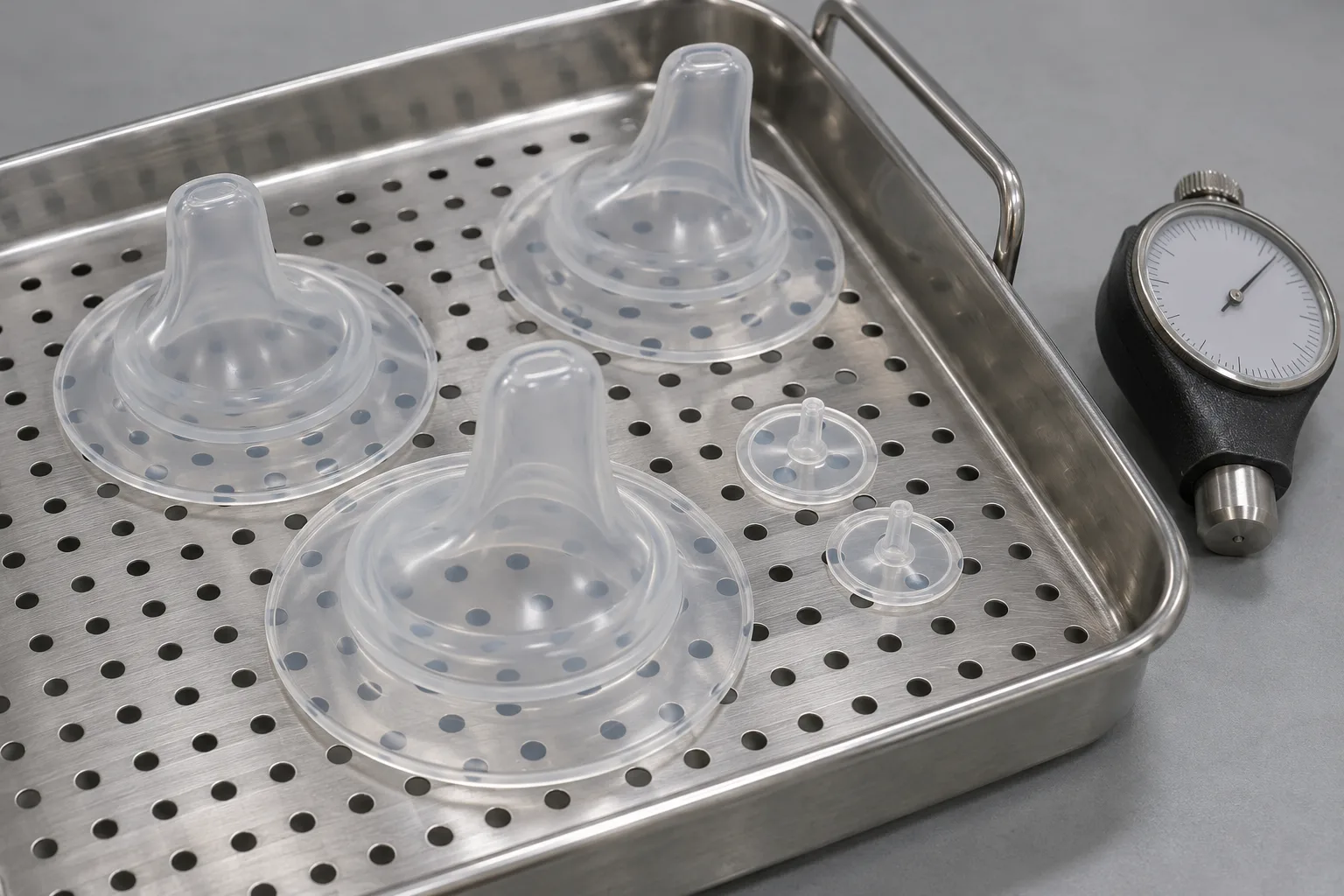
Crystal-clear platinum silicone baby sippy spouts and small LSR valve membranes arranged on a perforated stainless autoclave tray beside an analog Shore A durometer

Product managers sourcing infant feeding spouts, menstrual cups, or hospital CPAP masks often receive disturbing sample complaints only after live kitchen boiling or clinic autoclave testing: clean translucent skirts turn opaque milky-white, valve slits weep lightly, or matte rings release a sharp sour smell right out of hot steam.

Inside Dongguan Youbang's 8,000 m² plant (integrating 10 LSR presses, 15 vacuum HCR presses, 6 ventilated circulating post-cure ovens, and Shore A durometer QC stations), wet-heat failure traces cleanly back to two chemistry and process controls.

1. Peroxide Cure Residues vs. Platinum Crosslink Hydrolysis Resistance

Root Cause What Happens at 100 °C Boil / 121–134 °C Steam Prevention on Youbang Production Runs
Peroxide (DBPH) Catalyst Residues Residual organic acids & decomposition by-products draw moisture inside thin walls—turning clear/tinted parts cloudy milky-white with sour odors Specify pure platinum addition-cured LSR or HCR with zero peroxide decomposition fragments
Skipped or Short 200 °C × 4–6h Post-Cure Free low-molecular siloxane chains migrate toward hot surfaces during steam release, driving surface bloom & softening Run complete 200 °C × 4–6 hours hot-air ventilated oven baking across 6 circulating ovens (≤0.5% volatile loss target)
Hydrolysis & Heavy Mineral Fillers Poor filler coupling or excessive reinforcing additives absorb hot vapor, widening Shore A hardness drift and flattening valve lip seal force Verify T1 boil soak clarity plus pre/post calibrated Shore A checks (platinum stocks typically hold within roughly ±3A when properly baked)

2. Checking Wall Thickness, Hardness Drift & Optical Haze at T1

Never accept room-temperature cosmetic inspection alone for steam-sterilized items:

  1. Run physical 100 °C distilled-water boiling (or client 121–134 °C autoclave validation) directly on oven-cured T1 silicone samples (7–15 days post-tooling kickoff) rather than relying solely on supplier datasheets.
  2. Measure Shore A durometer and optical clarity before, immediately after drying, and 24 hours post-boil so spring-back stiffness remains locked onto your mask housing or sippy spout seat.
  3. Coordinate finished-part lab testing via SGS, Intertek, or TÜV (~10 days) matching FDA 21 CFR 177.2600, German LFGB, or ISO 10993 requirements after lock-in.

3. Scaling Safely From 100 pcs Sterile Validation Trials

Validate your translucent platinum compound before heavy multi-cavity steel investments:

  • Check frame latch geometry via free 3D-printed structural prototypes (buyer covers shipping).
  • Prove steam-cycle clarity and mechanical fit across 100 pcs pilot orders before expanding to standard 1,000 pcs or $2,000 USD production volumes packed in our 600 m² clean assembly & double-PE area.

Upload STEP files and sterilization cycle expectations on our LSR respiratory mask cushion page or platinum vs. peroxide silicone guide for an initial compound review within 24 hours.

References & Engineering Sources

  1. Dongguan Youbang Platinum vs. Peroxide Crosslink Engineering Guide
  2. ASTM D471 / D573 — Standard Test Methods for Rubber Fluid & Heat Aging Resistance
Turn the selection into a reviewable project brief

Sourcing & Tooling FAQ

Key Answers Before Tooling

Covering CAD readiness, 100 pc trial & 1,000 pc / $2,000 USD standard MOQ policy, free 3D fit prototypes vs. T1 silicone samples, NDA protection, and mold ownership.

Have a part-specific question?

Send your drawing or sample photo directly to Youbang’s engineering desk; we send an initial response within 24 hours.

Is white fogging after boiling translucent baby or medical silicone purely hard-water scale, or a rubber failure?

Hard-water calcium leaves chalky surface deposits that rub clean with diluted vinegar; peroxide catalyst residues, filler blooms, and un-baked siloxane volatiles turn the interior rubber wall milky and cloudy even inside pure distilled steam.

Can platinum addition-cured silicone tolerate 121 °C to 134 °C steam autoclaving better than peroxide-cured rubber?

Yes. Because platinum addition crosslinking creates no peroxide carboxylic decomposition fragments inside the matrix, translucent platinum LSR and HCR parts resist hydrolytic blooming, odor release, and compression sag far cleaner after full oven baking.

How does Youbang verify whether molded parts will drift in hardness or turn yellow during boiling?

Every lot for reusable sterilization applications undergoes 200 °C × 4–6 hours circulating oven conditioning followed at T1 by physical boil/hot-soak clarity checks and calibrated Shore A durometer comparisons pre- vs. post-exposure.

Does thicker cross-section HCR parts require longer 200 °C post-curing than thin 0.30 mm LSR diaphragms?

Yes. While standard circulating bake schedules run 200 °C × 4–6 hours per material grade, thick 6–10 mm compression rings require conservative ramp-and-soak curves so volatile oligomers diffuse cleanly out of the core without skin blistering.

B2B Factory Direct · initial response within 24 hours

Match your compound & 200 °C oven cure window to actual boil or autoclave cycles

Share sterilization temp (100 °C boil vs. 121–134 °C steam), required clarity, and target durometer for platinum compound & T1 boil-check recommendations.

✓ Trial from 100 pcs · Standard 1,000 pcs or $2,000 USD✓ Free 3D-printed fit prototypes before steel tooling✓ Paid molds 100% owned by customer

Send Your Project Brief or CAD

For confidential drawings, sign the mutual NDA before uploading the files.

Only rights holders or their authorized representatives may upload files. We keep inquiries and attachments to prepare quotes and follow up on your project.

Prefer email or files > 20 MB? Send directly to zhouli@ybsilicone.com · Privacy Policy