
Key Sourcing Takeaways
- Platinum (addition) curing forms Si–CH2–CH2–Si crosslinks with zero organic peroxide decomposition odor or surface blooming.
- All two-part LSR (85T/120T presses) is platinum-cured; solid HCR (200–250T presses) can be compounded as either peroxide (1.0×) or platinum (1.25×–1.6×).
- Both systems still require ventilated secondary post-curing (typically 200 °C × 4 h) to hit EU LFGB ≤ 0.5% volatile limits.
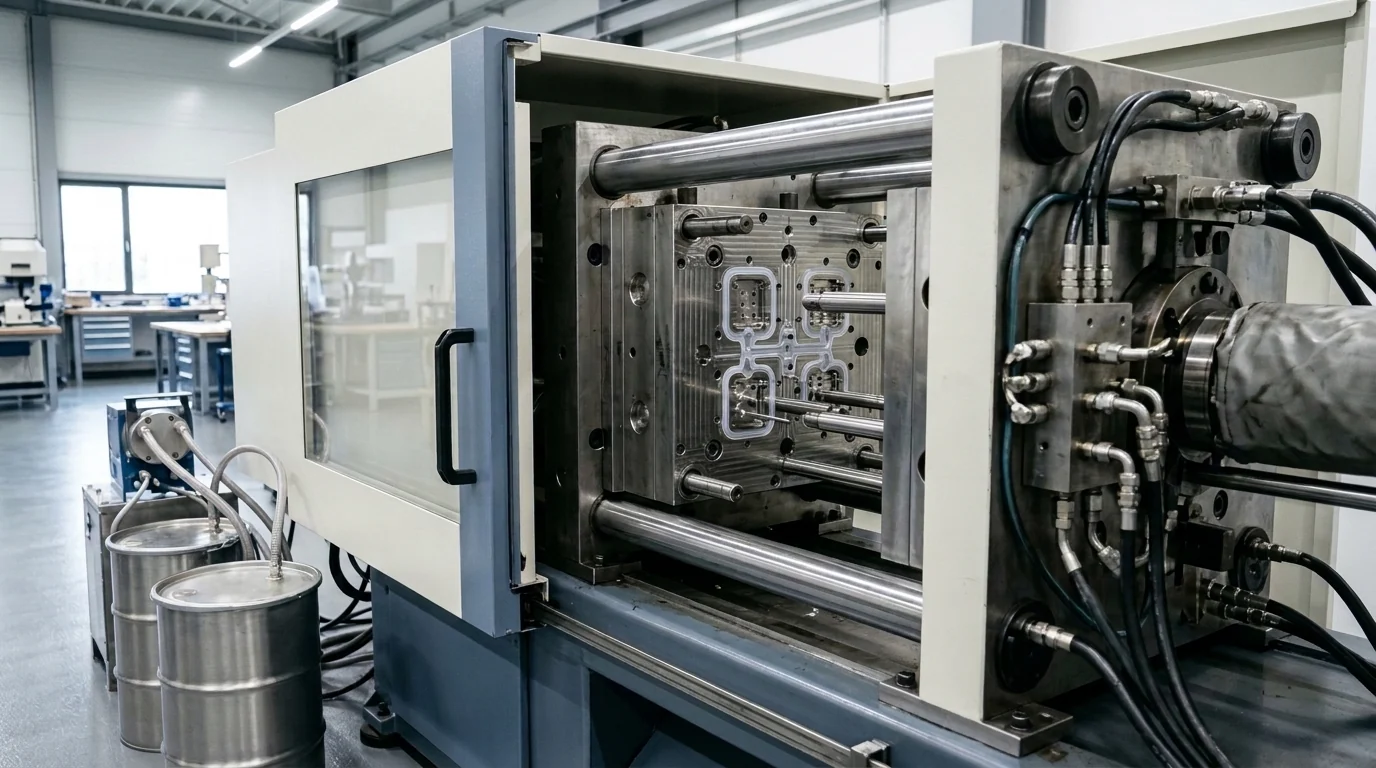
Platinum-cured silicone (addition-cured) uses a noble-metal platinum complex to crosslink vinyl and silicon-hydride (Si–H) groups directly—generating zero chemical cleavage byproducts, higher tear strength, superior water-white clarity, and odor-free stability required for EU LFGB bakeware, infant feeding, menstrual cups, and medical components. Peroxide-cured silicone uses organic peroxides that thermally decompose to crosslink polymer chains, offering lower raw-compound cost (1.0× baseline) and robust high-temperature static sealing for non-food industrial gaskets, vibration mounts, and general protective sleeves.
At Dongguan Youbang, all Liquid Silicone Rubber (LSR) molded on our 85T and 120T injection presses is addition-cured with platinum, whereas High-Consistency Rubber (HCR) milled on our 2 open mixing mills and molded across 10 × 200–250T compression presses can be formulated with either platinum or organic peroxide curing agents depending on your compliance and cost brief.
1. Engineering Comparison Matrix: Platinum Addition Cure vs. Peroxide Cure
| Engineering Dimension | Platinum-Cured Silicone (Addition Cure — LSR & Platinum HCR) | Peroxide-Cured Silicone (Free-Radical Cure — Standard HCR) |
|---|---|---|
| Crosslinking Reaction | Hydrosilylation (Si–CH=CH2 + H–Si → Si–CH2–CH2–Si) catalyzed by trace Pt |
Thermal cleavage of organic peroxides forming carbon/methyl crosslinks |
| Reaction Byproducts & Blooming | Zero curing decomposition byproducts; non-yellowing, zero white surface frost | Volatile organic acids/ketones (can cause pungent odor or chalky surface blooming if unbaked) |
| Optical Clarity & Color Purity | High water-white translucency; crisp pastel & vivid Pantone reproduction | Slight yellowish tint in thick sections; best suited to opaque colors |
| Tear Strength & Elongation | High tear propagation resistance & brisk snap-back recovery (ideal for deep undercuts) | Moderate tear strength; proven static compression-set resistance in industrial seals |
| Molding Platforms at Youbang | 85T & 120T LSR injection (0.25–0.30 mm min wall) or 200–250T HCR compression |
200–250T HCR compression presses (400×400–650×650 mm platens; 0.40–0.50 mm min wall) |
| Catalyst Inhibition Sensitivity | High — poisoned by sulfur, amines, tin-cure silicones, latex gloves, or certain inks/primers | Low — forgiving around industrial inserts, sulfur-bearing rubbers, and shop-floor handling |
| Relative Compound Cost Ratio | 1.25× – 1.6× (Food Platinum HCR) / 2.2× – 4.0× (Sourced Medical Two-Part LSR) | 1.0× Baseline (industry order-of-magnitude elastomer ratio, not a fixed price quote) |
| Primary B2B Applications | EU LFGB / BfR XV kitchen & bakeware, baby teethers/bowls, menstrual cups, medical valves | Industrial O-rings/gaskets, electronics bumpers, mechanical vibration isolators (ISO 9001) |
(Technical reference: WACKER Solid and Liquid Silicone Rubber — Material and Processing Guidelines, 6709-EN.)
2. Myth-Busting: Why Platinum Silicone Still Needs Secondary Post-Curing
A common sourcing mistake is assuming that specifying "100% platinum silicone" eliminates the need for secondary oven post-curing. While platinum hydrosilylation produces no peroxide breakdown acids, raw polysiloxane polymers naturally contain equilibrium traces of low-molecular-weight cyclic siloxanes (D4–D8 volatiles).
As documented in Wacker's processing literature, ventilated secondary post-curing—typically around 200 °C for 4 hours, adjusted for compound grade and wall thickness—serves two critical engineering functions even on platinum-cured parts:
- Driving Volatile Weight Loss Below
≤ 0.5%: Mandatory to pass German LFGB / BfR XV and French DGCCRF volatile organic matter tests on bakeware, baby tableware, and intimate-care cups. - Stabilizing Final Mechanical & Compression-Set Properties: Completes residual crosslinking so Shore A durometer (
0–80Arange; commonly30–70A) and sealing recovery remain stable across service life.
3. Catalyst Poisoning & Overmolding Interface Precautions
Because platinum catalyst concentrations are measured in parts per million, addition-cured HCR and LSR require strict material compatibility discipline on the shop floor:
- Segregated Milling & Clean Handling: On our 2 open mixing mills, platinum HCR compounds are kept strictly isolated from sulfur-cured rubbers, amine accelerators, and natural latex gloves—any trace contamination leaves tacky, uncured spots on the molded surface.
- Insert Overmolding Compatibility: When overmolding platinum silicone onto customer-supplied PC, PP, PA, stainless steel, aluminum, or copper inserts, both the substrate cleaning solvent and the chemical primer (
底涂) must be verified platinum-compatible duringT1trials (typically 7–15 days).
4. Decision Framework: How to Specify Cure Chemistry in Your RFQ
Use these three rules to avoid either over-specifying industrial parts or failing consumer lab tests:
- Specify Platinum LSR (
85T / 120T) when your part requires0.25–0.30 mmthin membranes, flash-free mucosal rims (e.g., menstrual cups), micro-pinholes, or upstreamISO 10993/USP Class VIraw-material traceability paired with our 150–200 m² clean washing, inspection, assembly, and packaging zone. - Specify Platinum HCR (
200–250TCompression) when launching custom Pantone kitchen utensils, baking molds, pet slow-feeders, or baby feeding sets that require EU LFGB / US FDA 21 CFR 177.2600 compliance with economical compression mold investment. - Specify Peroxide HCR (
200–250TCompression) when buying non-food industrial gaskets, equipment feet, or rugged device bumpers where unit cost efficiency and static compression sealing matter more than food/skin extraction limits.
Always confirm cure feel, odor neutrality, and color on physical T1 molded silicone samples—and review Food-Grade Silicone Specifications alongside Custom Silicone Product Cost before finalizing your RFQ.
Pre-Tooling DFM Spec Sheet
8-Point Custom Silicone DFM Self-Check
Check these eight engineering points on your CAD or brief before cutting steel tooling.