
Youbang · B2B Custom Silicone Manufacturing · Dongguan
Silicone Insert Overmolding
Primer-bonded LSR injection and HCR compression overmolding onto customer-supplied PC, PP, PA, stainless steel, aluminum, and copper inserts—combining rigid structural frames with permanently sealed elastomeric grips, gaskets, and keypads.
- ARigid datum & locating surface
- Defined insert features seat against steel pins or nest pockets to hold position under clamp and injection pressure.
- BShut-off shoulder & keep-clear zone
- Machined steps or crush ribs seal against the insert so silicone cannot flash onto exposed threads, contacts, or mating faces.
- CPrimer-bonded + mechanical interface
- Chemical primer applied to cleaned PC, PP, PA, SS, Al, or Cu combines with optional through-holes or undercuts for durable retention.
Supported inserts: Customer-supplied PC, PP, PA, stainless steel, aluminum & copper
Bonding route: Surface preparation + chemical primer (no primerless LSR claimed)
Molding platforms: 85T/120T LSR injection or 200–250T HCR compression presses
Sampling & lead time: new mold T1 typically 7–15 days (after insert arrival); mass 15–30 days
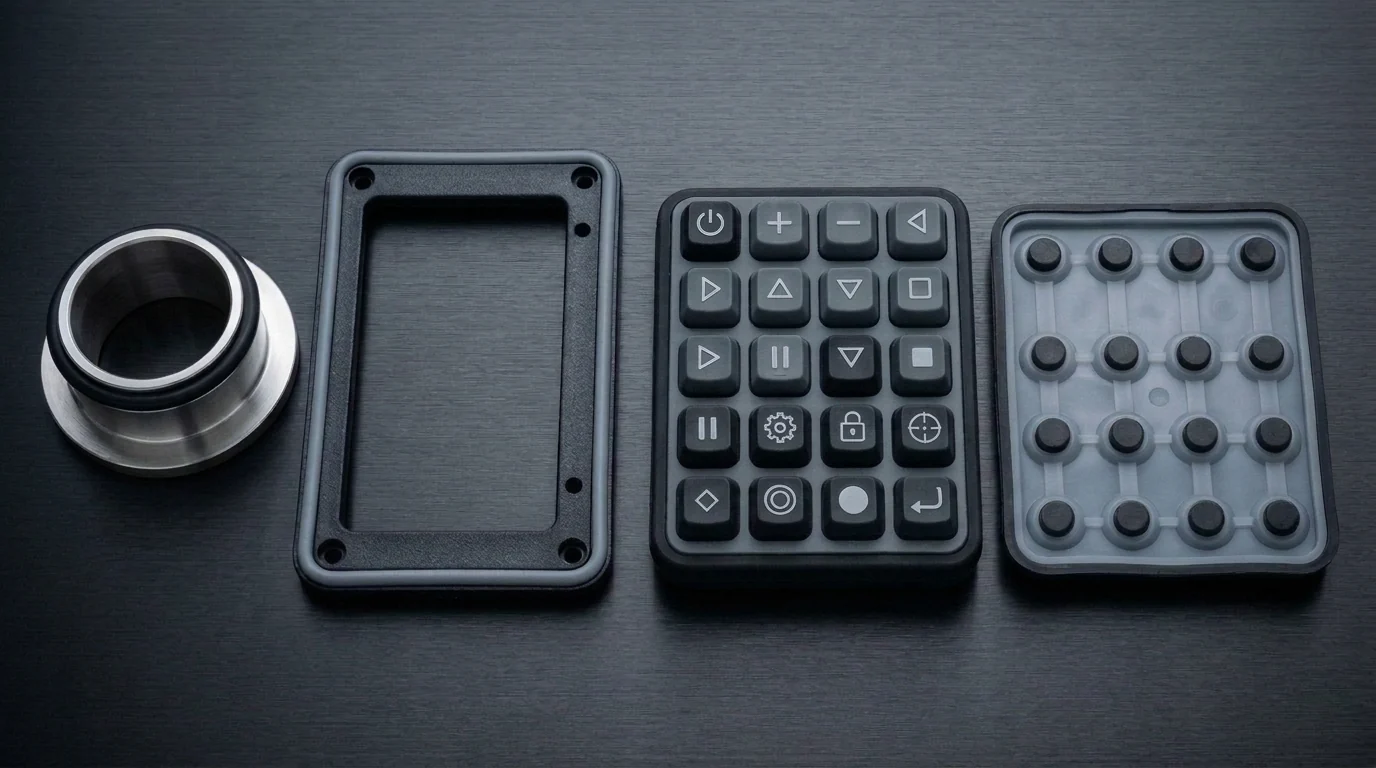
Four engineering inputs required before cutting an overmold tool
Overmolding success depends as much on the incoming tolerance and heat deflection of your supplied insert as on the silicone cavity itself.
- Exact substrate grade & thermal ceiling
- Confirm the exact insert grade among PC, PP, PA (e.g., glass-filled PA66), stainless steel, aluminum, or copper. Plastic inserts must withstand mold curing temperatures (often 120–170 °C) without warping or sink collapse.
- Incoming insert tolerances at shut-off collars
- Tight, repeatable dimensions (±0.05–0.10 mm) at the silicone boundary prevent steel cavities from either crushing rigid plastic inserts or leaking thin silicone flash onto keep-clear zones.
- Primer masking & mechanical interlock backup
- Primer adhesion requires clean, oil-free inserts (no silicone mold-release spray used by your plastic molder!). Where geometry allows, add mechanical through-holes or dovetail grooves alongside chemical primer.
- Trial insert allowance & P+R keypad options
- Plan extra customer-supplied inserts for T1 tool setup, primer trials, and destructive peel checks. For electronics interfaces, we also build P+R (plastic cap + conductive/silicone rubber base) keypads.
We evaluate PC, PP, PA, stainless steel, aluminum, and copper with primer per project; we do not claim primerless self-bonding LSR or unverified substrates.
Verify shut-off cleanliness, insert geometry, and bond integrity on T1
Dimensional metrology alone cannot qualify an overmolded part—T1 validation pairs optical inspection with destructive adhesion and service-environment checks.
- Inspect keep-clear threads, electrical contacts, and cosmetic faces for zero silicone bleed or primer staining.
- Check post-molding insert flatness and critical assembly datums on our 2D optical coordinate measuring system.
- Conduct 90°/180° peel checks, boiling/dishwasher thermal cycling, or pull-off tests agreed for your end-use environment—looking for cohesive tearing within the silicone rather than clean interfacial delamination.
Which route fits the project?
Could a snap-on or stretch-fit silicone sleeve avoid insert logistics?
When field replaceability, insert heat limits, or separate recycling matter, compare molding a standalone HCR sleeve or seal instead of permanent overmolding.
Review standalone HCR molding →Intricate thin-wall seal overmolded onto PA66, PC, or stainless steel?
Explore low-viscosity 85T/120T LSR injection when lower cavity clamping stress and thin 0.25–0.30 mm elastomeric lips are required around delicate inserts.
Review LSR injection molding →Sourcing & Tooling FAQ
Key Answers Before Tooling
Covering CAD readiness, custom MOQ evaluation, free 3D fit checks vs. T1 silicone samples, NDA protection and mold ownership.
Send your drawing or sample photo directly to Zhou Li’s engineering desk for a 24h DFM reply.
Which plastic and metal insert materials does Youbang support for silicone overmolding?+
We overmold customer-supplied polycarbonate (PC), polypropylene (PP), polyamide/nylon (PA), stainless steel, aluminum, and copper inserts using surface preparation and chemical primer. Because plastic heat deflection temperatures vary widely (especially unfilled PP vs. glass-filled PA), every resin datasheet is reviewed before tooling.
Do you manufacture the plastic or metal inserts in-house, or must we supply them?+
Plastic and metal inserts are customer-supplied (either shipped from your nominated injection/stamping vendor or coordinated in Dongguan to your specification). Importantly, plastic inserts molded for silicone overmolding must be produced without silicone-based mold release agents, which poison primer adhesion.
Should my overmolded part run on LSR injection or HCR compression presses?+
Both routes are available in-house. High-precision medical frames, thin sealing lips (0.25–0.30 mm), and delicate plastic inserts typically run on our 85T/120T LSR presses due to low injection viscosity and gentler cavity temperatures; heavy metal cores, kitchen utensil handles, and roll-up drying racks with stainless rods often run economically on our 200–250T HCR presses.
How many extra inserts do we need to supply for T1 sampling and mass production?+
During T1 mold trials and primer parameter tuning, expect to supply an agreed setup buffer (typically 30–100 extra inserts depending on cavity count) plus a small percentage scrap allowance in mass production so shipped order quantities come out complete.
B2B Factory Direct · 24h Engineering & Tooling Review
Send both insert and overmold CAD files for a feasibility check
Share 3D STEP + 2D drawings of the bare insert and finished assembly, exact resin/alloy grade, keep-clear zones, and batch quantity for a 24-hour engineering review.
Direct Dongguan Engineering Desk
- Accepts STEP / IGES / PDF / DWG or sample photos
- New mold T1 typically 7–15 days · Mass run 15–30 days
- Direct Tel / WeChat: +86 185 6655 6911 (Zhou Li)