Youbang · B2B Custom Silicone Manufacturing · Dongguan

Custom Silicone
Household & Bath Products

Partner with our Dongguan molding factory to develop private-label bathroom drainage accessories, quiet furniture leg caps, doorstops, hobby work mats and drawer organizers—molded on 200–250T HCR presses (platens up to 650×650 mm) and 85T/120T LSR lines with custom Pantone compounding and 7–15 day T1 sampling.

WET ITEMS & WATER ROUTES

Engineer Self-Draining Soap Dishes, Vanity Trays & Shower Catchers

Keep bars dry, organize pump bottles and trap shower hair without clogging flow—designed around real basin rim steps, shower drain flanges and one-wipe rinsing.

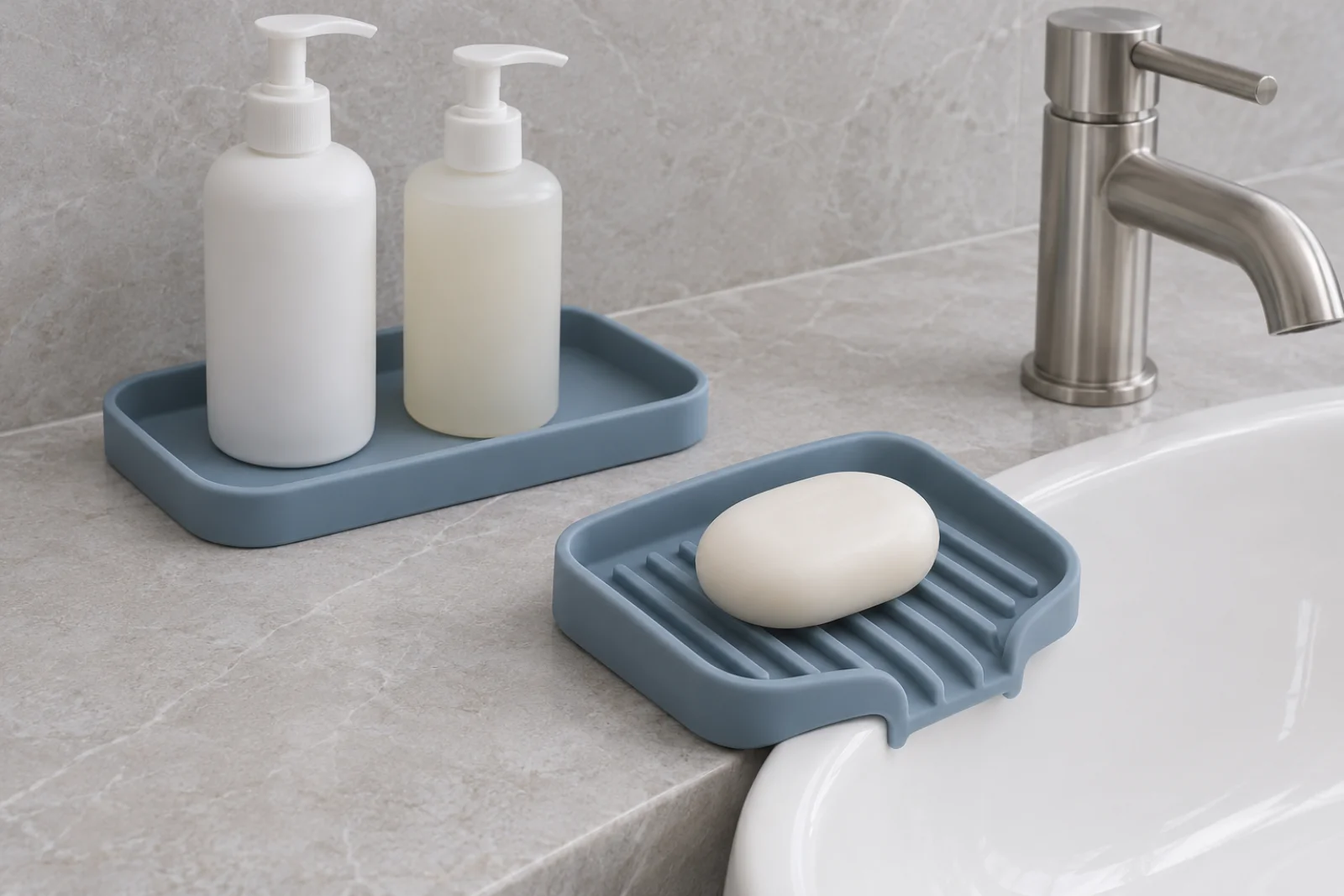
Draining soap dish and water-collecting bottle tray

Soap dishes & resting trays

Raised ribs or contact points support the bar while leaving room for fingers and residue cleanup. A collecting tray retains water for emptying; an outlet-equipped dish directs it toward the basin edge.

Match the outlet to the installed height and basin position. An open channel needs somewhere for the water to go, while a closed tray needs a practical emptying action.

Useful inputs · Bar size, available basin-edge width, pickup direction and water destination.
Toiletry trays & holders

A shallow tray gathers bottles and drips; a divided holder locates handles or separates objects. Bottle bases, pump operation and removal height influence the contact layout.

An open layout is easy to reach, while divisions locate individual items. Attached or wall-mounted versions add a mounting surface, fixing component and removal decision.

Useful inputs · Object outlines, resting or mounting surface, drip quantity and access for lifting and cleaning.

Hair catchers, strainers & stoppers

A filter lets water pass while retaining selected debris; a stopper closes an opening for temporary water retention. Lifting tabs and accessible edges help remove the part for cleaning.

Hole and slot size balance passage with cleaning access. Choose filtering or stopping as the main task, then define the drain shape and any raised cap it must fit around.

Useful inputs · Bath or shower drain geometry, support edges, lifting space and the intended retained material or water use.

FIT, MOVEMENT & CONTACT

Custom-Mold Furniture Leg Caps, Impact Bumpers & Floor Wedges

Tailor sleeve stretch fit, floor-glide wall thickness and 40–75 Shore A impact damping around tubular metal legs, solid wood feet, cabinet doors and floor clearances.

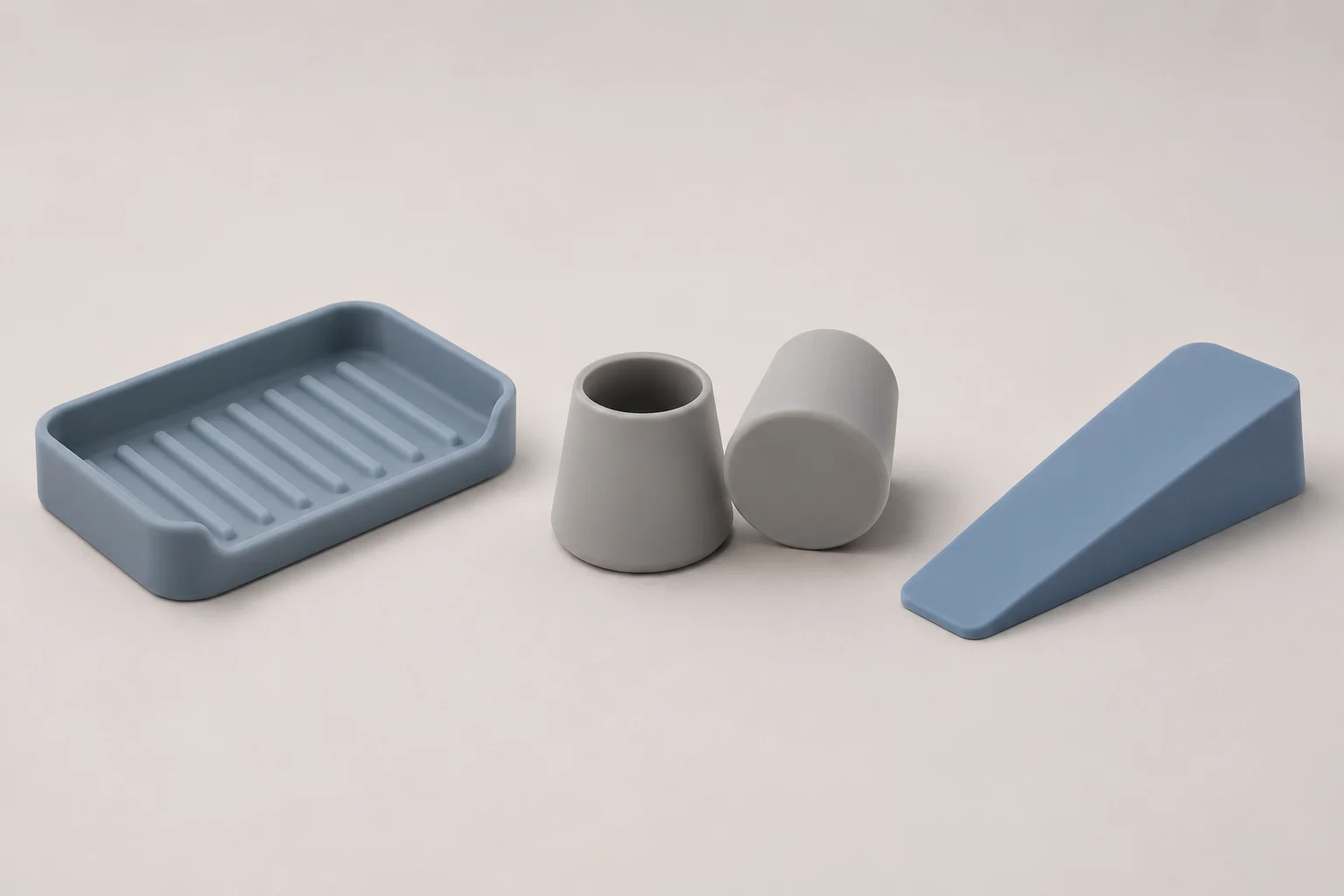
Soap dish, chair-foot cover and wedge doorstop

Chair-foot covers

Round, square and irregular legs need different mouth shapes and insertion depths. The leg fit and the floor-contact face are separate parts of the design.

A closer fit changes installation and removal. An added contact layer introduces its own material and joining choice; the illustrated cover has no lining.

Useful inputs · Leg outline and end detail, movement direction, floor material and removal needs.

Bumpers & contact pads

A bumper meets a moving door or drawer; a resting pad separates a stationary object from a surface. Place the contact area where the actual movement ends.

Loose, retained and attached pads use different fixing interfaces. Thickness occupies assembly clearance, so compare the contact and closing motion on the intended sample.

Useful inputs · Contact objects, travel, available gap, fixing surface and cleaning conditions.

Wedge doorstops

A wedge sits in the door-to-floor gap and is placed or removed by the user. Its height, slope and hand access work with that gap.

A steeper profile changes the insertion distance and handling. Compare the intended door and floor combination rather than assuming the same holding behavior everywhere.

Useful inputs · Door clearance, opening direction, floor condition and the intended placement and removal action.

WORK AREAS & ORGANIZING

Mold Wide Craft Work Mats, Appliance Pads & Drawer Organizers

Leverage our 400×400 to 650×650 mm HCR heated platens to produce large raised-rim craft mats, heat/vibration appliance pads and modular drawer trays with clean EDM matte textures.

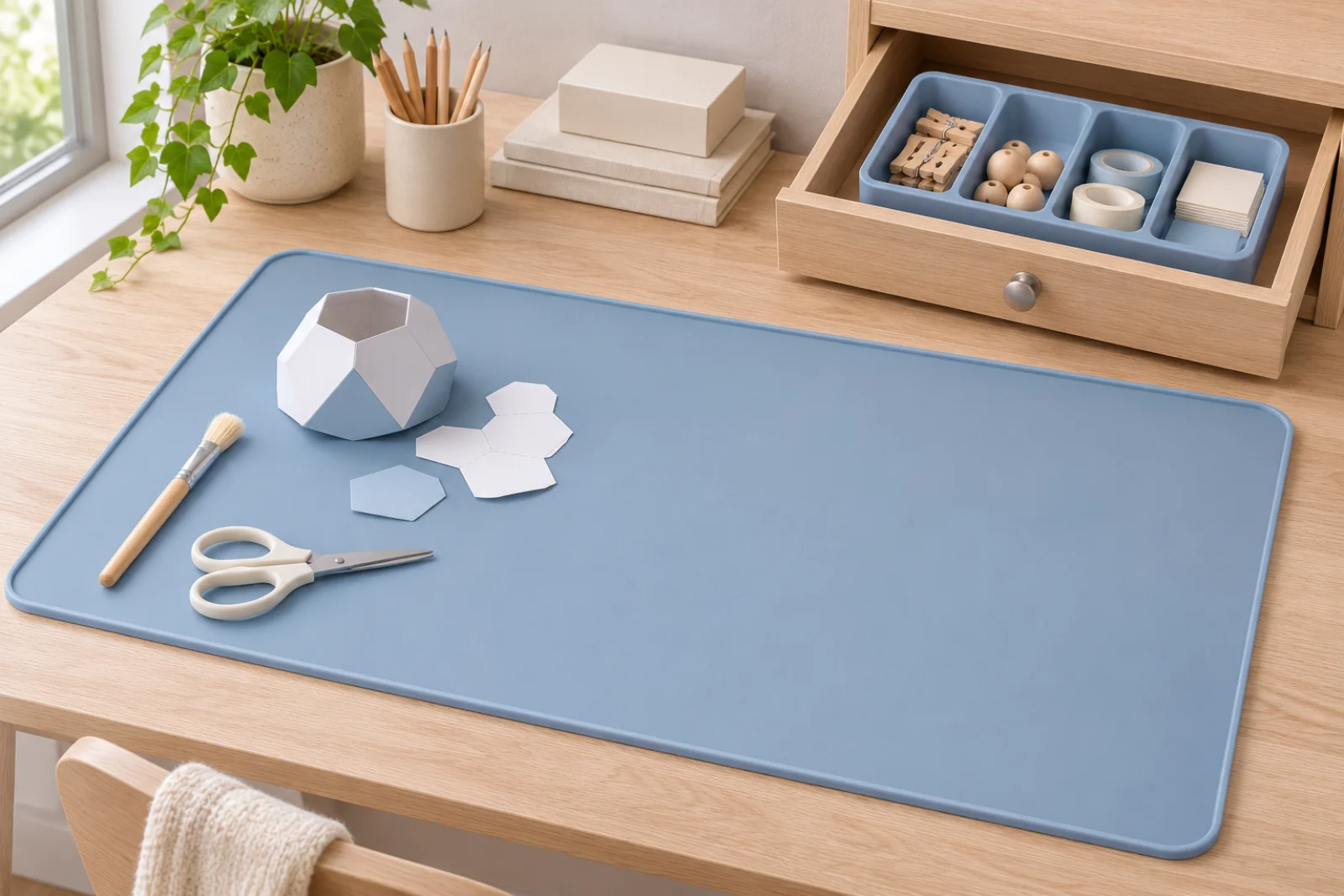
Work-area mat and compartment drawer organizer

Work & hobby mats

A flat area supports a task, while a low rim or local collecting zone changes how small items and residues are gathered. Leave access to lift and clean corners.

More area changes handling and packing; rims may obstruct a tool path. Define the tools and substances used instead of treating the mat as cutting, solvent or heat protection.

Useful inputs · Working footprint, tools, contact materials, cleanup method and storage or packing preference.

Resting pads & surface separators

A pad can follow the base of an object or provide several contact points. Its edge should let the object be placed and picked up as intended.

Local contacts and a full supporting plane distribute contact differently. If temperature or load matters, specify the exposure and acceptance conditions for the actual combination.

Useful inputs · Object base, contact area, weight and any temperature, duration or surface requirements.

Drawer organizers

A divided tray gives objects separate positions; removable pieces allow a different arrangement. Usable depth and pickup height matter as much as the outer footprint.

More compartments add corners and reduce uninterrupted space. Plan how the organizer is lifted and cleaned within the drawer opening.

Useful inputs · Clear drawer dimensions and opening, stored objects, compartment needs and lifting access.

Keep household and kitchen tasks distinct

Bathroom drain accessories focus on hair and bathing-water handling; kitchen accessories address sink fit and food-related tasks. Coordinate appearance if needed, while defining each product’s contact, cleaning and documentation requirements separately.

Sourcing & Tooling FAQ

Key Answers Before Tooling

Covering CAD readiness, custom MOQ evaluation, free 3D fit checks vs. T1 silicone samples, NDA protection and mold ownership.

Have a part-specific question?

Send your drawing or sample photo directly to Zhou Li’s engineering desk for a 24h DFM reply.

How do you balance floor grip vs. smooth sliding on chair-leg caps and doorstops?

A wedge doorstop needs high-friction bare silicone ribs (45–65 Shore A) to bite onto tile or hardwood, whereas a chair-leg floor protector needs thickened wear-resistant soles and tear-proof collar stretch—or an integrated felt/PP base where sliding is required. Share your leg diameters and floor type so we verify grip and wear on T1 samples.

What information is needed for wall-mounted or suction bathroom holders?

Send the target tile/glass surface finish, bottle load weight and mounting method (integral molded suction skirt, mechanical bracket or customer-supplied adhesive backing). Any rigid PC, PP, PA or stainless-steel mounting insert overmolded into silicone uses silane primer for durable wet-room bonding.

Can we coordinate home, bathroom and kitchen SKUs in one brand palette?

Yes. Our two in-house open-mill compounders match custom Pantone swatches across bathroom trays, drawer organizers and kitchen sink mats, while separating RoHS/REACH household formulations from ~200 °C × 4 h post-cured FDA/LFGB food-contact compounds where needed.

Can we develop a custom household line starting from retail benchmark samples?

Yes. Share benchmark photos, target dimensions and functional improvements—our in-house mold design team replies within 24 hours. Eligible projects can review 1–3 free 3D geometry prototypes (buyer pays shipping) before cutting 7–15 day T1 silicone production molds.

B2B Factory Direct · 24h Engineering & Tooling Review

Launch Your Custom Silicone Household & Bath Line

Share your target SKU dimensions or reference photos, Shore A/surface preferences, Pantone colors and order quantities—receive DFM feedback within 24 hours.

✓ NDA available before CAD exchange✓ Eligible for 1–3 free 3D fit prototypes✓ Paid molds 100% owned by customer

Helpful RFQ Inputs

  • Object and supporting surface
  • Use and cleaning conditions
  • Drawing or reference, planned quantities