
Key Sourcing Takeaways
- Silicone (VMQ) O-rings typically run -60 °C to 230 °C in dry air. FKM typically runs -20 °C to 205 °C, so silicone is the usual choice for freezer, outdoor and other cold-service seals.
- In gasoline, diesel and mineral oil, general-purpose silicone commonly swells 20% or more in ASTM D471 immersion. FKM usually stays in single digits on the same fluids.
- Platinum-cured silicone is the common compound for FDA 21 CFR 177.2600 and LFGB food-contact seals. Standard FKM grades are rarely tested for food contact.
- Viton is a Chemours trademark for FKM. Specifying the ASTM D1418 class (VMQ or FKM) on the drawing lets you compare suppliers on the same material.
Where Silicone (VMQ) and FKM O-Rings Each Belong
- Resists gasoline, diesel, mineral oil and aromatic solvents
- About -20 °C to 205 °C in dry air
- Stiffens near -15 °C to -20 °C
- Higher tear and abrasion resistance for dynamic duty
- Suits water, air, steam and food media
- About -60 °C to 230 °C in dry air
- Stays elastic to about -50 °C
- Platinum-cured grades are routinely tested for food contact
Takeaway: Pick by medium first. Fuel, oil and solvents need FKM; otherwise cold service and compliance usually point to silicone.
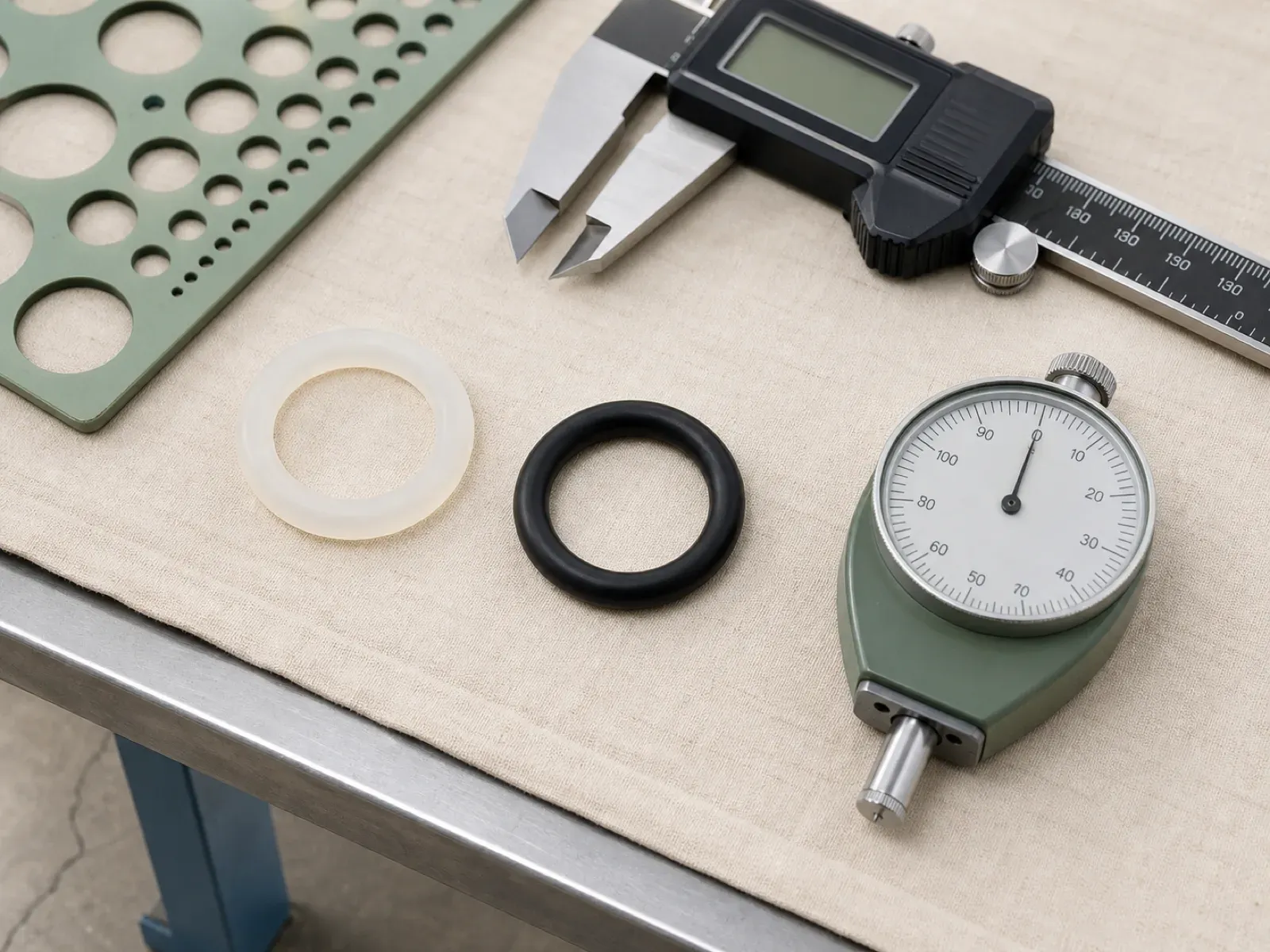
Most wrong O-ring choices come from reading only the temperature line on a datasheet. Silicone and FKM both survive heat. What separates them is the fluid they sit in. Silicone (ASTM D1418 class VMQ) has a silicon-oxygen backbone that stays flexible in deep cold and is easy to qualify for food contact. FKM, sold by Chemours under the Viton name, has a carbon-fluorine backbone that resists fuel, oil and many solvents.
Youbang molds silicone O-rings and seals on 15 vacuum compression presses (200T–350T) in Dongguan, and also molds FKM, EPDM and nitrile rubber parts when the application calls for them. The ranges below are typical published values for general-purpose grades. Confirm the exact compound against its datasheet and your own fluid test.
When should you choose silicone, and when FKM?
Choose silicone when the seal touches water, air, steam, food or body-contact fluids, or when it must stay flexible below -20 °C. Choose FKM when the seal touches gasoline, diesel, mineral oil, aromatic solvents or dilute acids. If the service mixes both, evaluate fluorosilicone (FVMQ).
| Factor | Silicone (VMQ) | FKM (Viton-type) |
|---|---|---|
| Continuous service in dry air | about -60 °C to 230 °C | about -20 °C to 205 °C |
| Low-temperature flexibility | Stays elastic to about -50 °C | Stiffens near -15 °C to -20 °C |
| Gasoline, diesel, mineral oil | Poor; swell commonly above 20% | Good; swell usually below 10% |
| Steam and hot water | Good for short steam cycles below 150 °C | Standard grades are poor in steam |
| Strong alkalis and amines | Fair to good | Poor |
| Food-contact testing | Routine for platinum-cured grades | Uncommon |
| Hardness range | 30–80 Shore A common | 65–90 Shore A common |
| Tear and abrasion | Lower; static seals preferred | Higher; tolerates dynamic duty better |
| Compound cost | Lower | Several times higher |
Temperature: the cold end decides more often than the hot end
On the hot side the two materials are close, and both handle a 200 °C dry-air flange. The cold side is where they differ. FKM begins to stiffen around -15 °C to -20 °C and can leak on a cold start. Silicone keeps sealing in freezer lines, outdoor enclosures and refrigerated food equipment.
Heat ratings assume dry air. A silicone O-ring in 150 °C engine oil fails by swelling, not by heat, so the datasheet maximum does not apply.
Chemical compatibility: where each one fails
Volume swell above roughly 20% is normally treated as a seal failure. The ring fills the groove, extrudes and loses sealing force when it cools.
| Medium | Silicone (VMQ) | FKM |
|---|---|---|
| Water and glycol coolant | Suitable | Suitable |
| Saturated steam below 150 °C | Suitable for short cycles | Not recommended for standard grades |
| Gasoline and diesel | Not suitable | Suitable |
| Mineral and engine oil | Not suitable when hot | Suitable |
| Glycol brake fluid | Not suitable | Not recommended; EPDM is the usual choice |
| Ketones such as MEK and acetone | Not suitable | Not suitable |
| Hot caustic and amines | Usually suitable | Not suitable |
| Ozone, UV and weather | Suitable | Suitable |
When one rubber is listed as unsuitable, test rather than assume. A seven-day immersion at service temperature on T1 samples, checking volume, hardness and compression set, settles most compatibility questions before production tooling is released.
Compression set, hardness and installation
Both materials can hold a static seal for years when fully cured. Silicone O-rings are post-cured, at Youbang in circulating ovens at about 200 °C for 4–6 hours with the cycle adjusted to wall thickness, which lowers volatiles and stabilises compression set.
Silicone stretches further before breaking, so it is easier to install over a large shoulder. Its lower tear strength means sharp groove edges and assembly burrs must be removed. FKM is tougher, which is why it is preferred where the ring slides or rotates.
Five questions that pick the compound
- What fluid does the seal touch? Water, air, steam or food points to silicone. Fuel, oil or solvent points to FKM.
- Is food, drinking water or skin contact involved? Silicone is the practical default, tested to the target market standard.
- What is the lowest temperature in service? Below -20 °C, use silicone or fluorosilicone.
- Is the seal static or dynamic? Static favours silicone on cost. Sliding or rotating duty favours FKM.
- Does a customer drawing or industry specification already name the rubber? Follow it, and write the ASTM D1418 class on every drawing revision.
What to put on the RFQ
- ISO 3601 size, or inside diameter and cross-section with tolerance. Precision molded parts typically hold ±0.05 mm and general parts ±0.1–0.2 mm, confirmed per drawing.
- Rubber class (VMQ, FKM, FVMQ or EPDM), hardness in Shore A, and colour.
- Sealed medium, continuous and peak temperature, and pressure.
- Required reports, for example FDA 21 CFR 177.2600, LFGB, RoHS or REACH. Third-party testing through SGS, Intertek or TÜV usually takes about 10 days.
- Trial quantity and annual volume. Trial orders start from 100 pcs.
See custom silicone O-rings and grommets for molding options, or read how compression set affects sealing gaskets before fixing the groove squeeze.
Continue with Custom molding in EPDM, nitrile and FKM.
References & Engineering Sources
- ASTM D1418 — Standard Practice for Rubber and Rubber Latices—Nomenclature
- ASTM D471 — Standard Test Method for Rubber Property—Effect of Liquids
- ASTM D395 — Standard Test Methods for Rubber Property—Compression Set
- ISO 3601-1 — Fluid power systems — O-rings — Inside diameters, cross-sections, tolerances
- 21 CFR 177.2600 — Rubber articles intended for repeated use