
Key Sourcing Takeaways
- Match seal elastomer to the actual liquid or gas contact first—not generic datasheet headlines: use post-cured platinum silicone for −50 °C to +230 °C dry heat and food/steam contact, EPDM for hot water/glycol coolant and weather, NBR for mineral oils, and FKM for fuel/solvent heat.
- Design static sealing glands around 15%–30% cross-section squeeze while capping total groove volume fill at roughly ≤75%–85% so thermal expansion never extrudes pinched elastomer into parting seams.
- Never skip 200 °C × 4–6 hours ventilated post-curing on static silicone seals; incomplete secondary crosslinking leaves loose chains that take severe permanent set under the first bolt-up heat cycle.
Gland Squeeze (15%–30%), Groove Fill & ASTM D395 Compression Set
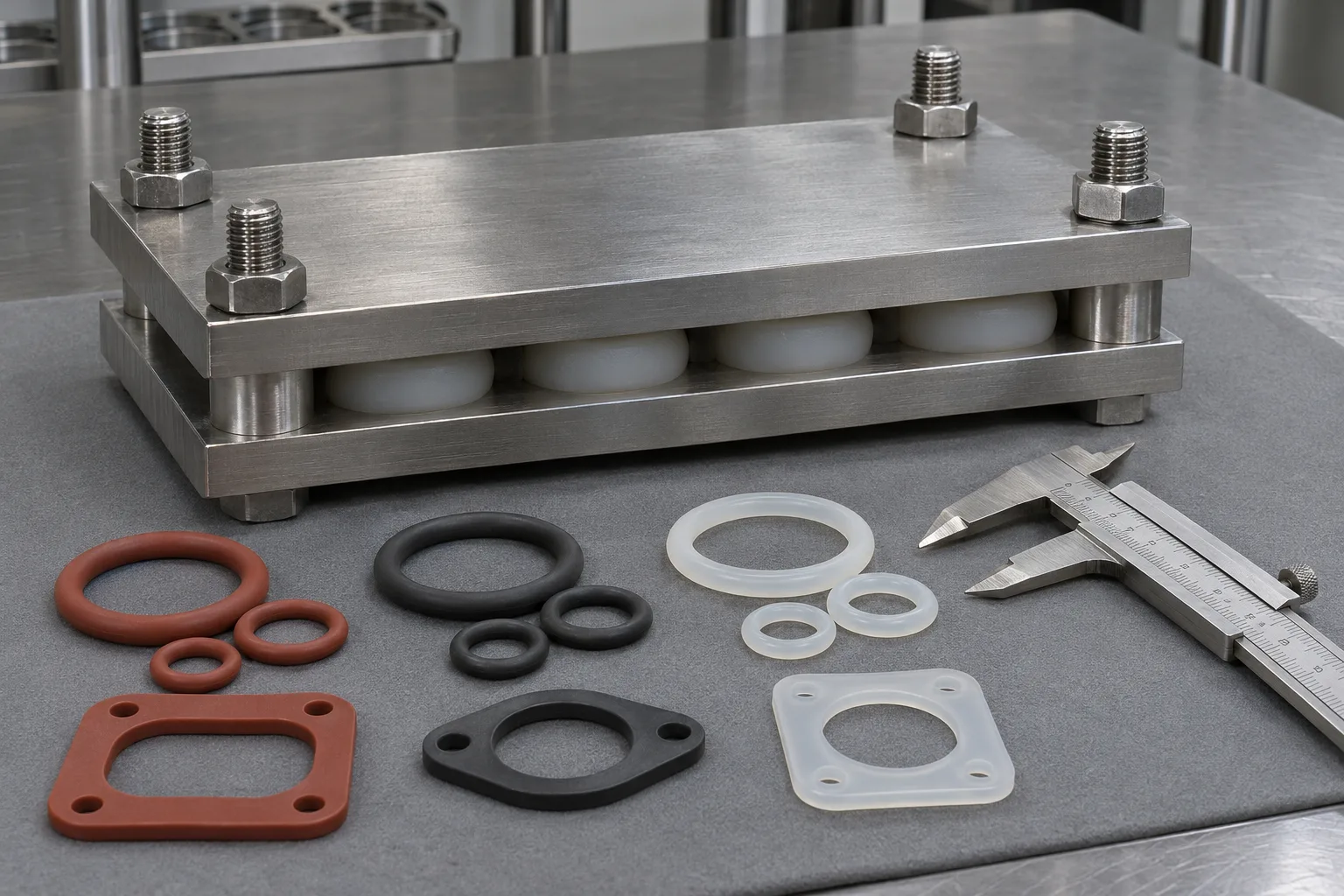
A bolt-down enclosure seal, pump flange gasket, or coffee-brewer boiler O-ring rarely leaks because initial dimensions missed blueprint tolerances—it leaks six months in when the elastomer stops pushing back against mating housing walls. In polymer engineering, that permanent loss of elastic rebound force under sustained load is compression set (ASTM D395 / ISO 815-1).
Inside Dongguan Youbang (8,000 m² plant running 10 closed-loop LSR presses, 15 HCR vacuum presses, and 6 ventilated post-cure ovens), engineers mold silicone, EPDM, NBR, and FKM seals side by side and eliminate field compression-set leaks across three engineering checkpoints.
1. Matching Elastomer Chemistry to Media, Heat & Compression Set Resistance
Choose low-compression-set gaskets by fluid contact and temperature before locking cavity dimensions: post-cured platinum silicone excels across −50 °C to +230 °C dry thermal cycling and food/UV contact, EPDM handles continuous hot water and glycol coolant, NBR seals general mineral oils cost-effectively, and FKM resists fuels and hot synthetic hydrocarbons. Never evaluate rubber solely by Shore A hardness on a room-temperature bench.
| Elastomer Family (Molded at Youbang) | Practical Service Temp Window | Best-Fit Sealing Media & Exposure | Where Compression Set Accelerates | Typical B2B Component Fit |
|---|---|---|---|---|
| Low-Set Platinum Silicone | −50 °C to +230 °C (dry heat) |
Food/steam equipment, dry electronics enclosures, UV/ozone outdoor housings | Hydrocarbon oils, fuel immersion, or skipped 200 °C × 4–6h bake |
Food/coffee appliance seals, LED/EV enclosure lids, LSR micro-valves |
| EPDM (Ethylene Propylene) | −40 °C to +140 °C (grade-tuned) |
Pressurized hot water, automotive coolant, weatherproofing, polar brake fluids | Mineral motor oil or petroleum grease causes rapid soft swelling | Plumbing manifolds, outdoor junction gaskets, radiator hose seals |
| NBR (Nitrile Buna-N) | −30 °C to +110 °C |
Hydraulic mineral oil, diesel/lubricant lines, budget industrial wipers | Outdoor ozone sun cracking or high-temp oxidation stiffening | Oil pump covers, pneumatic piston cups, workshop fluid couplings |
| FKM (Fluoroelastomer) | −20 °C to +200 °C+ |
Automotive fuels, aromatic hydrocarbons, hot ester lubricants | Acetones, amines, or very hot continuous steam above formula limits | Fuel-rail grommets, chemical dosing pump seals, high-temp valve seats |
2. Gland Fill & 15%–30% Squeeze Design Rules Before Cutting Steel
Even the lowest-compression-set platinum LSR or peroxide HCR compound fails prematurely if the rigid metal/plastic housing groove starves expansion space:
- Stay Inside
15%–30%Static Deflection: Too little squeeze (<10%) risks bypassing flange surface roughness (Ra); compressing a static gasket past35%–40%overstresses polymer bonds and forces irreversible creep flattening. - Cap Groove Volume Fill at
≤75%–85%: Silicone exhibits a notably higher coefficient of thermal expansion than aluminum, steel, or rigidPC/PA. Leaving15%–25%void cross-section prevents expanding rubber from hydraulic-locking against bolted flange corners and tearing out through micro-clearance parting lines. - Break Sharp Machining Corners: Mill generous corner radii inside metal gland pockets and balance perimeter height via our 200T–350T vacuum HCR and LSR press tolerances (
±0.05 mmtight critical sealing zones).
3. Why Oven Post-Curing & Low-Set Masterbatch Compounding Matter
Two identical 50 Shore A silicone gaskets can behave dramatically differently after 70 hours clamped at 150–175 °C:
- Peroxide vs. Addition-Cure Crosslink Architecture: Addition-cured (platinum) and specialized vinyl-rich low-compression-set compounds form denser, thermally cleaner carbon-carbon crosslinks that rebound far closer to original thickness than commodity general-purpose peroxide grades.
- Full
200 °C × 4–6 hoursVentilated Conditioning: Passing production seals across our 6 circulating ovens completes free-radical reaction termination and removes low-molecular siloxane fragments that otherwise plasticize the rubber and accelerate permanent creep once clamped inside warm assemblies. - Batch Lot Retain Logs (
36Months): Approved seal formulations stay archived with upstream CoAs, Shore A checks, and optical cross-section verification for clean repeat orders from100 pcspilot runs through ongoing production.
Share housing gland CAD, fluid chemical sheets, and temperature soak targets via our seal compression DFM brief for a first engineering reply within 24 hours, or browse our custom EV harness seals & gaskets.