
Key Sourcing Takeaways
- Molded silicone does not automatically arrive flash-free; minimal witness seams require closed-loop cold-runner LSR tooling or precision shutoffs positioned off sealing lands.
- Across Youbang’s 15 HCR vacuum presses (200–350T), 5-axis CNC tear-trim grooves compress overflow web thickness so operators strip edges cleanly along chamfered lands within ±0.08–0.18 mm.
- Always relocate parting seams away from circular radial lip crowns, ergonomic mouth rims, and overmolded sensor windows during DFM review.
Order Volume vs. Tooling & Piece-Price Crossover
Curve meaning and calculation
| Process Route | Total Unit Cost Formula |
|---|---|
| HCR | Unit cost = mold investment ÷ quantity + compression piece price (low barrier from 100 pcs) |
| LSR | Higher cold-runner mold outlay offset by fast cycle speed at scale |
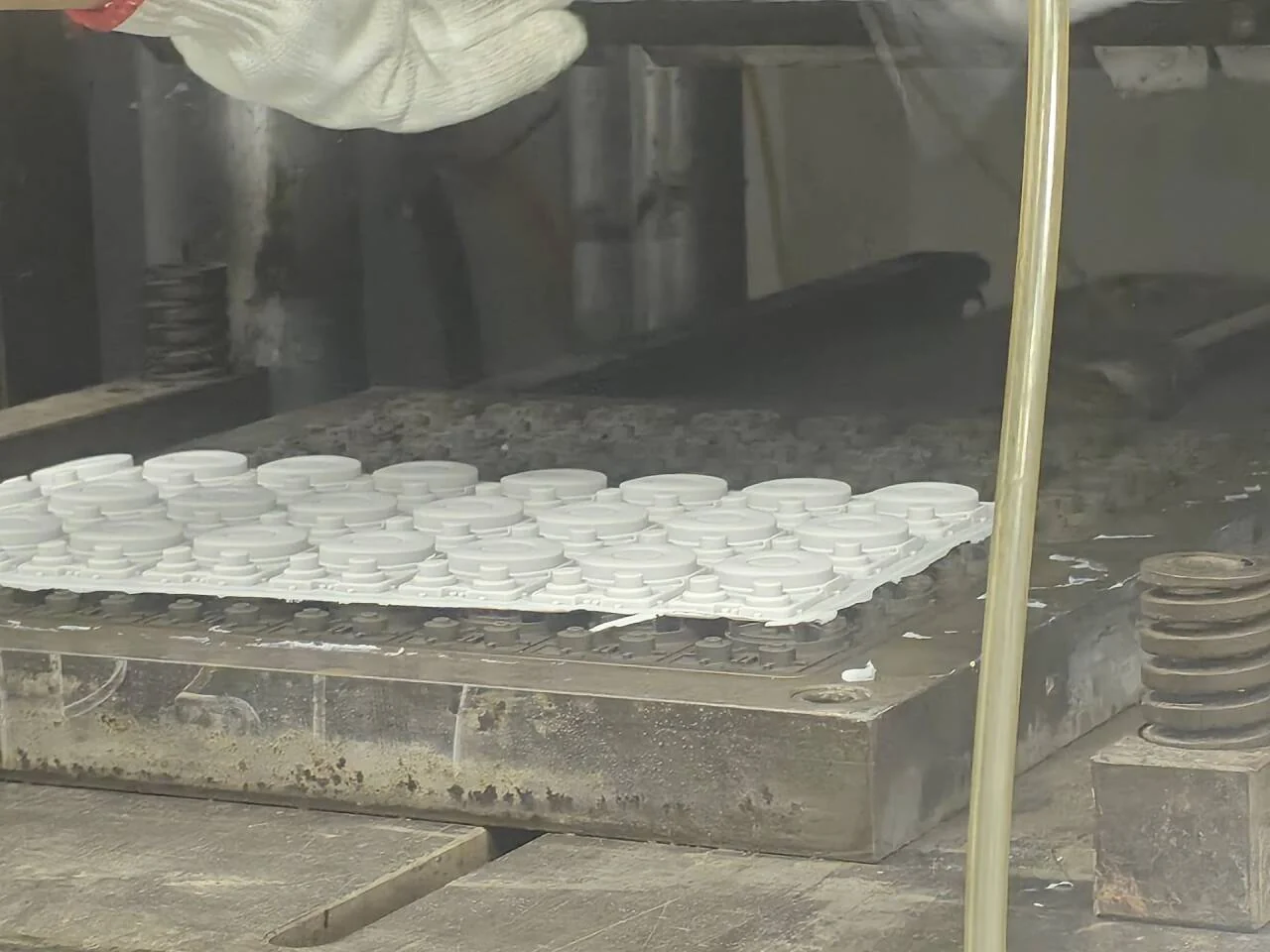
Flash is the ultra-thin feather of cured elastomer that squeezes into the microscopic gap between mold steel plates. Left unchecked across the crest of a waterproof silicone gasket or the mouthpiece of an infant spoon, flash breaks seal compression and irritates skin. Conversely, specifying "zero flash anywhere" blindly multiplies mold cost when strategic parting placement solves the functional risk.
Inside Dongguan Youbang’s self-operated 5-axis CNC/EDM toolroom, we coordinate steel shutoff tolerances across 10 LSR injection presses (85T–160T) and 15 HCR vacuum compression presses (200–350T) so flash is kept out of functional zones and trimmed repeatably.
1. Engineering Comparison: HCR Tear-Trim vs. Fixture Trim vs. Precision LSR
Compression HCR molds manage excess gum through deliberate tear-trim overflow grooves (0.08–0.18 mm edge witness) and low-cost tooling; cold-runner LSR injection injects into vacuum-sealed CNC shutoffs to hold ≤ 0.03 mm flash-minimized edges on thin valves and skin-contact rims.
| Process & Trim Method | Press Platform at Youbang | Typical Residual Edge Step | Best Fit Geometries | Tooling & Unit Cost Tradeoff |
|---|---|---|---|---|
| HCR + Precision Tear-Trim Land | 15 × 200–350T vacuum HCR presses (400×400–650×650 mm) |
~0.08–0.18 mm clean tear witness along designated groove | Mats, baby tableware, suction bowls, medium/thick gaskets | Lowest steel mold outlay; fast hand peel along chamfered knife edge |
| HCR + Guided Fixture / Rotary Buff Trim | HCR presses + custom trimming fixtures & QC stations | ~0.05–0.12 mm smooth radius blend | Complex 3D stepped seals, deep sleeves, heavy overmolded grips | Adds modest per-piece finishing labor; preserves smooth transitions on thick blocks |
| HCR Multi-Split Stepped Core | HCR presses + multi-plate precision EDM blocks | ~0.05–0.10 mm shifted onto non-sealing shoulder | Undercut collars, double-lip grommets, thick protective housings | Medium tooling cost; hides seam off cosmetic front faces |
| Closed-Loop Cold-Runner LSR | 10 × 85T–160T LSR presses (ISO 13485 QMS) |
≤ 0.03 mm (micro hairline shutoff seam only) | LSR check valves, menstrual cups, medical cushions | Higher multi-plate cold-runner steel cost; eliminates hand-trimming risk on delicate 0.25–0.30 mm lips |
2. Three DFM Rules for Placing Parting Lines Before Steel Is Cut
Move Seams Off O-Ring Crown & Gasket Sealing Surfaces
Never split an O-ring mold straight along the 12-o'clock/6-o'clock contact tangent if that tangent seals against a cylindrical bore or flange face. Slightly offsetting the shutoff angle (30°–45° or radial back-edge chamfer) keeps compression contact uninterrupted under ISO 3302-1 [1] molded rubber tolerances.
Step the Groove Depth (0.08–0.15 mm Thin Land)
Effective HCR tear-trim tooling machines a narrow sharp land (0.3–0.5 mm wide) stepping quickly into a deep relief moat (1.5–2.5 mm). Operators strip the excess blanket in one continuous pull without tearing the functional part lip.
Align Shutoffs With Rigid Insert Tolerances in Overmolding
When sealing LSR onto buyer-supplied PC, PP, PA, or metal inserts, slight injection shrinkage variance in the rigid substrate causes heavy flash unless CAD incorporates a 0.10–0.20 mm crush-rib shutoff land around the perimeter. Verify insert tolerances in our Overmolding Substrate Checker and run exact cavitation economics in the LSR vs. HCR Estimator.
Need Youbang’s mold designers to mark parting lines, tear-trim grooves, and runner gates directly on screenshots of your 3D CAD? Send STEP files via our CAD DFM Desk — you get a First Engineering Reply Within 24h.