
Key Sourcing Takeaways
- Customer-supplied stamped or CNC-turned stainless steel, aluminum, and copper inserts carry hidden drawing/cutting oils and anti-rust films: run ultrasonic degreasing ahead of metal-matched silane primer application and controlled oven activation.
- Raw brass and copper alloys often inhibit addition-cured platinum LSR right against the metal boundary, leaving soft uncured skins—specify bright nickel plating or barrier-isolated primer qualification at T1.
- Design knurled grooves, Ø2.0–3.5 mm thru-holes, or shoulder undercuts directly onto metal inserts alongside soft sacrificial brass/stepped steel shutoff seats where thin anodized aluminum cosmetics cannot tolerate full clamp crush.
Four-Stage Defense for Metal Insert Overmolding: Steel, Aluminum & Copper
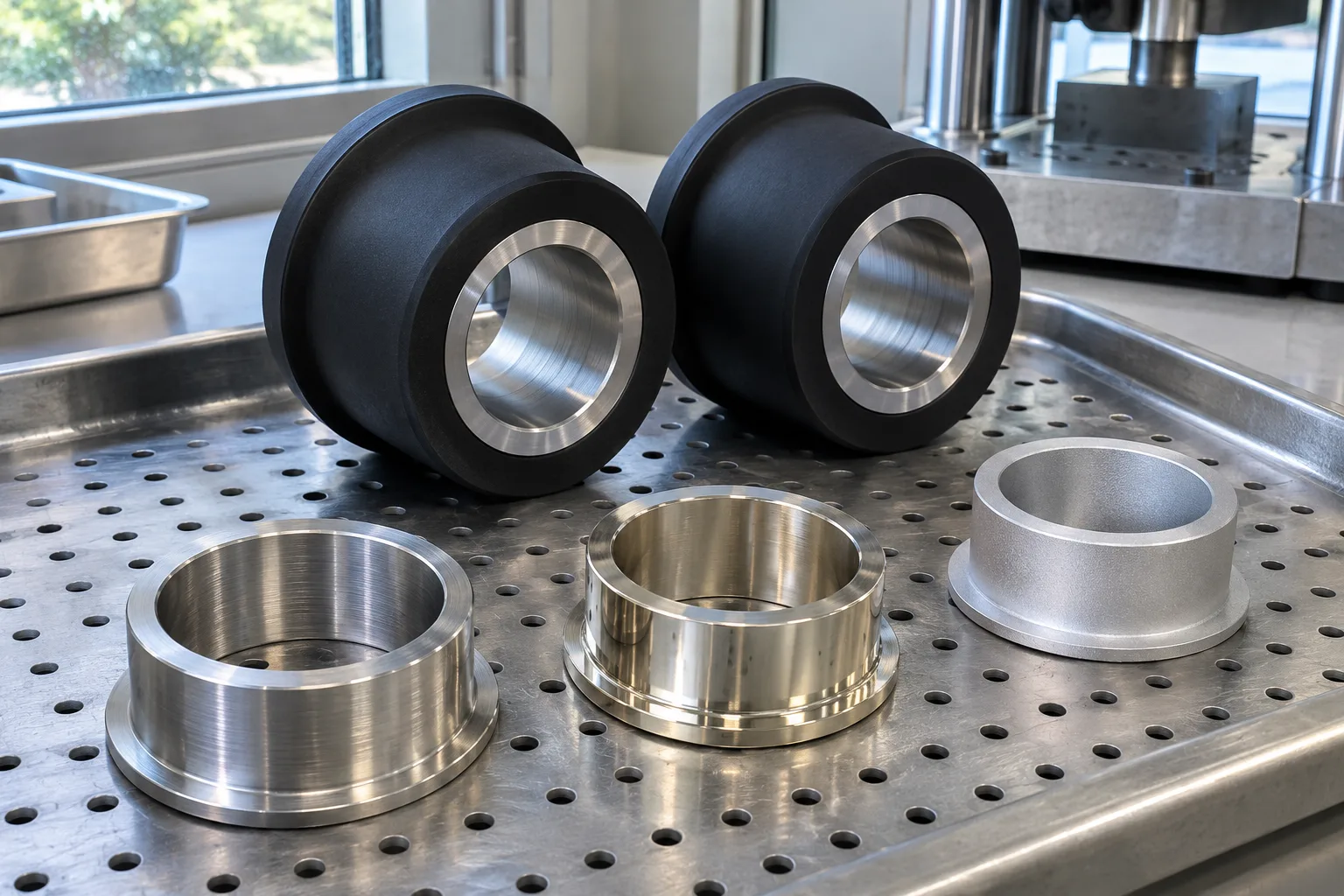
Bonding silicone cleanly onto machined steel collars, anodized aluminum housings, or threaded brass studs requires far more precision than simply loading loose metal hardware into a press cavity. Even trace stamping oil, an incompatible alloy plating, or 0.08 mm of loose outer-diameter variance across supplied metal inserts causes sudden delamination or costly mold flash.
Operating across Dongguan Youbang's 8,000 m² plant (pairing 15 HCR vacuum compression presses, 10 closed-loop LSR systems, an in-house 5-axis CNC/EDM toolroom, and calibrated destructive peel testers), hardware insert preparation follows four strict metal-specific rules for customer-supplied stainless steel, aluminum, and copper parts.
1. Alloy-Specific Failure Traps & Shop-Floor Controls
| Supplied Metal Family | Hidden Production Risk on Silicone Molds | Youbang Incoming Prep & Steel Control |
|---|---|---|
Stainless Steel (304 / 316L) |
Stamping grease, honing oils & passive wax films prevent silane chemical cross-bridging, leaving smooth zero-adhesion peels | Perform ultrasonic degreasing ahead of metal-specific baked silane primer + shaft knurl/thru-hole mechanical anchors |
| Copper & Raw Brass Alloys | Surface sulfur/copper ion complexes inhibit platinum addition catalysts—creating soft tacky gums or blistering skin | Specify nickel-plated barriers whenever feasible or qualify barrier isolation + strict batch T1 cure checks prior to tooling freeze |
| Anodized / Machined Aluminum | Tight steel shutoffs crack brittle anodic layers or compress soft aluminum shoulders out-of-round under clamp pressure | Hold close incoming metal tolerances, add knurled interlock tracks beneath covered zones, and calibrate stepped shutoff relief faces |
2. Pair Baked Silane Primers With Mechanical Interlocks
Never expect chemical primers to work alone under sharp twisting torque or thermal cycling:
- Cut diamond knurls, axial flutes, or
Ø2.0–3.5 mmthru-holes right into concealed shank regions so liquid/solid elastomer locks physically through the rigid core. - Pre-bake customer-supplied clean inserts uniformly with metal-matched silane primer so covalent silica coupling bridges vulcanize tightly during molding and subsequent
200 °C × 4–6 hoursoven conditioning.
3. Destructive T1 Cohesive-Tear Verification Before Volume Scheduling
Before releasing past 100 pcs pilot orders into 15–30 day mass production:
- Pull-test random finished hardware-rubber assemblies until failure: a passing part suffers cohesive tearing inside the silicone body, leaving a torn elastomer skin still fused over the primed metal face rather than separating cleanly along shiny bare alloy.
Submit metal insert drawings, incoming tolerances, and service fluids via our overmolding manufacturing page or industrial vibration mount specs for an initial bonding DFM check within 24 hours.