
Key Sourcing Takeaways
- Always check single-durometer wall-thickness modulation first (e.g., 0.8–1.2 mm flex hinge + 3.5 mm support rib in one 50A mold); it cuts steel tooling budget roughly in half and avoids any bond interface risk.
- When true softness disparity (such as a 15–30A facial or medical seal fused to a 65–75A silicone grip ring) is required without plastic, two-step platinum silicone co-molding forms covalent elastomer crosslinks without chemical silane primers.
- When latches, threads, or beam stiffness demand true rigidity beyond 80 Shore A silicone, overmold LSR or HCR onto buyer-supplied PC, PA, PP, stainless steel, aluminum, or copper inserts using baked silane primer and Ø2.0–3.5 mm mechanical lock holes.
Three Routes to Dual Stiffness: Wall Geometry vs. Co-Molded Silicone vs. Insert Overmold
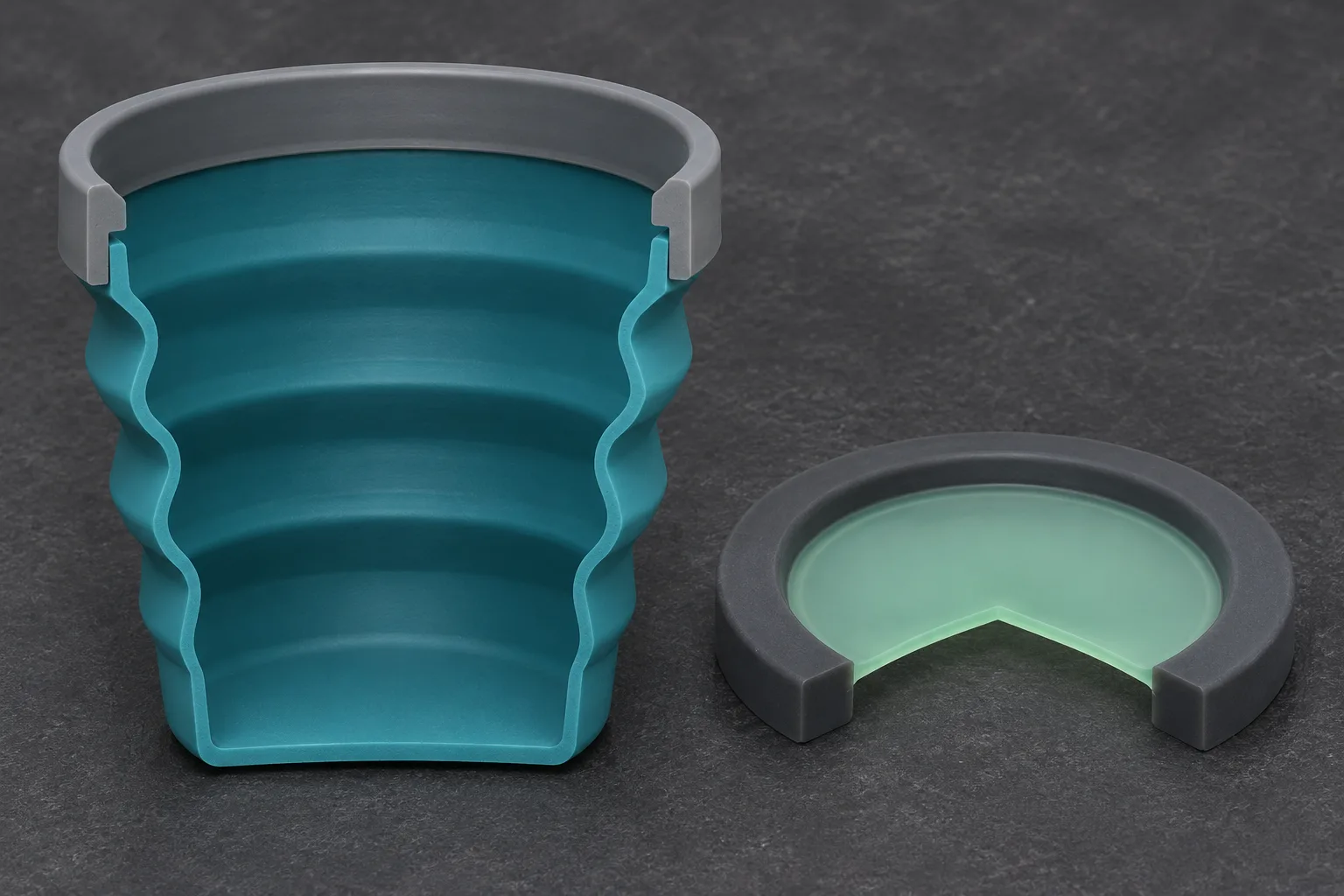
When industrial designers sketch a folding camp cup, a dual-density scrubber handle, a diagnostic housing seal, or an ergonomic kitchen spatula, the CAD notes almost always point at two arrows: "firm non-sag frame" and "ultra-soft 20A skin/food seal." Turning that sketch into high-yield production at Dongguan Youbang (10 closed-loop LSR presses + 15 vacuum HCR presses + 5-axis CNC/EDM toolroom) comes down to choosing between three distinctly priced manufacturing routes.
1. Three-Way Decision Matrix: Pick the Simplest Route That Meets Mechanics
Achieve dual stiffness in custom silicone parts cleanly by ranking three engineering options from leanest to stiffest: (1) vary section thickness (1.0–1.2 mm hinge vs. 3.5–5.0 mm frame) inside one 50A steel mold, (2) two-step platinum silicone-on-silicone co-molding (60–75A + 15–35A) when contrasting tactile bounce or two-color rubber without plastic is required, or (3) silicone overmolding over buyer-supplied PC, PA, PP, stainless steel, aluminum, or copper inserts via silane primer when rigid snap latches or beam strength are non-negotiable.
| Mechanical Route | Tooling Structure & Press Path | Achievable Stiffness Span | Bonding & Failure Boundary | Best-Fit Commercial Applications |
|---|---|---|---|---|
| 1. Variable Wall Ratio (Single Gum) | 1 mold (HCR or LSR); modulate wall from 0.8–1.2 mm up to 3.5–5.0 mm |
Effective soft flex membrane beside semi-rigid molded rims | Zero inter-shot interface; zero delamination risk | Collapsible bowls/cups, folding lids, integrated duckbill check valves |
| 2. Two-Step Silicone Co-Molding | Transfer pre-mold 60–75A core into 2nd LSR/HCR cavity (15–35A wrap) |
True 15–30A soft touch fused onto firm 65–75A rubber rim |
Compatible platinum-to-platinum covalent bond; zero primer solvent; keep stage-1 clean | Menstrual disc/cup rims, high-contrast two-tone mats, soft face-mask cushions on firm rubber flanges |
| 3. Rigid Insert Overmolding | Buyer PC / PA / PP / steel / Al / Cu cleaned + silane primer + LSR/HCR shot |
Rubber elastomer over full rigid structural engineering cores | Chemical silane + Ø2.0–3.5 mm thru-hole locks required; pull test must hit cohesive rubber tear | Cooking utensils (nylon/steel tangs), PC mask frames, wellness motor housings, aluminum industrial handles |
2. Two-Step Silicone-on-Silicone Bonding Rules (No Primer Needed, Strict Staging)
When buyers specify a soft translucent 25A cushion bonded to a firm dark-gray 70A silicone collar without hard plastic:
- Stay Platinum-to-Platinum (Avoid Peroxide Inhibition): Match both durometers on clean platinum addition-cure elastomers. Attempting to LSR-overmold onto a sulfur/DBPH-cured base piece risks cure poisoning and tacky boundary peeling.
- Transfer Freshly Cured — Hold Oven Post-Cure Until After Shot 2: Leave controlled reactive crosslink sites active on shot #1 rather than fully exhausting the elastomer through
200 °C × 4–6 hoursoven baking ahead of shot #2; bake the complete fused article together at the end. - Cut Dedicated Shutoff Grooves Along Color Transitions: Two contrasting silicone shades need crisp recessed shutoff shoulders machined inside S136 steel (
±0.05 mmlocating pins) so high-flowLSRnever bleeds thin halos over the hard rubber collar.
3. When Rigid Buyer Inserts (PC / PA / PP / Metal) Are Worth the Extra Preparation Step
Remember the upper ceiling of solid silicone chemistry: Youbang molds elastomers across 0–80 Shore A, meaning even 75–80A silicone bends appreciably across an unsupported 100 mm span. If your part needs a rigid snap-on clip, screw thread, or frying-pan pry rigidity, switch upfront to buyer-supplied PC, PP, PA (nylon), stainless steel, aluminum, or copper inserts—paired cleanly with masked silane priming and overmolding troubleshooting rules.
Upload a 3D STEP model marking rigid vs. soft grip/seal surfaces via our engineering DFM brief for a first engineering reply within 24 hours (including side-by-side single-mold vs. two-step tooling cost options from 100 pcs pilot runs).