
Key Sourcing Takeaways
- Silane-based overmolding primers need clean degreased substrates, thin uniform coating, controlled flash-off baking, and bounded staging before molding—never bare uncoated metal or dusty plastic lots.
- When a destructive pull test separates clean bare plastic or shiny steel with zero torn silicone residue on the insert, the bond failed chemically before reaching elastomer cohesive tear strength.
- Pairing baked silane primer with Ø2.0–3.5 mm mechanical pass-through holes and edge groove shutoffs stops edge lifting in wet, steam, or repetitive twist service.
Silane Primer Interface & Mechanical Undercut Cross-Section
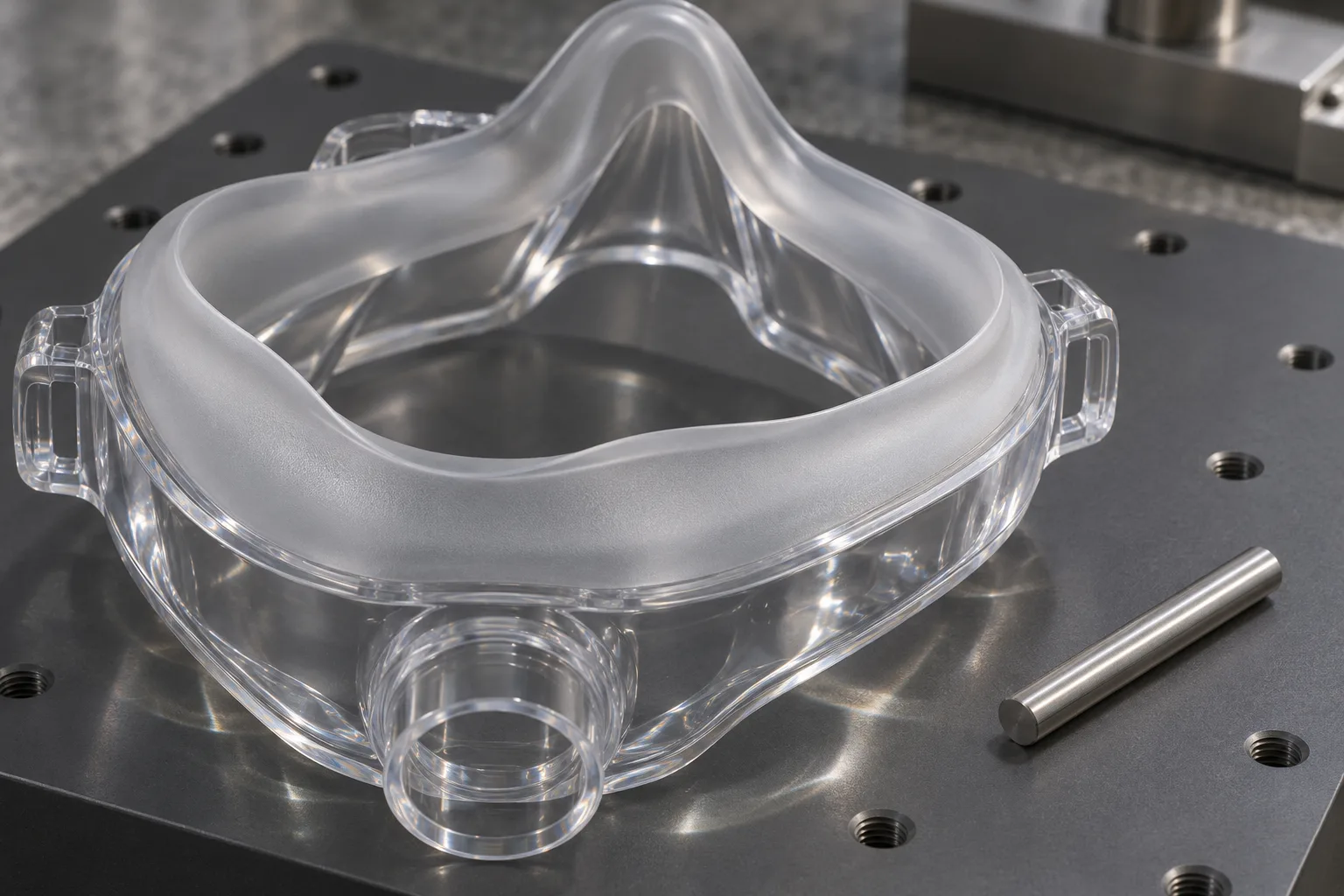
When a buyer experiences silicone grips twisting off stainless kitchen tangs, medical cushions lifting from clear polycarbonate (PC) housings, or sealing lips peeling away from nylon (PA) and PP frames, swapping silicone brands rarely fixes the problem. Across 10 closed-loop LSR presses and 15 HCR vacuum compression presses, Youbang engineers trace overmold delamination to four repeatable interface failures between the elastomer, silane primer film, and buyer-supplied rigid core.
Note on materials: Youbang overmolds onto customer-supplied rigid inserts in PC, PP, PA (nylon), stainless steel, aluminum, and copper using baked silane primer chemistry matched to insert heat deflection limits.
1. Root-Cause Diagnostic Matrix: Clean Peel vs. Cohesive Failure
Fix silicone-to-insert delamination by diagnosing the peeled fracture surface first: zero silicone film left on bare PC / PA / PP / metal signals grease, stale silane primer, or catalyst poisoning, whereas localized rubber tearing near sharp corners points to edge shear that requires Ø2.0–3.5 mm mechanical pass-through locks and recessed edge shutoffs. Confirm insert resin heat deflection temperature (HDT) before selecting LSR vs. lower-cycle-heat molding windows.
| Symptom on Pulled Sample | Most Likely Shop Floor Root Cause | Corrective Action in Tooling & Prep | Verification Gate at Youbang |
|---|---|---|---|
| Bare glossy substrate with zero torn rubber left behind | Mold-release spray on injection-molded plastic or cutting oil film on stamped metal blocked primer wetting | Switch buyers off silicone-containing mold release; add ultrasonic degreasing / plasma surface prep ahead of priming | Pull-tab failure mode must transition to cohesive elastomer tear on tensile tester |
| Gummy uncured LSR layer touching plastic/copper only | Platinum catalyst poisoning from amine stabilizers, tin residues, solder flux, or sulfur additives inside resin/metal | Audit exact PC/PA/PP resin additive sheet; clean copper/steel oxidation & isolate via baked silane barrier coat | Zero tacky boundary smear on cut cross-section during T1 FAI check |
| Strong center bond, but edge lip curls up after soaking | Knife-edge feather termination lets steam or surfactant creep under sharp bond edge via thermal shrink stress | Step edge down into a recessed 0.5–1.0 mm mechanical pocket and isolate insert shutoff land inside steel mold | Boil/wash soak conditioning followed by edge pull inspection |
| Silicone rotates or walks around smooth cylindrical shaft | Relying purely on surface adhesion against high torque load without physical keys | Add Ø2.0–3.5 mm through-holes, knurls, or stepped snap grooves across bare core for locked rubber rivets | Torque twist + tensile pull test on assembled T1 sample |
2. Substrate Thermal Limits & Silane Primer Staging Rules
Unlike bare aluminum or stainless steel (which tolerate full cure heat easily), thermoplastic inserts (PC, PA, PP) narrow your press and oven window:
- Match Cure Temperature to Resin HDT: Polypropylene (
PP) softens well below un-modified 200 °C × 4–6 hours standalone oven cycles. ForPP, thinPC, orPAframes, engineers tune faster mold-dwell addition cure cycles and sub-HDT bake plans—validated physically on buyer insert lots so housings never warp or craze at snap latches. - Respect Primer Flash-Off & Shelf Window: Spraying or dipping silane primer too thick forms a brittle glass layer that fractures under flexion; leaving primed inserts exposed in humid air hydrolyzes reactive silane groups before molding. Coat even thin coats, bake per primer window, and mold promptly inside clean trays.
- Mask Non-Bonded Optical & Snapping Zones: On items like overmolded respiratory masks or intimate wellness LSR assemblies, hard snap clips and optical windows require precision silicone masking caps before primer application so zero haze mars functional latches.
3. Mechanical Interlock DFM Checklist Before Cutting Steel
Even with high-performing silane primer adhesion, B2B parts seeing high shear, dishwasher cycles, or sterilization benefit from pairing chemistry with geometry:
- Design Ø2.0–3.5 mm through-rivet pass holes or perimeter dovetail undercuts wherever wall space allows.
- Keep minimum 0.8–1.2 mm silicone thickness over stressed metal tang corners to avoid tear propagation under thermal shrinkage.
- Ship representative sample inserts from the production supplier prior to T1 mold cutting so shutoff pins lock tight against actual insert tolerances (
±0.05 mmmold steel tolerance vs. real molding variance).
Need an engineer to mark up priming masks, through-hole anchor locations, and safe cure heat on your insert CAD? Upload drawings via our overmolding engineering brief for a first engineering reply within 24 hours, or review full workshop specs on our silicone overmolding page.