
Youbang · B2B Custom Silicone Manufacturing · Dongguan

LSR Cold Runner vs. Open-Gate Tooling: Calculating the Scrap Payback

Liquid silicone rubber (LSR) cures permanently under heat—meaning every cured runner tree ejected from an uncooled sprue turns directly into non-recyclable elastomer scrap. Across Dongguan Youbang's 10 closed-loop LSR injection presses (85T–160T) and 5-axis CNC/EDM toolroom, choosing between an open-gate cold-sprue block and a needle-valve cold-runner manifold comes down cleanly to part shot weight, elastomer $/kg price, and multi-year volume.

Cost & Tooling EconomicsUpdated

4 min readCompiled by Youbang Silicone Engineering Team

Key Sourcing Takeaways

  • Unchilled open-gate LSR molds waste ~15%–40% of total shot elastomer in cured sprues and runners that cannot be re-melted or reground—particularly painful on expensive medical-grade or self-lubricating fluorosilicone compounds.
  • A chilled needle-valve cold-runner manifold keeps Part A+B liquid unvulcanized until entering each heated cavity gate—cutting runner scrap below ~1% and dropping flush pin witness scars near sealing edges.
  • However, cold-runner plates raise initial mold cost sharply and demand extra tooling lead discipline: for micro parts below 2 g running only 1,000–5,000 pcs/year or testing market fit from 100 pcs, a compact open-gate LSR mold (or HCR pilot mold) almost always pays back faster.

LSR Valve-Gate Cold Runner vs. Open-Gate: Runner Scrap & Amortization Split
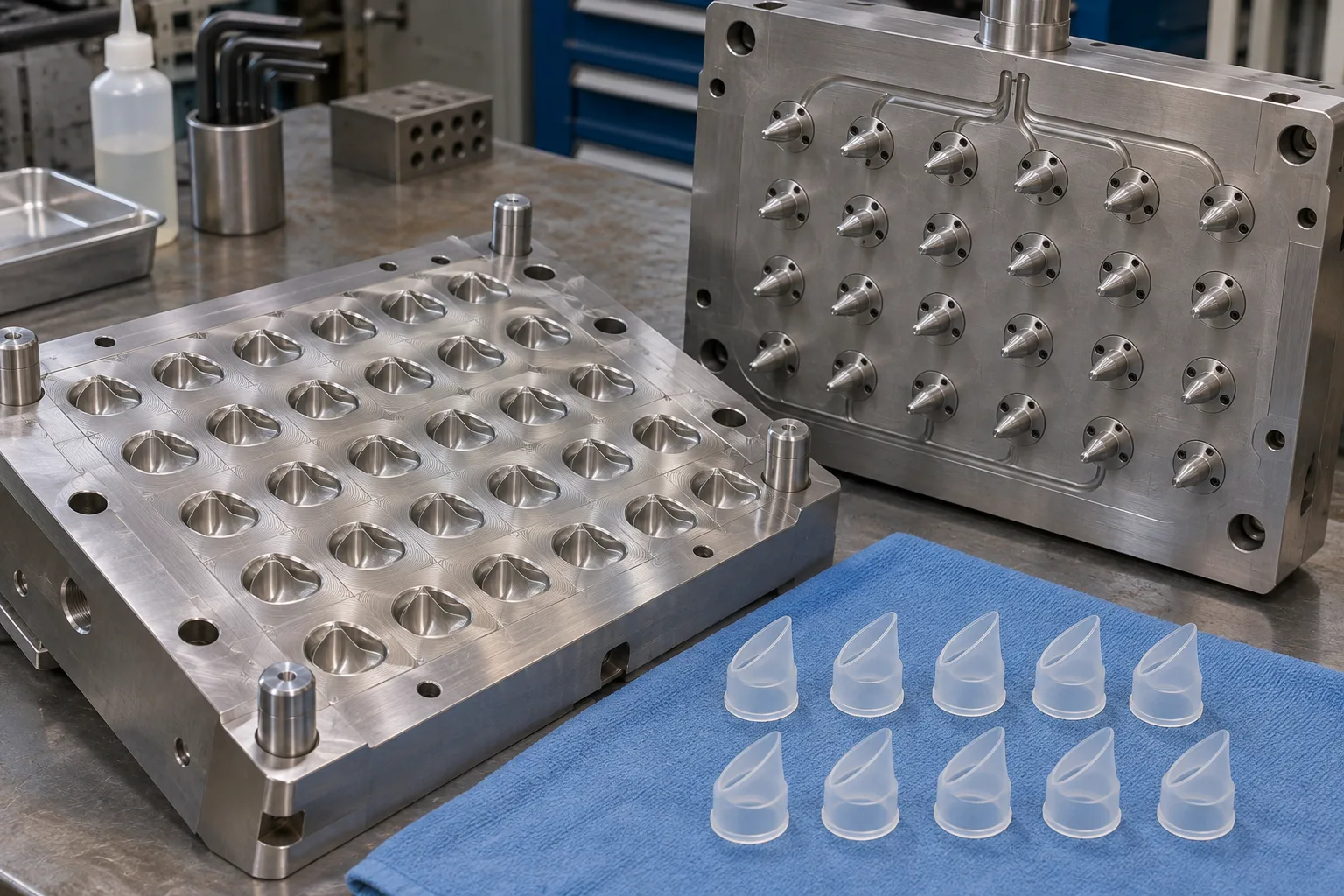
LSR Valve-Gate Cold Runner vs. Open-Gate: Runner Scrap & Amortization SplitEngineering process control benchmark · final tolerances confirmed per project CADProcess parameter window (verified per part CAD)Cold-Runner Valve-Gate LSR Tool• Runner waste: Near zero (<1%, chilled manifold)• Gate vestige: Flush valve pin witness, zero sprue• Tooling CAPEX: Higher (insulated block + valve pins)• Best fit: High annual volume & precious medical elastomerOpen-Gate / Conventional Cold-Sprue LSR• Runner waste: ~15%–40% cured non-recyclable scrap• Gate vestige: Manual sprue trim on parting land• Tooling CAPEX: Lower entry cost, fast 7–15d T1• Best fit: 100-pc pilot runs & heavy-wall partsCompare annual LSR weight saved (15%–40%) against valve-gate manifold delta before tooling
Engineering process control benchmark · final tolerances confirmed per project CAD
CNC-machined steel multi-cavity LSR mold half and upper cold-runner nozzle manifold block beside sprueless translucent molded check valves on a blue bench cloth

Unlike thermoplastic polypropylene or ABS—where cold runners get granulated back into hopper blends—liquid silicone rubber (LSR) crosslinks chemically inside heated cavities. Once a sprue bar solidifies in an open-gate mold, that rubber never melts again. Every gram left outside the finished cavity becomes permanent raw-material loss multiplied across the entire product lifecycle.

Yet reflexively insisting on a full needle-valve cold-runner block for low annual volumes traps buyer budgets inside expensive chilled manifolds that never pay themselves back. Inside Dongguan Youbang's 8,000 m² plant (integrating 10 closed-loop 85T–160T LSR presses and an in-house 5-axis CNC/EDM toolroom), engineering compares four numbers before locking tool architecture.

1. Material Scrap & Witness Comparison at a Glance

Choose an open-gate mold when upfront tooling payback outweighs material savings; step up to a valve-gate cold runner once annual cured runner scrap exceeds manifold depreciation.

Comparison Factor Open-Gate / Cold-Sprue LSR Tool Cold-Runner Valve-Gate LSR Tool Real Procurement Impact
Uncoiled / Cured Runner Scrap Typically 15%–40% of total shot weight lost as cured non-recyclable sprues Typically <1% waste (mixed A+B silicone held chilled inside manifold nozzles until cavity entry) Crucial when running medical-grade, translucent optical, or self-lubricating LSR compounds
Gate Vestige on Part Skin Manual sprue nip/trim scar right along parting edge or tunnel tab Flush micro-pin witness dot directly behind part face; zero manual stem snipping Essential on aesthetic intimate devices, valve rings, and feathered facial cushions
Upfront Tooling CAPEX Substantially lower (5-axis cavity + core plates without chilled manifold assembly) Noticeably higher due to precision thermal isolation blocks, coolant channels & actuated valve pins Keeps 100-pc pilot launches and early market validation capital light
Engineering Modification Speed Fast steel edits & clean 7–15 day T1 sample turnaround Slower nozzle geometry shifts; manifold spacing fixes cavity pitch permanently Keep revision-prone prototypes in simpler cavity blocks until CAD freezes

2. How to Run the Simple Annual Scrap Breakeven Check

You do not need complex financial software to spot the tipping point between open-gate and cold-runner LSR steel:

  1. Multiply Annual Unit Volume × Single-Part Weight (g), then check what 15%–40% open-gate sprue weight represents in annual kilograms of wasted medical or food-grade LSR.
  2. Compare that Annual Wasted Silicone Cost + Manual Trimming Labor directly against the incremental price of a chilled valve-gate manifold on your quote sheet.
  3. As a rule of thumb: high-volume medical diaphragms, baby spouts above 50,000–100,000+ pcs/year, and high-cost medical elastomer components cross payback quickly inside cold-runner blocks—whereas tiny <2 g grommets or 100–2,000 pc market launches belong cleanly in compact open-gate tools.

3. Staging From 100 pcs Pilot Tooling to Scaled Cold-Runner Production

Smart brands avoid gambling full production manifold budgets ahead of real sales traction:

  • Verify physical assembly fit first with free 3D-printed structural prototypes (buyer covers freight).
  • Validate sealing lips and customer acceptance across 100 pcs pilot batches (7–15 day T1) inside simpler tooling, keeping steel ownership 100% locked under your company name.
  • Scale into dedicated multi-cavity cold-runner molds across our 10 LSR presses (15–30 day production turns) once reorder velocity turns scrap percentages into meaningful margin.

Upload STEP files and expected annual demand via our LSR injection molding page or medical LSR valve specs for a first side-by-side mold payback comparison within 24 hours.

References & Engineering Sources

  1. Dongguan Youbang 85T–160T Closed-Loop LSR Molding Specifications
  2. Society of Plastics Engineers (SPE) — Liquid Silicone Rubber Tooling Principles
Turn the selection into a reviewable project brief

Interactive Engineering Tool

LSR Injection vs. HCR Compression Route & Tooling Estimator

Select four project parameters to compare the recommended molding route, tooling cost drivers, typical T1 lead time, and prefill your RFQ brief.

Engineering Reference · Confirmed per CAD
1. Order Volume (Trial from 100 pcs)
2. Application & Compliance
3. Geometry & Construction
4. Current Documentation Stage
Molding Route to Evaluate

Evaluate multi-cavity HCR compression molding

For a standard molded part, compare alternative cavity layouts on the available platens using the drawing and expected order mix.

Tooling Cost Drivers
Compare cavity machining, setup and trim cost per accepted part.
Elastomer & Post-Process
Choose the grade and post-cure for the use. For food contact, confirm the destination market and test the finished part.
MOQ & Typical Schedule
Trials from 100 pcs. Standard orders from 1,000 pcs or US$2,000, confirmed per project. New tooling starts after drawing approval and full tooling payment. First T1 samples typically take 7–15 days from tool start.
Request Quote with This Spec Final cavity count, tolerances and pricing are confirmed against your drawing.

Sourcing & Tooling FAQ

Key Answers Before Tooling

Covering CAD readiness, 100 pc trial & 1,000 pc / $2,000 USD standard MOQ policy, free 3D fit prototypes vs. T1 silicone samples, NDA protection, and mold ownership.

Have a part-specific question?

Send your drawing or sample photo directly to Youbang’s engineering desk; we send an initial response within 24 hours.

Can cured silicone sprues and runners from an open-gate LSR mold be ground up and reused like thermoplastic PP or ABS?

No. Because silicone elastomers undergo irreversible chemical platinum crosslinking during molding, cured runners cannot be re-melted or extruded back into virgin parts. Open-gate sprue waste leaves the plant directly as disposed scrap rubber.

Does a cold-runner valve-gate system eliminate every trace of a gate mark on a medical or cosmetic silicone surface?

It reduces gate witness dramatically to a tiny flush micro-dot compared with torn manual sprue stubs—making automated flush finish ideal around respiratory skirts, check-valve housings, and glossy feeding rims.

When should a brand intentionally start with an open-gate LSR mold or HCR pilot cavity instead of a cold runner?

When testing initial demand from 100 pcs to a few thousand units on light sub-3 g components—or before part geometry stabilizes past EVT/DVT—lower upfront steel cost beats saving pennies per shot on runner material.

How does Youbang run small 100-pc trials if cold-runner manifolds carry higher tooling outlays?

Engineering teams frequently qualify geometry on free 3D fit prints first, tool an affordable single- or 2-cavity open-gate LSR (or HCR compression) mold within 7–15 days for 100-pc pilot validation, and step up to a multi-cavity cold-runner production tool once volume justifies manifold payback.

B2B Factory Direct · initial response within 24 hours

Model open-gate vs. cold-runner cavity amortization on your exact part gram weight

Share STEP CAD, annual target demand, and elastomer family for side-by-side mold CAPEX and piece-price amortization within 24 hours.

✓ Trial from 100 pcs · Standard 1,000 pcs or $2,000 USD✓ Free 3D-printed fit prototypes before steel tooling✓ Paid molds 100% owned by customer

Send Your Project Brief or CAD

For confidential drawings, sign the mutual NDA before uploading the files.

Only rights holders or their authorized representatives may upload files. We keep inquiries and attachments to prepare quotes and follow up on your project.

Prefer email or files > 20 MB? Send directly to zhouli@ybsilicone.com · Privacy Policy