
Key Sourcing Takeaways
- Dongguan Youbang accepts private-mold trial production runs starting from 100 pcs once steel tooling is built, with recurring bulk runs flexibly handled from 1,000 pcs or $2,000 USD.
- Never spend money twice on disposable aluminum or urethane cast molds unless parts are non-structural; a 2-cavity P20/S136 HCR steel mold gives genuine elastomer T1 parts in 7–15 days and carries through thousands of future reorders.
- Before cutting steel, confirmed briefs with agreed pricing and clear CAD qualify for free 3D-printed geometry fit prototypes (buyer covers shipping) so port cutouts and hand ergonomics lock before steel cost hits.
Three-Stage Ramp: Free 3D Fit Check → 100-Pc Pilot → Multi-Cavity Scale
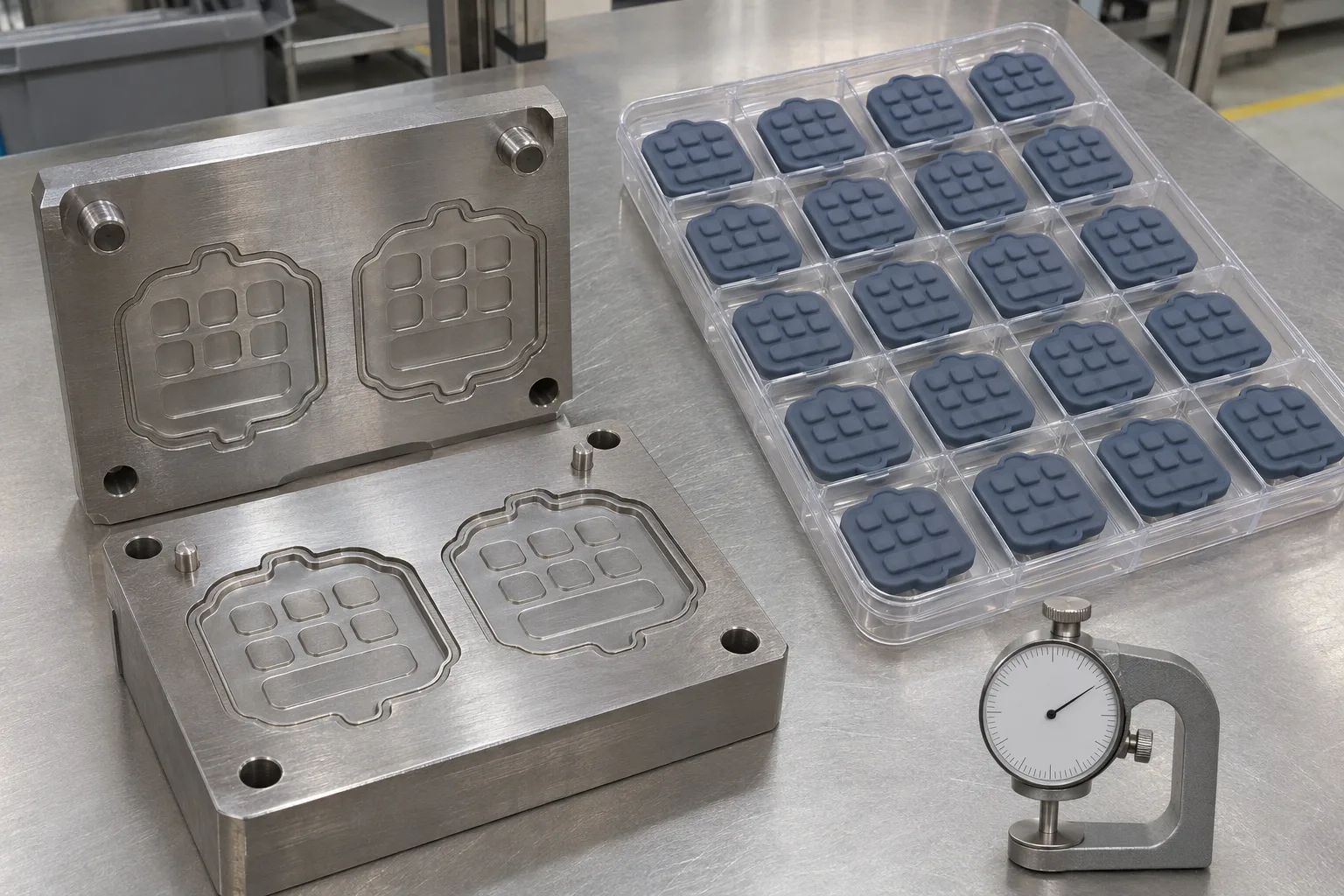
Launching a new handheld scanner sleeve, EV interior accessory, baby feeding tray, or cosmetic applicator always hits the same wall: engineering prototypes look solid in CAD, yet spending thousands of dollars on an 8-cavity steel mold and 3,000 pieces of dead inventory before market test sells through feels like gambling blind.
At Dongguan Youbang (8,000 m² factory, 15 HCR presses + 10 LSR presses, in-house 5-axis CNC/EDM toolroom), flexible launch staging keeps capital risk tight: trial production orders start from 100 pcs, while standard recurring runs start flexibly from 1,000 pcs or $2,000 USD per order.
1. Three-Stage Launch Ladder: Pick the Right Step Before Spending on Steel
Scale custom silicone parts without stranded inventory in three steps: confirm physical port/enclosure fit first using free 3D-printed geometry prototypes (once scope, pricing, and clear CAD align; buyer covers freight), launch 100-piece real elastomer trials from a 2–4 cavity hardened steel mold (7–15 days to T1), then expand cavities or transition to LSR once recurring reorders cross 1,000 pcs / $2,000 USD. Never trap pilot budgets in throwaway urethane or soft aluminum molds that cannot hold commercial parting lines when volume arrives.
| Launch Stage | Recommended Tooling Path | Realistic Trial / Order Scope | Unit Economics & Hidden Trap | Ownership & Next Step |
|---|---|---|---|---|
| Stage 1: Pre-Tooling Envelope Verification | Free 3D-printed structural geometry prototype | Physical snap/port fit check before steel cut | Not true elastomer flexibility or color; prevents costly cradle or USB cutout misses | Confirm final CAD geometry cleanly |
| Stage 2: Market / Pilot Validation (100+ Pcs) | 2–4 cavity P20 or S136 hardened steel HCR mold (7–15 days to T1) |
100 pcs trial order minimum in real Shore A, Pantone pigment & 200 °C × 4–6h bake |
Higher piece cycle cost offset by ~60–75% lower upfront tooling outlay vs. full multi-cavity steel | Zero sunk waste: steel mold handles reorders up to thousands |
| Stage 3: Volume Scaling (1,000 Pcs / $2,000+) | 8–16+ cavity production HCR or 85T–160T closed-loop LSR | 1,000 pcs or $2,000 USD formal run; quarterly rollouts (15–30 days) |
Lower cycle time per part; cold-runner LSR slashes hand tear-trim labor | Paid molds 100% customer-owned; free active maintenance |
2. Why Hardened Pilot Steel Beats "Temporary Soft Tooling"
Many overseas sourcing brokers pitch silicone vacuum casting or low-melting aluminum molds as a "cheap bridge" to save money on 100–200 pieces. On functional B2B parts, that shortcut usually backfires in three ways:
- Unusable Flash & Parting Steps: Soft mold blocks deform quickly under compression clamping (
200T–350T), leaving thick flash seams that fail retail or medical assembly checks. - Sunk Dead-End Cost: Silicone vacuum casting tools degrade after roughly 15–30 pulls—requiring you to pay 100% of production steel tooling all over again if those first 100 units sell out.
- Zero Transferable Dimensional Baseline: Soft resin pulls shrink differently than compressed peroxide or platinum silicone, making early tolerance validation useless for volume approval.
Because Youbang machines its own 5-axis CNC/EDM P20 and S136 steel cavities in-house, a lean 2-cavity pilot steel mold delivers clean parting shutoffs from piece #1, gives real ±0.05 mm (precision datum) or ±0.1–0.2 mm (body) baseline checks at T1, and continues running reorders cleanly under customer-owned mold IDs.
3. Keeping Packaging & Lab Costs Aligned With a 100-Piece Trial
Even after cutting factory MOQ down to 100 pcs, secondary supply-chain bottlenecks can catch first-time buyers by surprise:
- Pack Clean Double-PE First, Defer Offset Retail Boxes: Custom offset color boxes, rigid foam inserts, and blister trays from outside packaging plants frequently demand
1,000–3,000+MOQs. Launch the first 100–500 pilot units in clean sealed double-PE polybags or generic kraft sleeves with FBA/SKU labels, then scale into printed retail boxes once demand proves steady. - Stage Compliance Testing Smartly: Request upstream raw silicone CoA records on your 100-piece pilot batch, mold exact pigmented SKUs in
200 °C × 4–6 hoursovens, and schedule final ~10-day third-party SGS/Intertek/TÜV tests right alongside your pre-launch inventory lot.
Ready to price a lean 2-cavity pilot mold alongside a full multi-cavity production option? Upload your CAD to our 100-piece pilot quote workflow for a first engineering reply within 24 hours, or model piece-price break-even directly inside the calculator below.