
Key Sourcing Takeaways
- Thermoset silicone (0–80 Shore A) will not melt up to +200–230 °C; most TPEs soften or creep above 80–110 °C.
- HCR compression silicone molds often require lower upfront tooling spend at pilot-to-medium volumes (< 50k pcs/yr) than multi-cavity thermoplastic injection tools.
- Hybrid overmolding bonds silicone onto customer-supplied PC, PP, PA, stainless steel, aluminum, or copper inserts via chemical primer.
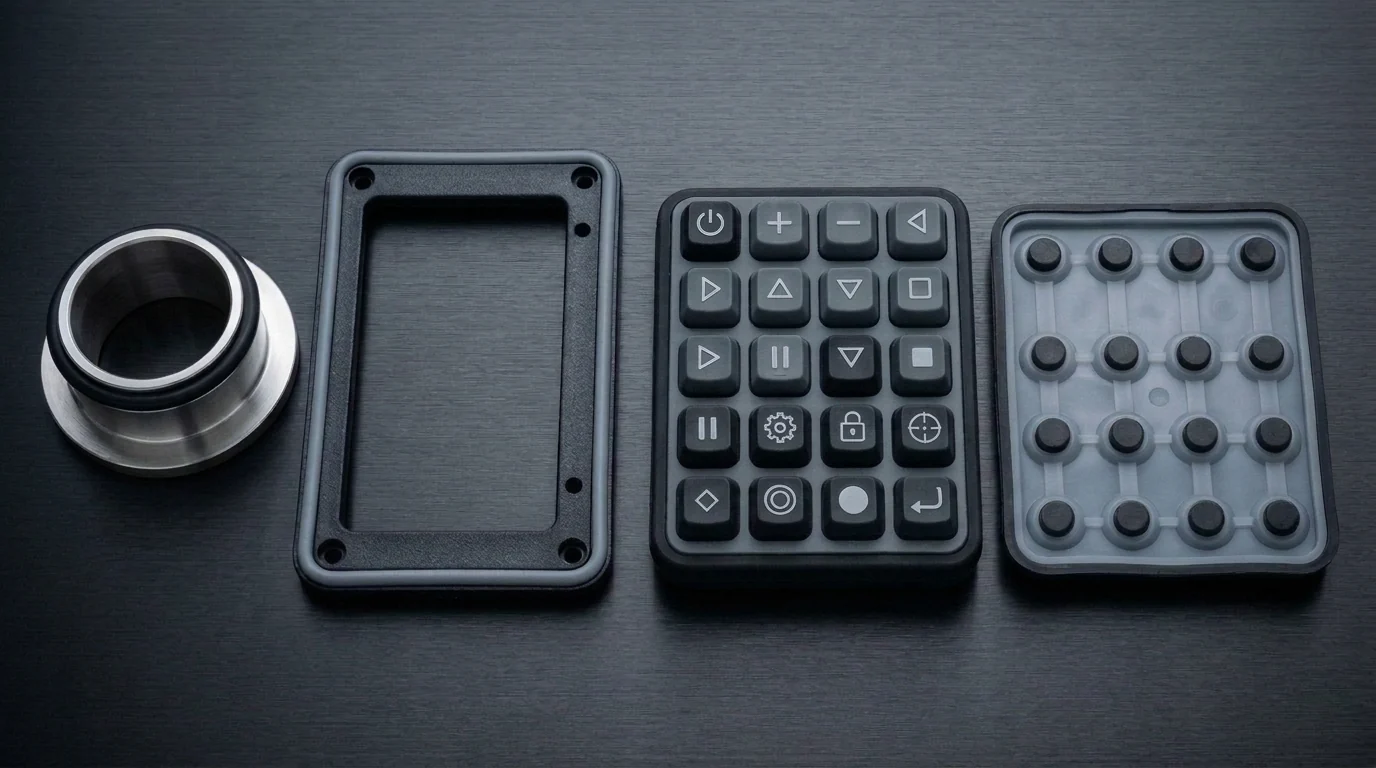
Silicone elastomer (LSR and HCR) is a chemically crosslinked thermoset that maintains elasticity, low compression set, and zero plasticizer leaching from -40 °C to +230 °C, whereas TPE and TPU are melt-processable thermoplastics optimized for high-speed ambient-temperature molding (typically < 80–110 °C) and melt recyclability, and rigid plastics (PC, PP, PA) provide structural stiffness. Choose thermoset silicone whenever your part faces boiling/dishwasher sterilization, oven heat, prolonged sealing compression, UV/ozone exposure, or sensitive mucosal/infant contact—or combine a rigid plastic/metal frame with primer-bonded silicone overmolding.
(Scope note: Dongguan Youbang specializes exclusively in thermoset silicone and rubber molding—LSR injection, HCR compression, and primer-bonded overmolding onto customer-supplied rigid inserts; we do not injection-mold standalone TPE/plastic parts, allowing us to advise candidly when silicone is—or is not—the right fit.)
1. Engineering Comparison Matrix: Thermoset Silicone vs. TPE/TPU vs. Rigid Plastics
| Engineering & Sourcing Parameter | Thermoset Silicone (LSR & HCR) | Thermoplastic Elastomers (TPE / SEBS / TPU) | Rigid Structural Plastics (PC, PP, PA66) |
|---|---|---|---|
| Polymer Network Structure | Permanent covalent Si–O–Si thermoset crosslinks (cannot re-melt) |
Physical phase-separated thermoplastic (softens & melts on reheating) | Semi-crystalline or amorphous rigid thermoplastics |
| Hardness / Stiffness Window | 0–80 Shore A (commonly 30–70 Shore A at Youbang) |
20 Shore A to 75 Shore D (TPU excels in hard abrasion resistance) |
Rigid Shore D / high flexural modulus |
| Service Temperature Envelope | -40 °C to +200 °C continuous (+230 °C baking; -60 °C specialty) |
Typically -30 °C to +80–110 °C (creeps under boiling water or steam) |
PP ~100 °C, PC ~130 °C, Glass-Filled PA66 ~180–200 °C |
| Compression Set & Creep | Low compression set—recovers shape after years of flange squeeze or folding | High thermal creep—permanently flattens or stretches if held warm | Rigid; cracks or stress-whitens if over-deflected |
| Chemical Purity & Plasticizers | Inherently soft; zero BPA, zero ortho-phthalates, ≤ 0.5% LFGB volatile capability |
Compound-dependent; some soft SEBS grades contain mineral processing oils | Rigid without plasticizers; structural backbone role |
| Upfront Tooling vs. Piece Cost | HCR mold (1.0×–3.5×) economical for <5k–50k/yr; LSR mold (4.0×–8.0×+) for high-volume precision |
High steel injection mold cost, but very fast 15–35 s cycle times above 100k+ pcs/yr |
High injection mold cost, lowest resin price at mass scale |
| End-of-Life vs. Service Lifespan | Not melt-recyclable, but multi-year durability cuts replacement waste | Runner scrap & parts can be reground / melt-recycled | Melt-recyclable within clean resin streams |
(Reference on thermoplastic elastomer families: Avient — Thermoplastic Elastomers Overview.)
2. Four Scenarios Where Silicone Decisively Outperforms TPE & TPU
- Boiling Water, Steam Sterilization & Oven Heat: Baby feeding bowls, teethers, menstrual cups, and kitchen bakeware routinely see
100 °Cboiling water, domestic dishwashers, or200–230 °Covens. Standard TPEs warp, turn tacky, or lose grip memory, whereas post-cured platinum silicone (200 °C × 4 h) holds geometry and elasticity cycle after cycle. - Long-Term Static Seals & Folding Memory: Collapsible travel bowls, industrial enclosure gaskets, and handheld terminal sleeves stretched repeatedly over corners rely on low compression/tension set. Silicone snaps back cleanly without developing loose, baggy edges.
- Biocompatible & Odor-Sensitive Contact: Pure fumed-silica-reinforced platinum silicone contains no hydrocarbon extender oils that migrate out over time as greasy surfaces, supporting
FDA 21 CFR 177.2600,EU LFGB, andISO 10993testing. - Pilot & Moderate-Volume Custom Launches (
< 50,000 pcs/yr): Buyers often assume TPE is always cheaper than silicone. While TPE pellet price is lower at500,000 pcs/year, launching2,000–15,000 pcsacross three Pantone colors on Youbang's 200–250T HCR compression presses frequently delivers a lower total project cost due to simpler compression mold steel (1.0×–3.5×tooling multiplier).
3. Where TPE, TPU, or Rigid Plastics Make Better Engineering Sense
- Extreme Sliding Abrasion & Sharp Puncture Loads: Shoe outsoles, caster wheels, or cable jackets dragged across rough concrete favor high-hardness TPU over soft silicone, which has lower cut-growth resistance once nicked.
- Load-Bearing Hinges, Threads & Snap Latches: Elastomers cannot hold tight screw threads or carry cantilevered weight on their own—use rigid
PC,PP,PA, or stainless steel for the structural skeleton.
4. Best of Both Worlds: Primer-Bonded Rigid + Silicone Overmolding
Many high-value products—such as rigid-rimmed collapsible bowls, ergonomic kitchen utensils, sealed medical mask frames, and P+R (plastic cap + silicone base) keypads—pair a rigid structural core with a soft silicone functional layer.
At Youbang, we overmold silicone onto customer-supplied PC, PP, PA, stainless steel, aluminum, and copper inserts using surface cleaning and chemical primer (底涂) across both our 85T/120T LSR injection machines and 200–250T HCR compression presses (note: we do not overmold onto TPE or ABS, nor claim primerless LSR). Before cutting steel (T1 typically 7–15 days), you can also test rigid mating clearances with 1–3 free 3D-printed engineering samples once requirements, quote, and CAD are confirmed (shipping paid by buyer).
Compare tooling economics in Custom Silicone Product Cost or review substrate design rules on our Silicone Overmolding page.