
Key Sourcing Takeaways
- US FDA 21 CFR 177.2600 tests water & n-hexane extractables; German LFGB / BfR XV adds strict ≤ 0.5% volatile loss, peroxide-zero, and sensory odor/taste checks.
- EU LFGB and baking/baby products require platinum-cured elastomer plus ventilated post-curing (typically 200 °C × 4 hours).
- Upstream raw-gum reports never replace finished-article SGS/Intertek/TÜV testing (~10 days) on your exact molded color.
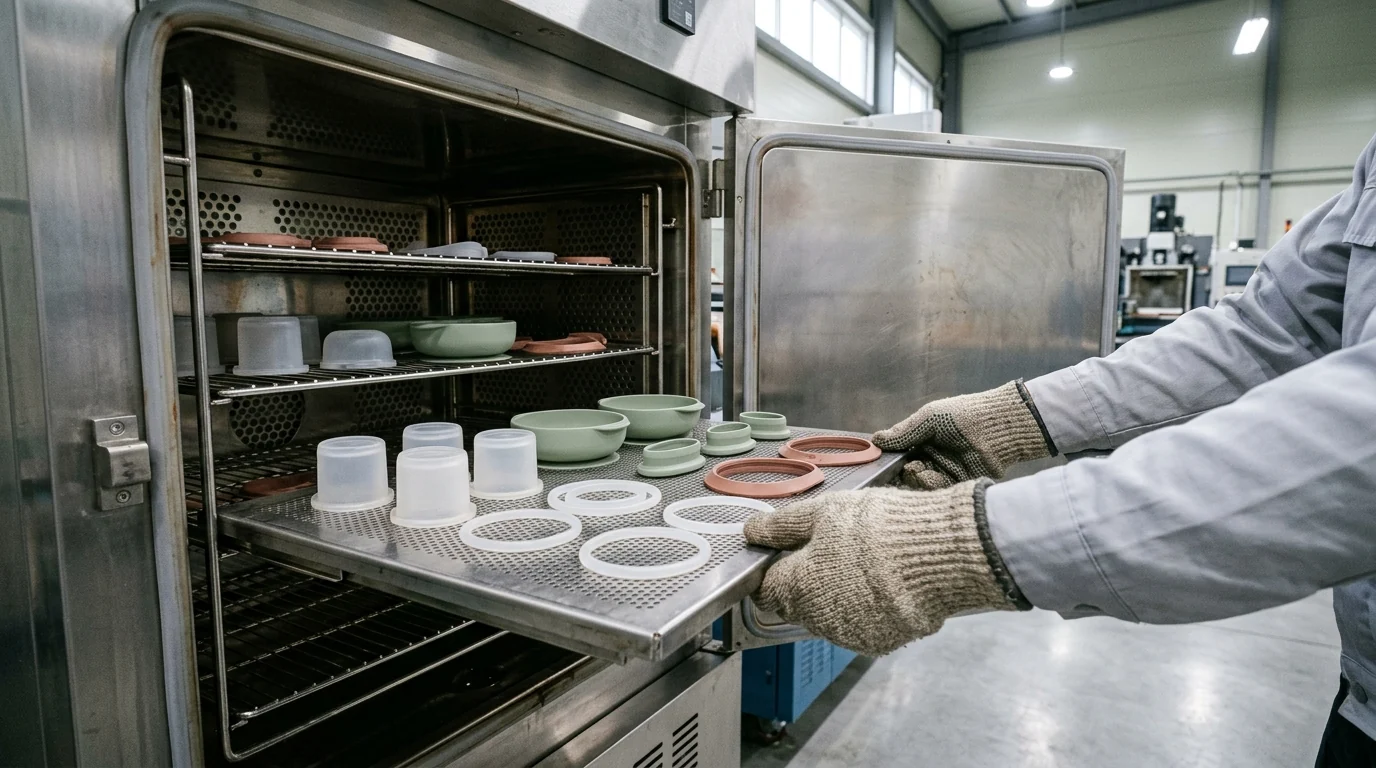
Food-grade silicone is not a single universal polymer grade—it refers to polysiloxane elastomers compounded, cured, and post-cured to pass specific destination-market migration limits on the finished molded article. While US FDA 21 CFR 177.2600 measures total extractables in refluxing distilled water and n-hexane (fatty-food simulant), German LFGB / BfR XV imposes far stricter ≤ 0.5% volatile organic matter, zero residual peroxides, organoleptic taste/odor neutrality, and multi-simulant migration limits—making platinum-cured silicone plus ventilated 200 °C × 4 h secondary post-curing essential for European kitchenware, bakeware, and infant feeding lines.
When sourcing custom kitchen tools, baking molds, ice trays, or baby tableware from Dongguan Youbang, specifying exact contact media, peak temperatures, and destination standards upfront prevents failed third-party lab tests and costly batch re-bakes.
1. Regulatory Comparison Matrix: US FDA vs. German LFGB vs. Infant Standards
| Compliance Standard | Target Market | Key Chemical & Sensory Test Parameters | Typical Cure & Post-Cure Requirement in Production |
|---|---|---|---|
| US FDA 21 CFR 177.2600 (Rubber articles for repeated use) | United States & North America | Distilled water extraction (≤ 20 mg/in² first 7 h; ≤ 1 mg/in² next 2 h) + n-hexane reflux extraction (≤ 175 mg/in² first 7 h; ≤ 4 mg/in² next 2 h) |
Food-contact peroxide HCR or platinum HCR/LSR + controlled secondary oven post-curing |
| German LFGB §§ 30–31 / BfR Recommendation XV | Germany & premium EU retail | Overall migration (ethanol / acetic acid / vegetable oil simulants), volatile organic matter ≤ 0.5% (200 °C × 4 h), extractable platinum/organotin limits, peroxide test = negative, sensory odor/taste transfer pass |
Platinum-cured (addition-cured) HCR or LSR + mandatory ventilated oven post-curing (typically 200 °C × 4 hours) |
| French Arrêté du 25 novembre 1992 (DGCCRF) | France | Overall migration, volatile organic matter (≤ 0.5%), peroxide-free requirement, specific metal/organotin release |
Platinum-cured elastomer + full ventilated secondary post-curing; dark/saturated pigments screened carefully |
| EU EN 14350 + REACH / US CPSIA | EU & US infant feeding / teethers | Food-contact extraction + phthalate ban, total lead/heavy metals, nitrosamines/nitrosatable substances, mechanical bite/pull safety | High-purity platinum LSR or platinum HCR + certified heavy-metal-free color masterbatch + post-curing |
(Regulatory references: US eCFR 21 CFR § 177.2600 and German BfR Recommendations on Food Contact Materials — XV. Silicones.)
2. Why Ventilated Secondary Post-Curing (200 °C × 4 Hours) Decides LFGB Pass/Fail
Even when a factory buys genuine raw gum from Wacker, Shin-Etsu, Momentive, Dow, Elkem, Dongjue, or Zheng'an, freshly molded silicone contains trace low-molecular-weight cyclic siloxanes (D4–D8 oligomers). If a supplier skips or shortens secondary baking to save electricity and oven capacity:
- Volatile Weight Loss Exceeds
0.5%: The part fails BfR XV / French DGCCRF volatile organic matter testing immediately. - Fatty-Food Extraction & Odor Spikes: Baking cake batter or hot oil at
200–230 °Cpulls unvolatilized siloxanes out of the rubber, leaving a soapy taste or oily film.
At Youbang, food-contact and baby/personal-care batches undergo secondary post-curing in ventilated convection ovens—typically around 200 °C for 4 hours, adjusted for compound grade and wall section thickness—ensuring fresh cross-flow air sweeps out vaporized volatiles rather than letting them re-condense onto cool parts.
3. Specify the Whole Multi-Material Construction—Not Just Base Gum
A finished kitchen or baby product often combines multiple chemical inputs that laboratories test together:
- Silicone Color Masterbatches: Vibrant red, orange, or black pigments must be formulated specifically for food-contact silicone without restricted heavy metals or primary aromatic amines (PAAs). Changing from translucent natural to deep black requires re-verifying pigment compliance.
- Surface Markings (Molded-In vs. Ink): Food-wetting zones (such as internal cup graduation lines or baking cavities) should use CNC-engraved molded-in relief rather than surface ink. Where exterior branding uses Youbang's in-house screen printing, keep ink strictly on non-food-contact outer grips.
- Overmolded Rigid Cores: For spatulas, ladles, or roll-up dish drying racks overmolded onto customer-supplied PA (nylon), PP, PC, or stainless steel cores via primer, confirm whether the rigid core is fully encapsulated in silicone or partially exposed to food and dishwasher detergents.
4. Upstream Raw-Material Reports vs. Finished-Article Lab Testing
Never accept an upstream raw-polymer PDF as proof that your finished colored product is "LFGB certified":
- Upstream Polymer Reports (for example, SGS reports held by raw-compound suppliers on uncolored base slabs) verify only that the raw elastomer candidate can pass extraction baselines.
- Finished-Article Reports test your actual molded SKU, pigment recipe, and post-cure execution. Youbang coordinates project-specific finished-part testing with SGS, Intertek, and TÜV (turnaround typically ~10 days depending on test protocol) and links raw-material batch CoAs to your production lot and shipment number.
(Note on factory QMS certificates: Youbang holds ISO 9001:2015 21424Q0270R1S for non-food/non-medical silicone and ISO 13485:2016 62026Q00072R100 for medical-system silicone production; food-contact compliance is established via material selection, post-curing control, and finished-product lab testing, not ISO 9001.)
5. Five-Item Food-Contact RFQ Specification Template
Include these five lines in your RFQ so every vendor quotes compliant materials and baking time:
- Food Type & Simulant Class: Aqueous, acidic, alcoholic, or high-fat/oil contact (e.g., olive oil, butter, milk).
- Thermal & Cleaning Duty: Peak temperature and duration (e.g.,
-40 °Cfreezer to+230 °Coven for60 min; residential dishwasher cycles). - Mandatory Cure System: Explicitly state
Platinum-cured HCRorTwo-part Platinum LSR+ventilated secondary post-curing. - Target Market Standard: Name exact protocols (
FDA 21 CFR 177.2600,German LFGB / BfR XV,French DGCCRF,EN 14350, orCPSIA). - Color List for Lab Grouping: List every Pantone shade so SGS/Intertek/TÜV can confirm composite vs. per-color extraction sample counts before T1 molding.
Compare curing chemistry further in Platinum vs. Peroxide-Cured Silicone and document verification in Silicone Product Test Reports.
Pre-Tooling DFM Spec Sheet
8-Point Custom Silicone DFM Self-Check
Check these eight engineering points on your CAD or brief before cutting steel tooling.