
Youbang · B2B Custom Silicone Manufacturing · Dongguan

Custom Molded Silicone Pet Lick Mats

Engineer private-label dog and cat lick mats with multi-zone feeding textures, dense tile-wall or floor suction arrays and reinforced peel tabs—molded on 200–250T HCR presses in odorless platinum-cured silicone (~200 °C × 4 h post-cured) with custom Pantone compounding and retail box packaging.

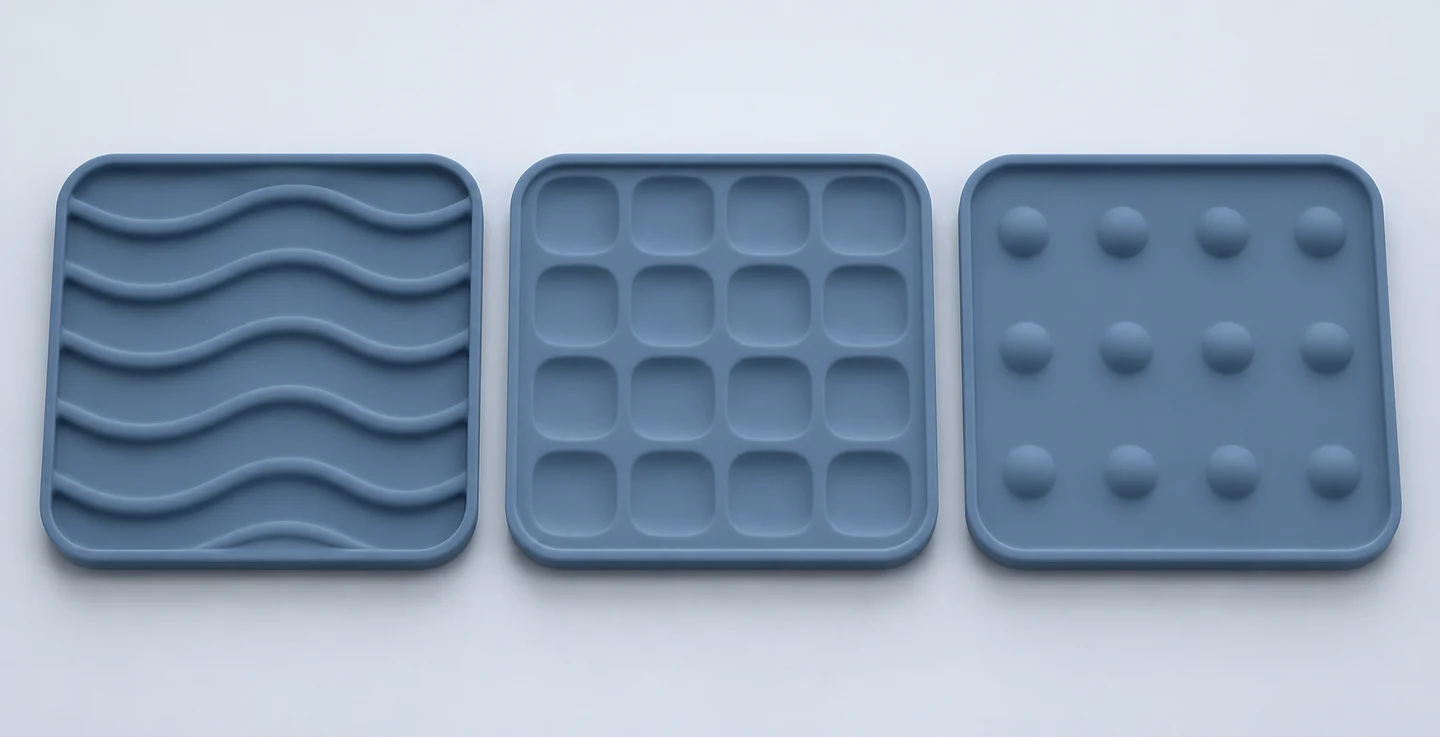
Left to right: wave ribs, shallow pockets and dome textures

Engineer Multi-Zone Textures Around Wet Food, Paste & Dishwasher Rinse

Balance slow-lick engagement for peanut butter, yogurt, wet pate and raw blends against rounded root radii that rinse clean without trapping greasy residue.

Wave ribs and continuous channels

Low, parallel wave ribs leave continuous paths between them. Compare movement along and across these paths, including the turns and channel ends where food can collect.

Share the intended food consistency and particle size, spreading direction and cleaning tool. On the sample, compare how food enters the channels and how the tool reaches their ends.
Shallow grid pockets

A shallow grid divides the surface into local spreading areas. Filling individual pockets and spreading across the grid create different handling tasks; the pocket floors and rounded intersections also need cleaning access.

Compare the proposed amount and spreading action with the pocket layout. Check whether the selected brush reaches each floor and corner, and record remaining residue.

Spaced dome bumps

Low rounded bumps leave connected space around their bases rather than separate enclosed pockets. Spreading passes around the bumps, while cleaning needs access around each root.

Use the intended food consistency and any particles to compare the usable gaps. Try the cleaning tool around the point bases and across the connected floor.

Choose placement, holding and release together

The reverse side follows the intended support surface and handling action. Flat placement and attachment to a specified surface solve different project needs.

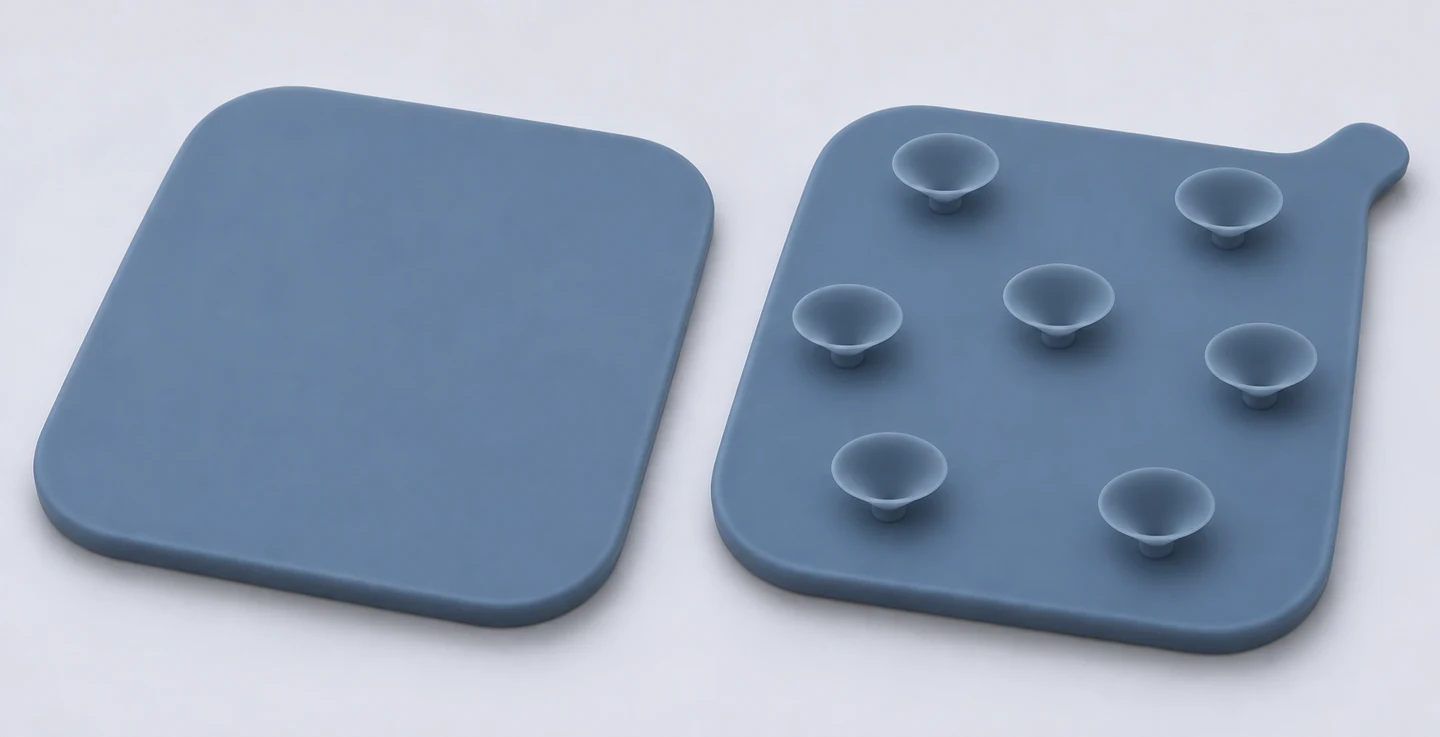
Flat and suction/release-tab backings

Flat placement

Define where the mat rests and how the whole food area is supported. Observe sliding, edge lift and picking up the loaded mat on that actual surface, including whether it is dry or wet.

Attachment to a specified surface

If suction features are part of the design, provide the surface material, finish and intended orientation. Agree the surface condition and holding requirement so attachment can be checked with molded silicone samples.

Leave a practical release point

A reachable tab or edge gives the user a defined place to start lifting. Review the access space and release direction together with the food surface, so removal can be observed without relying on an unspecified pull anywhere on the mat.

Review the edge, support and handling as one part

Edge and usable food area

The border determines where spreading stops and where the mat can be held. Compare a clear handling edge with the space needed for the texture and any surrounding objects.

Overall support during loading and lifting

Plan how the mat is supported while food is applied and when it is moved. The outline, wall layout and lifting points should be tried together on the intended arrangement.

Cleaning, drying and packing

Review both sides and any release features for cleaning access. Include the intended drying and storage position, and compare the proposed packing form with the sample so the working surface and edges remain practical to handle.

Record what the molded sample needs to show

Use the intended food, support surface and cleaning method in the sample plan. Keep observations tied to the agreed conditions.

Confirm the design before tooling

Bring the selected food-contact texture, backing, handling edge and marking locations into one drawing revision. Confirm the material grade, color and required documents for the intended use. Youbang handles mold design in-house, with tool machining coordinated externally; use the agreed drawing and molded sample to record approval.

  1. Apply and access the food

    Observe spreading into the selected texture, access to the food and the locations where residue remains.

  2. Place, lift and release

    Check support and the defined removal action on the target surface. If attachment is required, record the surface condition and agreed holding and release observations.

  3. Clean and prepare for storage

    Review access around texture roots, borders and reverse-side features, then try the intended drying and packing actions.

A 3D geometry sample may help with the outline or a handling feature when useful. Surface feel, flexibility, color and use observations require molded silicone samples. Choose the sample route for the questions still to answer.

Sourcing & Tooling FAQ

Key Answers Before Tooling

Covering CAD readiness, custom MOQ evaluation, free 3D fit checks vs. T1 silicone samples, NDA protection and mold ownership.

Have a part-specific question?

Send your drawing or sample photo directly to Zhou Li’s engineering desk for a 24h DFM reply.

How do we design a signature multi-zone lick mat that stands out from generic online listings?

Combine complementary zones—such as cross-grids for thick pastes, raised nubs for wet food and wavy channels for yogurt—around your brand’s custom silhouette and embossed border logo. Our in-house mold designers radius pocket roots so top-rack dishwashers and bottle brushes clean every corner.

When should a lick mat use full-back suction cups vs. a weighted flat anti-skid base?

Vertical shower-wall grooming mats and smooth tile/hardwood enrichment mats benefit from dense micro-suction arrays paired with a corner peel tab; heavier tabletop or crate mats can use a thicker high-friction flat back or an overmolded PP stiffener plate (customer-supplied PP + silane primer).

Should custom lick mats ship flat in retail color boxes or rolled?

Flat retail color boxes or die-cut window sleeves keep suction skirts crisp out of the box and showcase multi-zone textures on shelf. If you prefer compact rolled packs, we test Shore A recovery on 7–15 day T1 molded samples to ensure corners and suction cups lie completely flat upon opening.

How does a lick mat differ from a bowl-underlay feeding mat in tooling and material?

A lick mat is a direct food-contact enrichment surface requiring deep sculpted cavities, tear-resistant pocket walls and odorless ~200 °C × 4 h post-cured platinum silicone; an underlay feeding mat is a wide thin floor protector molded on our 650×650 mm platens to catch water splashes beneath bowls.

B2B Factory Direct · 24h Engineering & Tooling Review

Custom-Tool Your Branded Pet Lick Mat

Send your texture layout sketch, suction-back preference, Pantone codes and estimated volume—our engineering team responds within 24 hours.

✓ NDA available before CAD exchange✓ Eligible for 1–3 free 3D fit prototypes✓ Paid molds 100% owned by customer

A useful first brief

  • Intended food state, spreading method and cleaning method.
  • Outline or reference, working texture, handling edge and lifting features.
  • Placement surface, orientation and any defined holding/release requirement.
  • Estimated quantity, color, marking, packing and required project documents.