
Youbang · B2B Custom Silicone Manufacturing · Dongguan

Custom Silicone Pet Bowls, Slow Feeders & Travel Bowls

Engineer private-label freestanding pet bowls, drop-in slow-feeder inserts for stainless-steel bowls, elevated stand bowls and high-volume collapsible travel bowls (typical line capacity ~100,000 pcs/month)—molded in odorless platinum-cured silicone with optional rigid-rim overmolding and 7–15 day T1 sampling.

Start with the bowl and its supporting container

Standalone bowl and a separate container/liner relationship

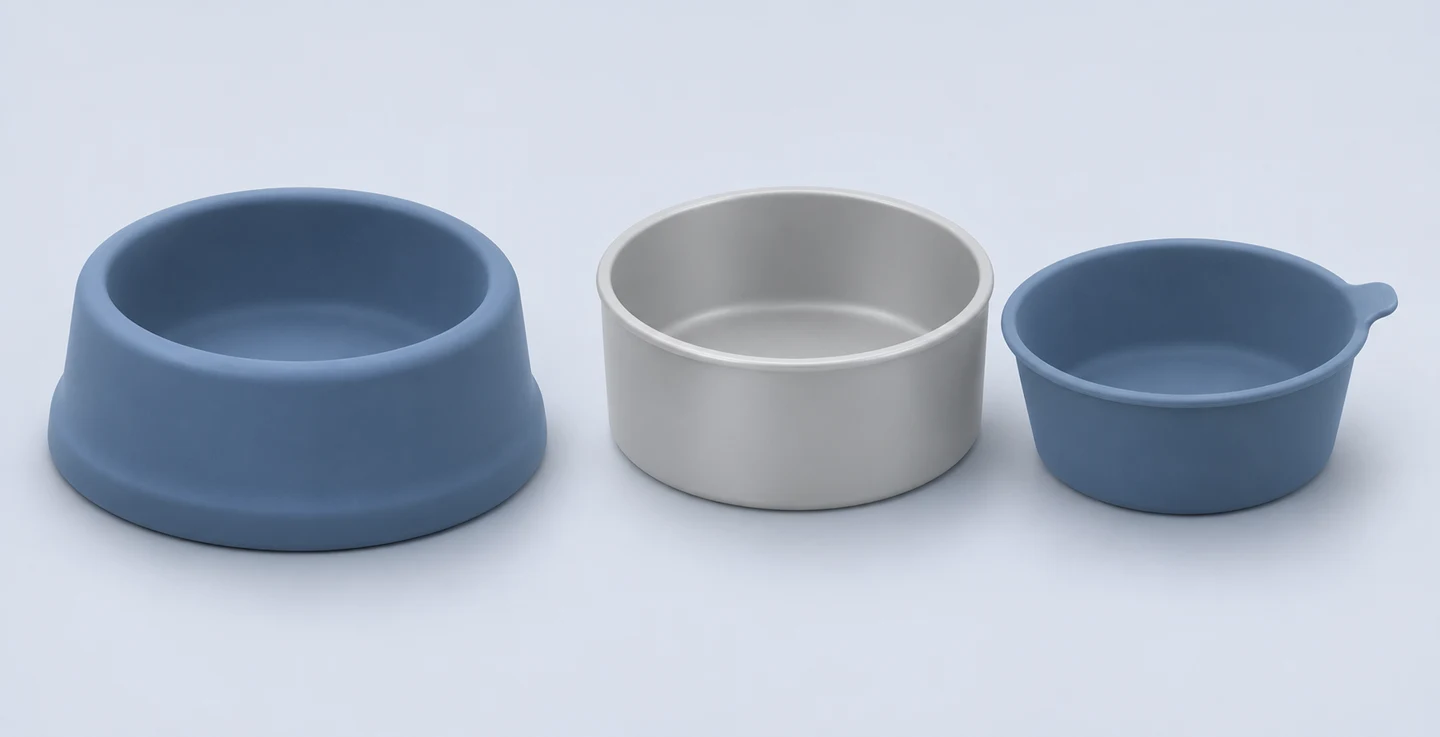
Standalone food and water bowls

A freestanding bowl combines the basin, rim and supporting base in one product. An open interior provides access for filling, emptying and cleaning. A wider opening changes the footprint, while a deeper wall changes the reach to the bottom and the way the filled bowl is lifted.

Define the food or water being held, the useful fill level and the intended placement. Discuss the base against that actual surface and agree how holding and release will be observed.
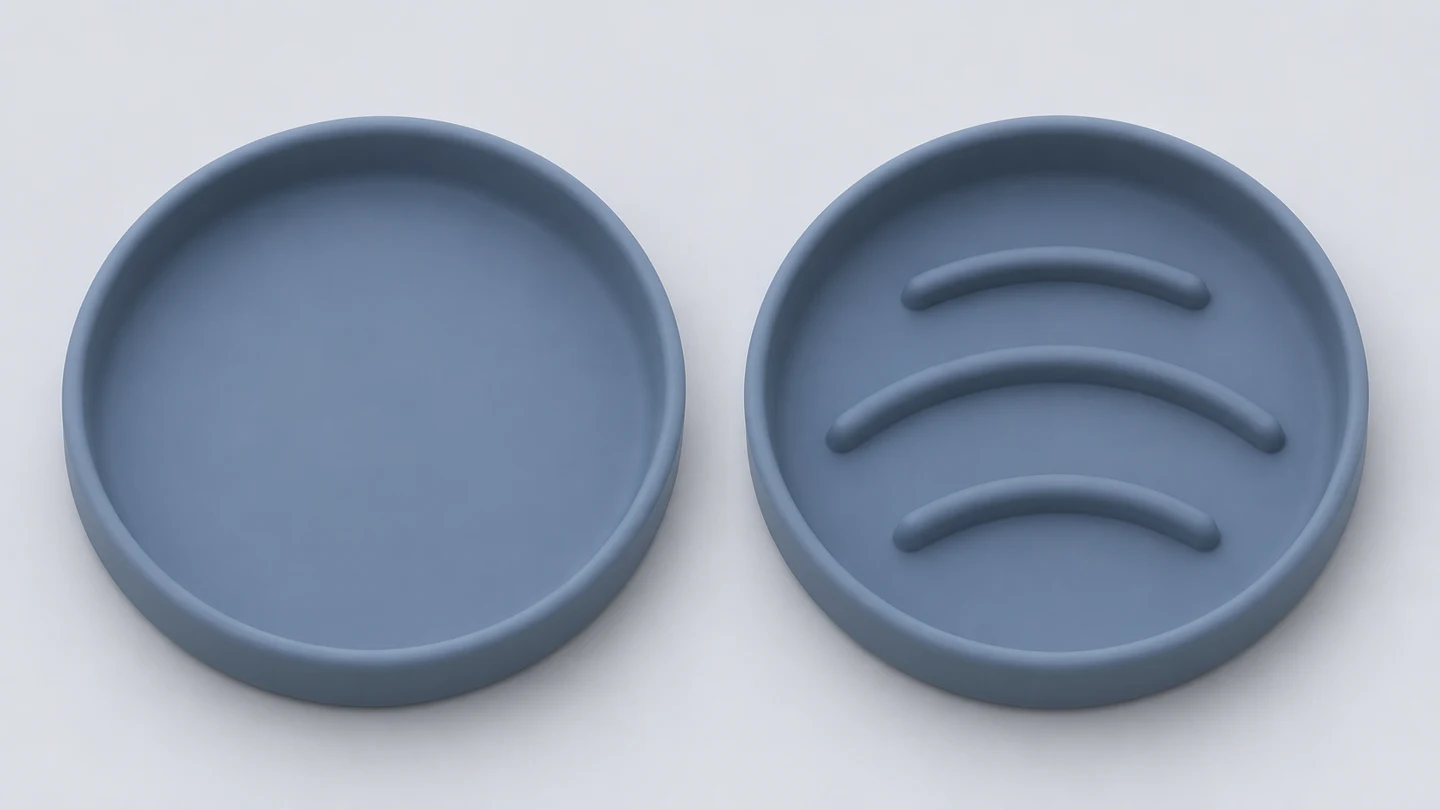
Inserts for existing bowls

An insert adds a food layout inside a separate container. Fit depends on more than the top diameter: internal taper, bottom shape and useful depth affect how it sits. The design also needs a practical place to lift or release the insert.

Provide the actual bowl or a drawing showing its internal profile. Identify any intended retention feature and observe it on that container with molded samples. Use the internal profile as the fit reference, including where nominally similar bowls differ.

Paired bowls and stand-mounted arrangements

A two-bowl arrangement can share a carrier or place two separate bowls within a stand. Decide which parts need independent removal, where the supported rim bears on the stand and whether the bowls must clear each other during lifting.

Use the stand opening, support thickness and available clearance as references. If a project includes a metal, plastic or wooden carrier, agree who supplies it and which interfaces the silicone part must meet. Include the surrounding assembly and its supplier responsibilities in the fit check.

Open and ribbed feeding layouts

Bowls with slow-feeding layouts

Raised ribs, islands or channels divide the food area and change the available approach paths. A pattern suitable for one food consistency may be awkward for another. Compare usable spaces and cleaning access rather than choosing solely by a decorative pattern.

Consider the food size or consistency, the intended animal’s access and how residue is reached during washing. Include rounded transitions and the spaces around features in the design review. Evaluate the intended food-access behavior through the project’s sample review.

Put food layout and cleaning in the same decision

Review the useful basin volume around ribs or inserts, not only the outside dimensions. The project brief should state what food is presented and how it is portioned, removed and washed away. Gaps that admit food also need an accessible cleaning method.

Observe the intended feeding and cleaning actions with a suitable sample. Check where residue remains, whether the insert can be removed as planned and whether a folding wall opens enough for washing and drying. Agree the relevant use instructions and acceptance criteria for the product.

Folding bowls for storage and travel

Folding changes the same vessel from a use shape to a storage shape. Consider the rim, wall transitions and base together: leave space for filling and handling when open, then account for layered walls, projecting features and the stored footprint.

Food layout and folding storage are different design dimensions that may be combined. Define the required combination, then include fill state, carrying position and cleaning actions in drawings and sample observations rather than comparing only the reduced height.

Open · Use state

Open · Use stateExterior concept in its open state. Rim and base widths match the stored view; the sidewall occupies more vertical space. A marks the rim, B the folding wall and C the base.ABC

Stored · Compact state

Stored · Compact stateStored exterior of the same concept. Rim and base retain corresponding widths; a lower layered wall silhouette represents storage, without showing an internal mechanism. A marks the rim, B the folding wall and C the base.ABC
A · Rim
The same rim width in both views.
B · Folding wall
Compare open height and stored wall space.
C · Base
The same base, corresponding to rim and wall.
Open and stored exterior views of one design, with corresponding rim and base widths; not to scale.

Bring both states into the brief

Use space

Provide the open outline, available placement area and intended fill level. Include room for filling, lifting and nearby objects.

Storage space

Show the intended storage location, available length, width and height, and any stacking arrangement. Include the rim, base and projecting features, not just the folded wall.

Carrying and cleaning actions

Describe how the empty or loaded bowl is lifted, moved and set down, and how wall transitions are washed and dried. Observe carrying position and any spill-control requirement on actual samples under agreed conditions.

Combine three design decisions

Container fit, food layout and storage can be considered together.

Design dimensionChoices to compareDefine for the project
Container fitChoices to compareStandalone bowl, insert or stand-supported arrangementDefine for the projectInternal profile, support surfaces and removal access.
Food layoutChoices to compareOpen basin or raised food-access featuresDefine for the projectFood consistency, approach paths and cleaning method.
Folding storageChoices to compareFixed use shape or folding storageDefine for the projectOpen and stored space, plus carrying actions.

Define the silicone part and any supplied components

Material, wall layout and supporting features are reviewed together. For a project with separate inserts or rims, distinguish a mechanically assembled part from a bonded overmolded part. Plastic or metal components used for overmolding are customer-supplied; primer is required, and material, positioning and bonding are reviewed for the project.

Internal mold design is available, with mold machining coordinated externally. Colors and markings are approved on the agreed sample, while the selected material and product-document requirements are confirmed for the intended use. Select the hardness and material documentation for the particular bowl and its intended use.

Four-Step Sample Verification From CAD to Golden Sample

  1. Confirm the geometry

    Compare the drawing or reference with the target bowl, stand and storage space. Where useful, a 3D print can help check an outline or interface; projects with sufficient geometry information need not pass through a compulsory 3D stage.

  2. Observe the molded part

    Review wall behavior, surface, color and the agreed dimensions. Try insertion, release, folding or filling on the actual relevant assembly.

  3. Check the intended use and cleaning

    Record the food, placement surface and washing method, together with holding, leakage and durability results under the agreed test conditions.

  4. Record the approval

    Keep the approved sample and agreed drawing revision, color, supplied-component interface and packaging requirements aligned before the production plan is confirmed.

For eligible projects, free 3D geometry samples are usually 1–3 pieces when requirements are clear, the quotation is confirmed and drawings are clear; shipping is paid by the customer. These prints do not verify silicone feel, flexibility or performance. Molded silicone sample costs are confirmed separately.

Sourcing & Tooling FAQ

Key Answers Before Tooling

Covering CAD readiness, custom MOQ evaluation, free 3D fit checks vs. T1 silicone samples, NDA protection and mold ownership.

Have a part-specific question?

Send your drawing or sample photo directly to Zhou Li’s engineering desk for a 24h DFM reply.

Can one slow-feeder maze pattern be offered as both a standalone bowl and a drop-in insert?

Yes, as two dedicated molds sharing your brand’s maze motif. A standalone bowl needs thickened outer walls and anti-skid or suction base geometry to hold its shape under vigorous feeding, whereas a drop-in insert requires tapered outer drafts, bottom suction or friction seating, and a finger-lift tab matched to your metal or ceramic outer bowl.

Can you combine slow-feeder ridges inside a collapsible travel bowl, or overmold a rigid rim?

Yes. We mold collapsible travel bowls at high volume (~100,000 pcs/month typical capacity) with carefully stepped hinge walls (≥0.5 mm stable HCR) so the bowl folds flat without tearing, and can either snap-fit or silane-primer overmold onto customer-supplied PP, PA, PC or stainless-steel collar rings.

How do you match custom silicone bowls to an existing wood, bamboo or metal elevated feeder stand?

Send your elevated stand’s cutout diameter, deck thickness, corner radii and under-deck clearance (or ship one stand frame). We verify flange bearing stiffness under full water weight and twin-bowl finger clearance on 1–3 free 3D geometry prints and T1 molded silicone samples.

What quality and compliance checks are completed before mass production?

Before 15–30 day mass production, you sign off T1 molded silicone samples for dimensional fit, Shore A durometer, custom Pantone swatch match, dishwasher/rinse access and ~200 °C × 4 h odor-free post-curing, alongside any requested SGS/Intertek/TÜV FDA 21 CFR 177.2600 or LFGB lab testing.

B2B Factory Direct · 24h Engineering & Tooling Review

Custom-Tool Your Pet Bowl or Slow-Feeder SKU

Share your bowl, insert or collapsible travel brief—receive engineering DFM feedback within 24 hours and T1 molded silicone samples in 7–15 days.

✓ NDA available before CAD exchange✓ Eligible for 1–3 free 3D fit prototypes✓ Paid molds 100% owned by customer

Start with these project details

  • The proposed form: standalone bowl, slow-feeding bowl, insert, paired/stand arrangement or folding design.
  • Target animal/use, food or water, working fill level and placement conditions.
  • Drawings or samples of the bowl, stand and supplied parts, including important internal profiles.
  • The folding/storage, release and cleaning actions to check, plus material, color, marking, quantity and document requirements.