
Youbang · B2B Custom Silicone Manufacturing · Dongguan

Custom Silicone
Cooking Utensils

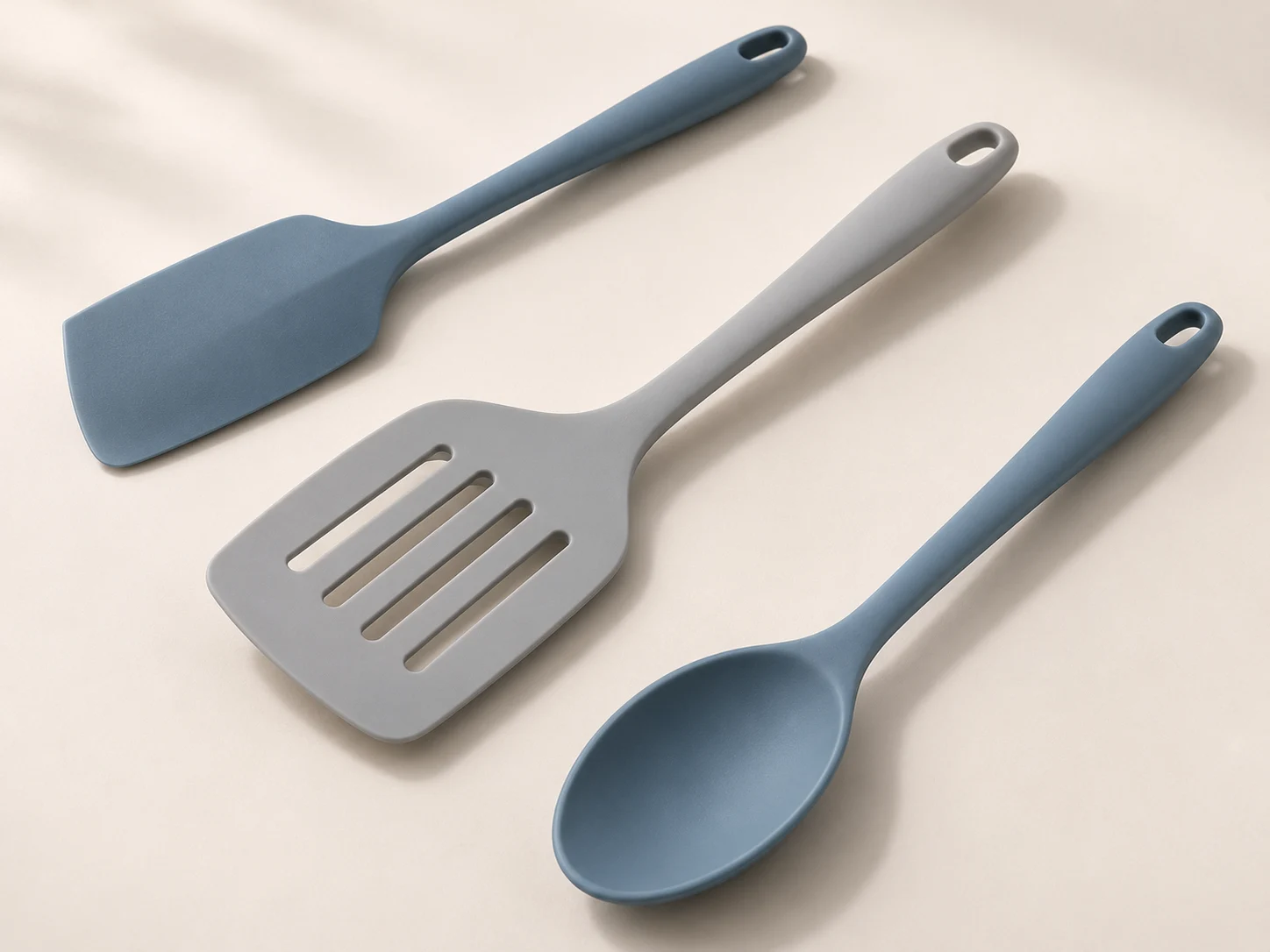
Develop seamless private-label cooking utensil sets—spatulas, slotted turners, deep soup ladles, pasta servers and basting brushes—molded in platinum-cured silicone over customer-supplied stainless steel or PA cores with silane primer, custom Pantone matching and ~200 °C × 4 h post-curing.

Youbang Silicone

CONTACT & LIFT

Engineer Working-Edge Taper & Neck Stiffness Around Cookware

A bowl scraper relies on a thin feathered tip to wipe cleanly, whereas a turner requires rigid internal spine support to slide beneath heavy food without folding.

Scraping & mixing

Choose the edge to reach the bowl wall, base or narrow opening without making the whole head equally flexible.

Tray and closure relationshipRelationship only, not to scale; dimensions confirmed per project CAD.
Broad curved edge / Narrow jar head · Outline schematic
Spatulas & scrapers
A long straight edge sweeps broad surfaces; a curved corner follows a bowl. The head width also sets how much mixture it moves in one pass.
Spoonulas
A shallow concave head combines scraping with carrying a small portion, trading a fully flat face for a scooping surface.
Jar spatulas
A narrow head and longer reach help access jar shoulders and corners. Check the opening and the load at the neck together.

Design trade-off · A thinner working edge can follow a curve while a supported center carries the mixture. Confirm contact and recovery on silicone samples.
Turning & lifting

The leading edge enters below food; the plate then needs enough support for the intended portion.

Tray and closure relationshipRelationship only, not to scale; dimensions confirmed per project CAD.
Solid / Slotted head · Outline schematic
Solid turners
A continuous plate supports small pieces and broad food surfaces. Define the front-edge profile and the transition into the neck.
Slotted turners
Slots let liquid pass through but remove supporting area. Their ends and spacing also affect access for cleaning.
Perforated skimmers
A cupped or broad perforated head separates food from cooking liquid. It is selected for lifting and draining rather than sliding beneath a flat item.

Design trade-off · Balance a thin entry edge, plate stiffness and hole area against the intended food and vessel. Evaluate surface contact under the specified use conditions.

PORTION & COAT

Size Ladle Capacity, Pour Lips & Brush Bristles by Task

Deep ladle leverage, drip-free pour spouts and bristle root spacing govern real kitchen usability and dishwasher hygiene—designed per head while maintaining uniform handle styling across your set.

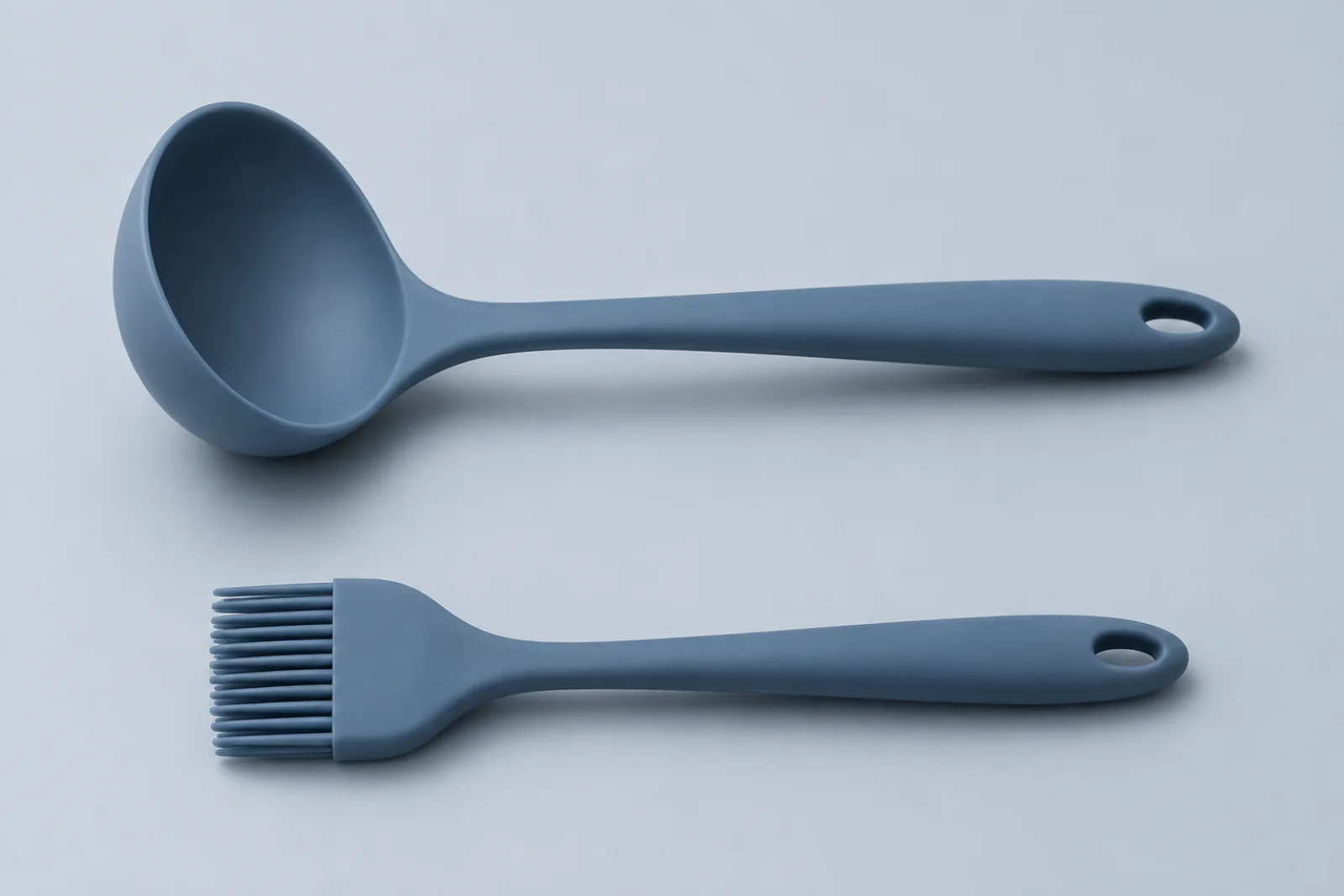
Ladle and silicone-bristle brush

Serving & portioning

The bowl shape determines whether a tool stirs, carries liquid or separates solids.

Cooking & serving spoons
A shallower bowl is easy to stir with; a deeper bowl carries more liquid. Match the neck and handle leverage to the portion.
Slotted spoons & ladles
Slots release liquid while a deep ladle retains it. A pouring lip can guide transfer, but its shape must work with the actual vessel.
Pasta servers
Spaced teeth gather strands while openings drain liquid. Tooth spacing, rounded tips and cleaning access belong in the same review.

Design trade-off · Increasing bowl depth changes both capacity and leverage. Review the filled head, neck support and pouring motion rather than capacity alone.

Brushing & combined tools

A brush applies a coating through multiple contact fingers. Combined tools add interfaces that need their own component and cleaning decisions.

Basting & pastry brushes
Shorter fingers offer a different contact pattern from longer flexible fingers. Define coating viscosity, reach and the gaps needed for rinsing.
Tong tips & whisk coatings
Silicone contact sections are part of a larger assembly. The metal mechanism or wire body, component supply and joining interface need separate review.
Reservoir-brush combinations
A reservoir adds a flow path and separable cleaning surfaces. Treat the bottle, connection and brush as a component system, not a brush-head color option.

Design trade-off · More closely spaced fingers can change coating contact and rinsing access. Compare the actual coating and cleaning method on a sample.

Choose Your Utensil Core & Assembly Architecture

Compare seamless all-silicone molding, silane-primer overmolding over customer-supplied rigid cores, and two-piece handle assemblies before cutting tooling.

All-silicone, without a rigid core

Tool support and joint schematicRelationship only, not to scale; dimensions confirmed per project CAD.
Structural schematic · Not to scale

Section thickness and geometry provide the support. A flexible edge and a thicker neck can serve different roles within the same piece.

Define · Working load, edge contact and acceptable bending.

Silicone around a supplied rigid core

Tool support and joint schematicRelationship only, not to scale; dimensions confirmed per project CAD.
Structural schematic · Not to scale

Customer-supplied stainless steel, aluminum, PC, PP or PA cores provide rigid leverage while silane-primer overmolding creates a hygienic seamless silicone skin.

Define · The insert drawing or sample, supplied material and keep-clear areas.

Separate head & handle

Tool support and joint schematicRelationship only, not to scale; dimensions confirmed per project CAD.
Structural schematic · Not to scale

Separate components create an assembly joint. Define removal, retention and cleaning access instead of assuming a joint is permanently sealed.

Define · Both component interfaces, assembly method and cleaning routine.

Coordinate a Multi-Piece Retail Utensil Set

Unify handle ergonomics, mold-in EDM matte finish and custom Pantone colors across 5-piece or 10-piece sets while tailoring each tool’s core insert and blade thickness.

  1. List each tool and its purpose

    Separate the required working heads from optional additions. Include the food and vessel each item serves.

  2. Coordinate size and grip

    Agree reach, storage space, hanging features and visual proportions across the set.

  3. Define color, marks and packaging

    Specify color references, mold marks and whether tools are packed individually or as a set. Packaging supply and quantities are confirmed by project.

Validate Flex, Core Retention & Hygiene on T1 Samples

Pair every T1 molded sample check with your target non-stick pan curvature, portion load and dishwasher cycle so tooling sign-off is objective.

Working-edge contact

Observe how the edge follows the intended surface and whether corners can be reached with the normal hand motion.

Handle and neck loading

Use the intended portion to check bending, handling and recovery, with acceptance criteria agreed for the project.

Cleaning access

Inspect joints, slots and brush gaps with the intended cleaning method, including drying and reassembly where relevant.

Appearance after agreed use

Compare appearance and dimensions after the specified use and cleaning conditions rather than relying on a universal durability claim.

Validate blade flex, core positioning, flash lines and oil/stain cleanup on 7–15 day T1 molded silicone samples. Eligible projects can request 1–3 free 3D-printed handle/head prototypes first (with clear brief, confirmed quote & CAD; buyer pays shipping) to check ergonomics and crock storage fit.

Sourcing & Tooling FAQ

Key Answers Before Tooling

Covering CAD readiness, custom MOQ evaluation, free 3D fit checks vs. T1 silicone samples, NDA protection and mold ownership.

Have a part-specific question?

Send your drawing or sample photo directly to Zhou Li’s engineering desk for a 24h DFM reply.

Can we launch a 5-piece or 10-piece utensil set with custom Pantone colors and gift-box packaging?

Yes. Our two in-house open-mill compounders match custom Pantone swatches across every tool in your set, while we engineer individual molds and core inserts per utensil and coordinate retail color boxes, utensil crocks or drawstring pouches with Dongguan packaging partners.

How does insert overmolding work for stainless-steel or nylon-core utensils?

Rigid inserts (stainless steel, aluminum, copper, PA, PP or PC) are customer-supplied and treated with silane primer before HCR compression or LSR injection overmolding. During DFM we review locating pins and flow balance so high-stress necks stay centered without core show-through.

How do you handle FDA and LFGB compliance for high-heat cooking tools?

We mold cooking utensils from platinum-cured food-contact silicone post-cured in ventilated ovens at ~200 °C × 4 hours to achieve ≤0.5% volatile weight loss for LFGB and odor-free use, and coordinate finished-part FDA 21 CFR 177.2600 or LFGB testing via SGS, Intertek or TÜV (~10 days).

B2B Factory Direct · 24h Engineering & Tooling Review

Scope Your Custom Silicone Utensil Range

Share your SKU list, 2D/3D CAD or reference tools, core insert details, target markets and estimated quantities—receive engineering DFM feedback within 24 hours.

✓ NDA available before CAD exchange✓ Eligible for 1–3 free 3D fit prototypes✓ Paid molds 100% owned by customer

Direct Dongguan Engineering Desk

  • Accepts STEP / IGES / PDF / DWG or sample photos
  • New mold T1 typically 7–15 days · Mass run 15–30 days
  • Direct Tel / WeChat: +86 185 6655 6911 (Zhou Li)