
Youbang · B2B Custom Silicone Manufacturing · Dongguan

Custom Silicone Baby Teethers & Fresh-Food Feeders

Manufacture custom one-piece baby teethers and perforated fresh-food feeder pouches on our 85T & 120T LSR injection molding machines and 200–250T HCR presses—combining clean flash control, thin-wall precision down to 0.25–0.30 mm, mold-in EDM matte finishes, ventilated ~200 °C × 4 h post-curing, and enclosed clean-zone inspection & packing.

Ring, flat-grip and sculpted handheld forms

Handheld Teethers: Engineer Grip Thickness, Gum Textures & Parting Lines

Beyond cute front silhouettes, oral-contact teethers demand smooth parting-line placement, tear-resistant neck transitions, mold-in EDM matte surfaces (zero sprayed coatings) and open rinse geometry.

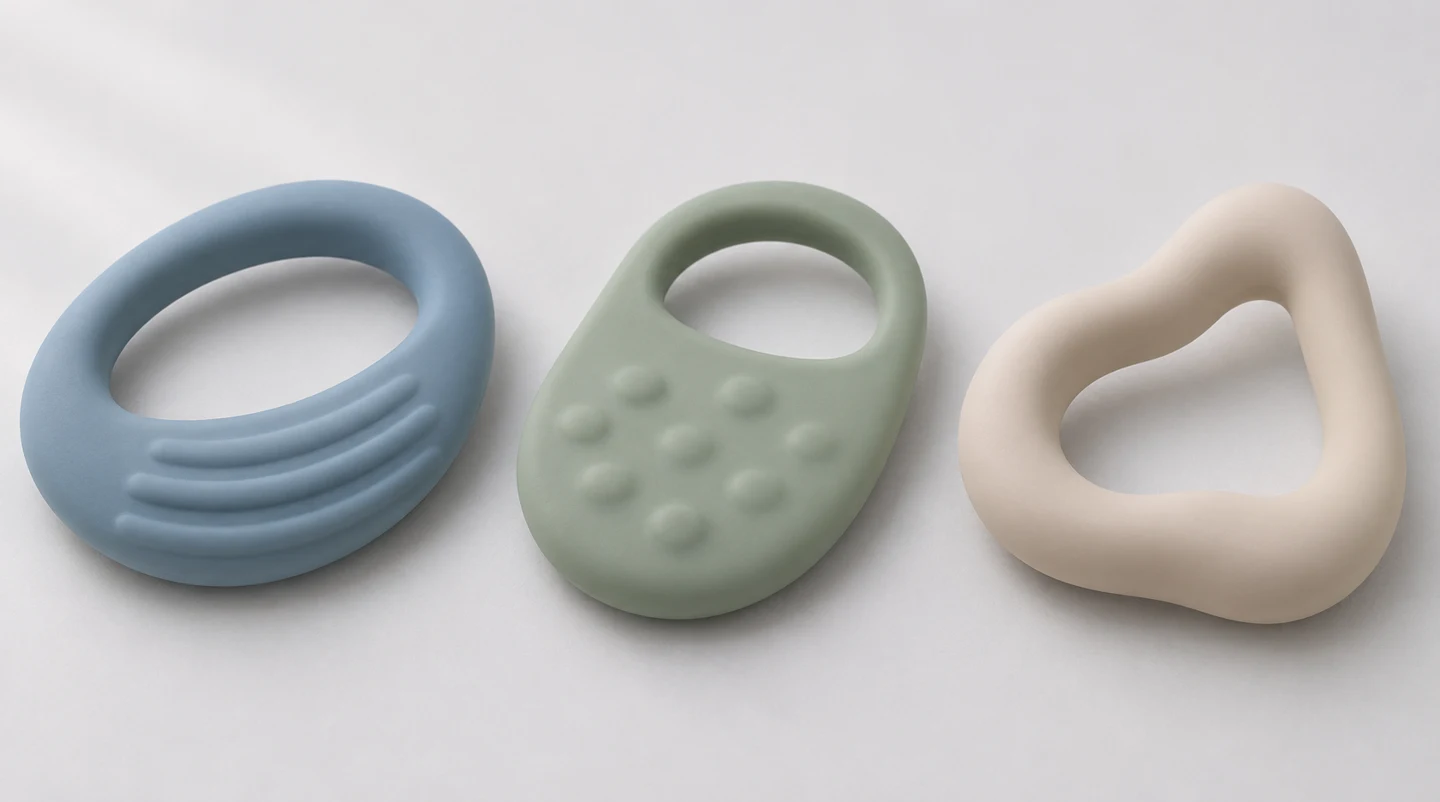
Ring form

An open center offers a continuous grasping route and several possible hand positions. The opening, surrounding section and the transition into any surface feature belong in the same drawing.

Show the grasping zone, opening shape and intended contact areas. Compare access around the inner curve and any rib intersections during cleaning.
Flat form with a defined grip

A flatter outline separates a broad contact shape from a visibly defined grasping area. Width, edge profile and local thickness change how the part is supported and handled.

Provide the silhouette and side profile, not just a face illustration. Compare the way the grip meets the broader part and the access to raised surface details.

One-piece three-dimensional form

A raised or sculpted body adds depth and transitions that are not visible in a front outline alone. A simple grip can be combined with different contact geometries, without introducing separate assembled pieces.

Include side views and the connection transitions. Observe the molded shape, surface junctions and drying access rather than selecting by a character outline alone.

Surface ribs or bumps are design features to describe by shape and location. Select their geometry alongside cleaning access; their appearance is not a basis for a health or comfort claim.

Fresh-Food Pouch Feeders: Precision LSR Perforations & Locking Flanges

A silicone feeder sac works inside a multi-piece locking handle—requiring burr-free juice apertures, ±0.05 mm critical collar seating and intuitive parent disassembly for boiling or dishwasher sterilization.

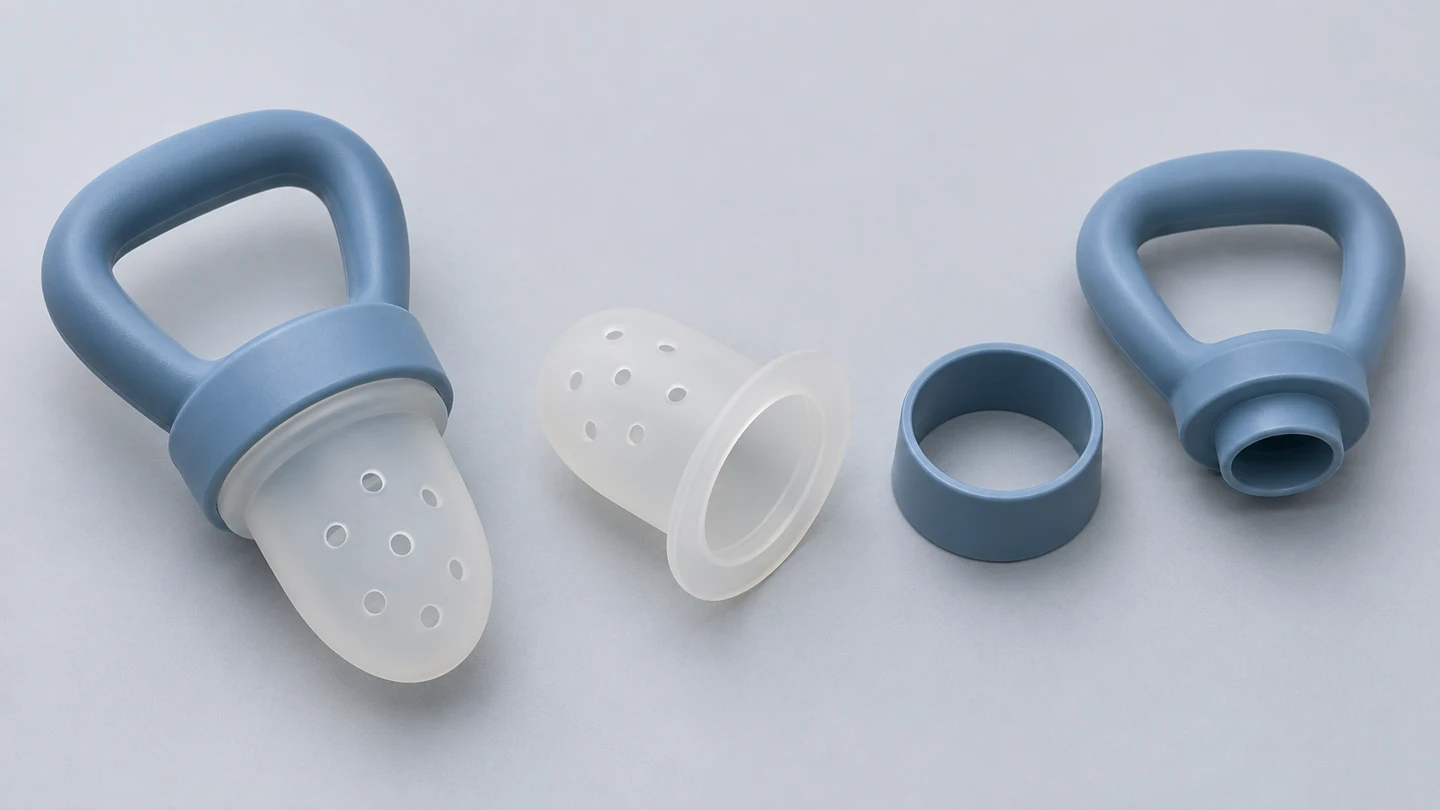
Food-feeder exterior and component study

Turn the visible parts into interface information

A · Pouch mouth and flange
Provide a drawing or reference of the mouth outline, flange and seating location.
B · Separate ring
Identify its intended role, mating component and supplier.
C · Handle coupling end
Provide the mating-end drawing, closed position and pouch-removal direction.

Pouch and perforated area

Describe the internal volume, flexible wall and distribution of openings separately from the handle. Opening shape and distribution affect how the selected food state interacts with the pouch and how residues can be reached.

Provide the intended food consistency or particle state, loading action and cleaning tools for comparison. Define opening geometry in the drawing rather than using one hole specification for every project.

Pouch mouth and handle interface

The mouth or flange has to locate in the matching assembly. The seating region, retaining component and closed position should be described with the actual mating parts, including the clearance needed to assemble and remove them.

Identify each component and its supplier. Supply the mating-part drawing or reference assembly, and record the intended closing and opening sequence.

Loading, cleaning and reassembly

The opening used to add food, the route for removing the pouch and the surfaces exposed after separation are different parts of the task. A cover also needs a defined role and storage position, if one is included.

Map the sequence from loading to emptying, washing, drying and reassembly. Check pouch-mouth folds, wall junctions and access around the retaining interface with the proposed cleaning method.

List silicone parts, rigid parts and any cover in the component brief. Agree supply and assembly responsibilities. If the selected design uses overmolding rather than a separate mechanical assembly, plastic or metal inserts are customer supplied and require primer; material, positioning and the bonding plan are reviewed together.

Before tooling: make the decisions visible

  1. One controlled drawing set

    Bring the selected shape, contact and grip areas, transitions, pouch openings and mating interfaces into the relevant drawing revisions. Add marking positions and a component/supplier list. Youbang designs molds internally; mold machining is outsourced.

  2. A prototype for the question

    An optional 3D print may help inspect geometry or assembly relationships. Treat it as an engineering reference, not an oral-use sample. Molded silicone is needed to examine the chosen material, surface and flexible behavior under the agreed evaluation plan.

  3. Part, assembly and document approval

    Review molded parts and the complete assembly with the defined observations, including separation, reassembly and cleaning access. Confirm the selected material and available documents, intended use and sales markets, and the applicable finished-product checks before approving production.

The project defines the appropriate evaluation and test scope. Engineering concepts and geometric prototypes are not intended for child use or a demonstration of product safety.

Sourcing & Tooling FAQ

Key Answers Before Tooling

Covering CAD readiness, custom MOQ evaluation, free 3D fit checks vs. T1 silicone samples, NDA protection and mold ownership.

Have a part-specific question?

Send your drawing or sample photo directly to Zhou Li’s engineering desk for a 24h DFM reply.

Should we choose LSR injection molding or HCR compression molding for teethers and feeder sacs?

Perforated fresh-food feeder pouches with fine juice holes, thin walls (0.25–0.30 mm) and tight ±0.05 mm locking flanges are best suited to our 85T & 120T LSR injection molding machines for clean flash control. Solid sculpted handheld teethers in custom opaque or pastel Pantone shades can run economically on either LSR or our 200–250T HCR presses.

How do you convert a 2D character illustration into a safe, moldable 3D teether?

Send your 2D artwork or 3D sculpt—our in-house mold design team reviews cross-sectional neck thickness, relocates parting lines away from primary gum-contact ridges, rounds deep crevices for hygiene, and applies mold-in EDM matte texturing rather than topical coatings.

Who supplies the PP/tritan locking handle, collar ring and dust cap on a food feeder?

Share your full BOM so we align component sourcing early. You can supply existing rigid plastic handles/caps for precision LSR pouch matching, or coordinate assembly responsibilities in our 150–200 m² enclosed clean washing, inspection and double-PE bag packing zone. Any overmolded rigid insert requires customer-supplied PC, PP, PA or metal parts with silane primer.

Can a 3D-printed prototype be used for mouthing tests, and what lab reports apply?

Never give a 3D-printed engineering prototype to a child—it checks geometry and handle snap-fit only. Oral-contact feel, tear behavior and compliance are verified on post-cured (~200 °C × 4 h) platinum-cured T1 silicone samples, with EN71, EN14350, CPSIA, FDA 21 CFR 177.2600 or LFGB testing coordinated via SGS, Intertek or TÜV (~10 days).

B2B Factory Direct · 24h Engineering & Tooling Review

Engineer Your Custom Teether or Fresh-Food Feeder

Send your 2D/3D teether sculpt or feeder assembly CAD, target markets and estimated order quantities—receive DFM and LSR/HCR process recommendations within 24 hours.

✓ NDA available before CAD exchange✓ Eligible for 1–3 free 3D fit prototypes✓ Paid molds 100% owned by customer

Helpful RFQ Inputs

  • Product task, grip/contact or feeding sequence
  • Drawings, surface details and mating components
  • Material, color and intended market requirements
  • Quantities, component supply and packaging