
Youbang · B2B Custom Silicone Manufacturing · Dongguan

Custom Baby Silicone Feeding Tableware & Suction Sets

Engineer private-label baby suction bowls, divided toddler plates, overmolded training spoons and high-chair placemats—molded in odorless platinum-cured silicone (~200 °C × 4 h post-cured for ≤0.5% LFGB volatiles) with scoop-friendly inner curves, concealed parent release tabs and in-house Pantone matching.

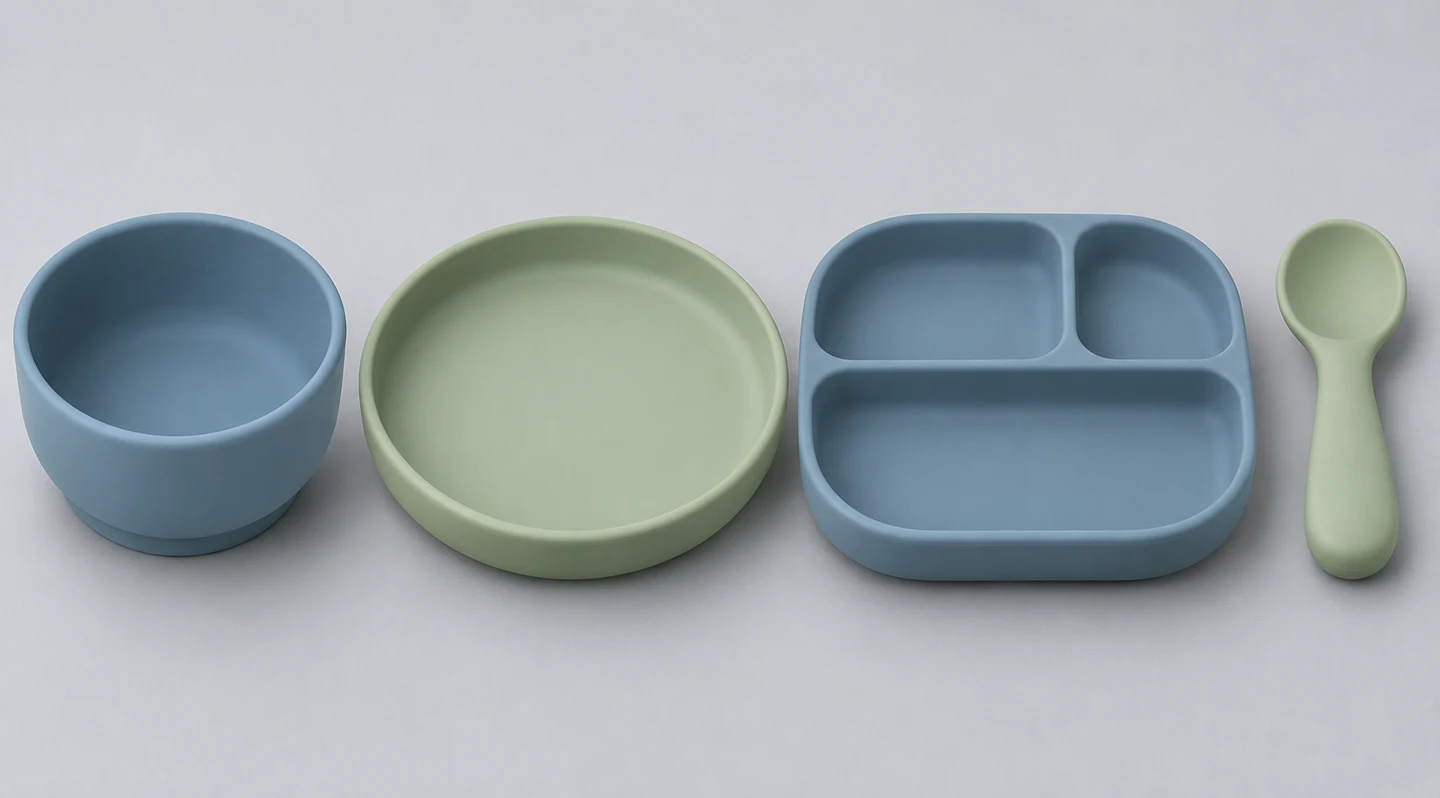
Deep bowl, open plate, divided plate and spoon

Engineer Scoop Curves, Divider Corners & Utensil Cores

Bowls: depth, opening and the scoop path

A deeper bowl concentrates food in a smaller footprint. Its wall angle and opening affect how a spoon reaches the bottom and how the bowl is held. An inward edge may change the scooping path, so show the intended spoon movement rather than specifying a lip in isolation.

Compare usable interior height, support at the base, rim access and available hand space when the bowl is filled. Provide the target serving arrangement and tray footprint; capacity and exterior size should be resolved together.
Open and divided plates: shared area or separate portions

An open plate gives a continuous serving surface. Dividers separate areas but add wall junctions and corners that must remain reachable for scooping and cleaning. The height and arrangement of partitions matter as much as their number.

Look at the footprint with food in place and the way the plate is lifted. A lid is a separate mating component: confirm the rim relationship, removal action and intended storage or carrying conditions.

Spoons and forks: contact end and supporting handle

The working end, handle and their transition should be described separately. A flexible contact end and a supported handle answer different handling questions; choose their balance with the actual food and intended grip.

If the design combines silicone with another component, define the supplied insert, covered areas and assembly checks. For overmolding, plastic or metal inserts are customer supplied and require primer; the selected construction is assessed before tooling.

Placemats: the surrounding area

A separate mat covers space around the vessels and may be removed on its own. A form that incorporates a food vessel changes the lifting, cleaning and packing task. Decide whether the project needs a separate surface or an integrated object.

Check the usable table area, edge relationship and the way the mat is lifted with residues on it. This is a feeding-surface choice, distinct from a countertop drying mat or a general household work mat.

Check the usable table or tray area

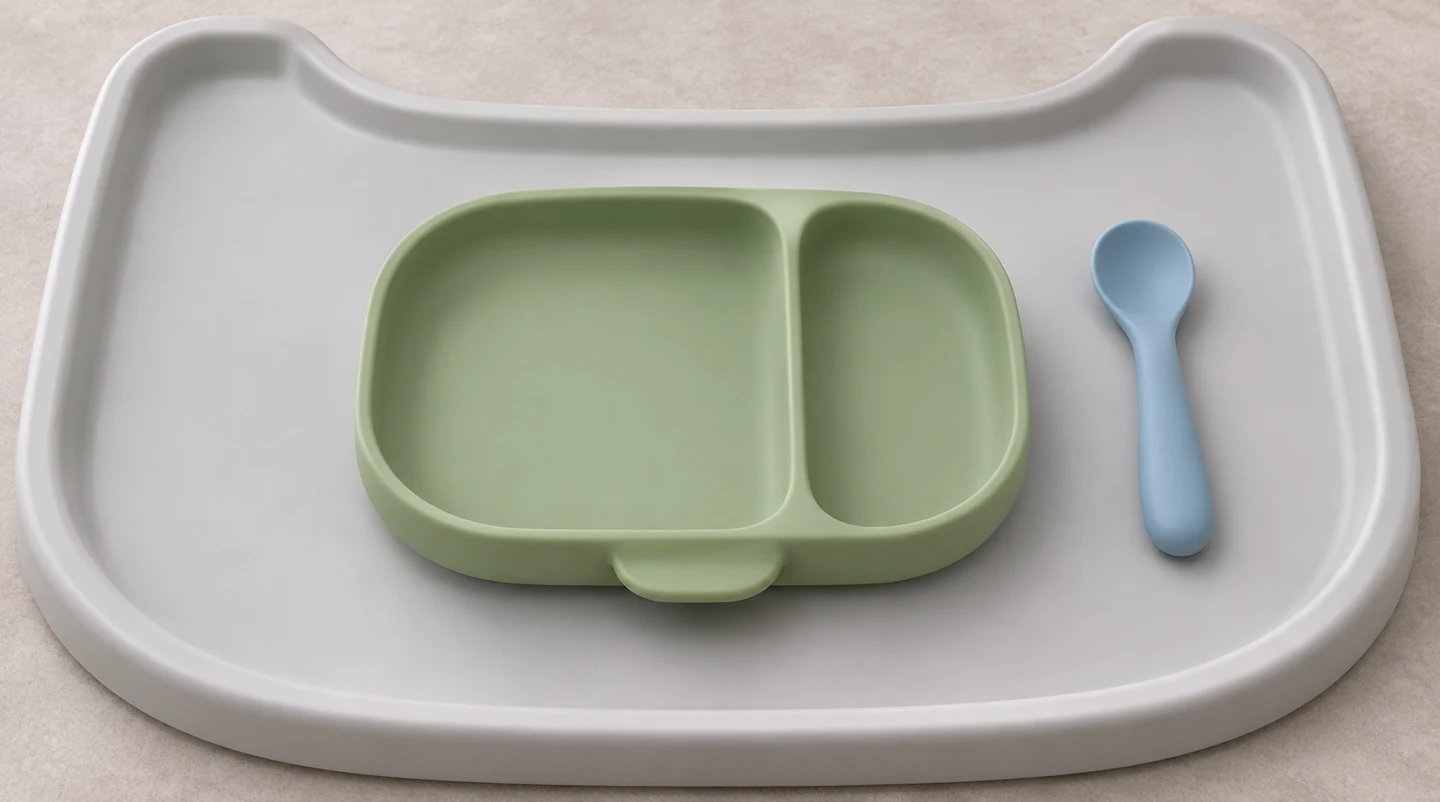
Plate and spoon within a tray

Placement and clearance

The outside tray dimensions do not define its usable flat area. Provide that area, raised edges, nearby openings and hand space. A reference photo with a drawing is more useful than a chair name alone. Compare the vessel footprint in its intended position.

A resting base or a specified attachment surface

The vessel outline does not establish its actual underside contact area. A resting base and an attachment feature are options that can accompany different vessel shapes. If suction is selected, record the actual surface finish, cleanliness, wet or dry condition and placement action for sample comparison.

Removal is part of the design

Locate the release feature where the intended adult can reach it without conflicting with a tray edge or adjacent item. Observe placement and release on the target surface, then lifting and cleaning; record the agreed conditions and results.

Show contact and access in the brief

Bottom contact to define

Bottom contact to defineAbstract underside information area. A is the vessel footprint; B marks contact information to define, not a suction cup, support ring or an engineered base.AB
A · Vessel footprint
Provide the underside outline and the usable area of the actual placement surface.
B · Contact information area
Resting support: Identify where the vessel should be supported.
Attachment option: Provide the proposed area, target surface texture and wet or dry conditions; the structure remains to be defined.

Proposed adult access and clearance

Proposed adult access and clearanceIndependent top-view space concept. C identifies a tray rim and nearby object; D marks a proposed adult access location and adjacent clearance. No force or validated release action is shown.CCD
C · Rim and nearby objects
Provide rim height, neighboring footprints and anything that could obstruct access.
D · Proposed access area
Mark the intended adult approach and removal direction, allowing hand space. Check clearance against the actual tray or table arrangement.
Underside contact area and tray access space, not to scale. Dashed areas mark contact information or clearance to define.

Bring the pieces together as a usable set

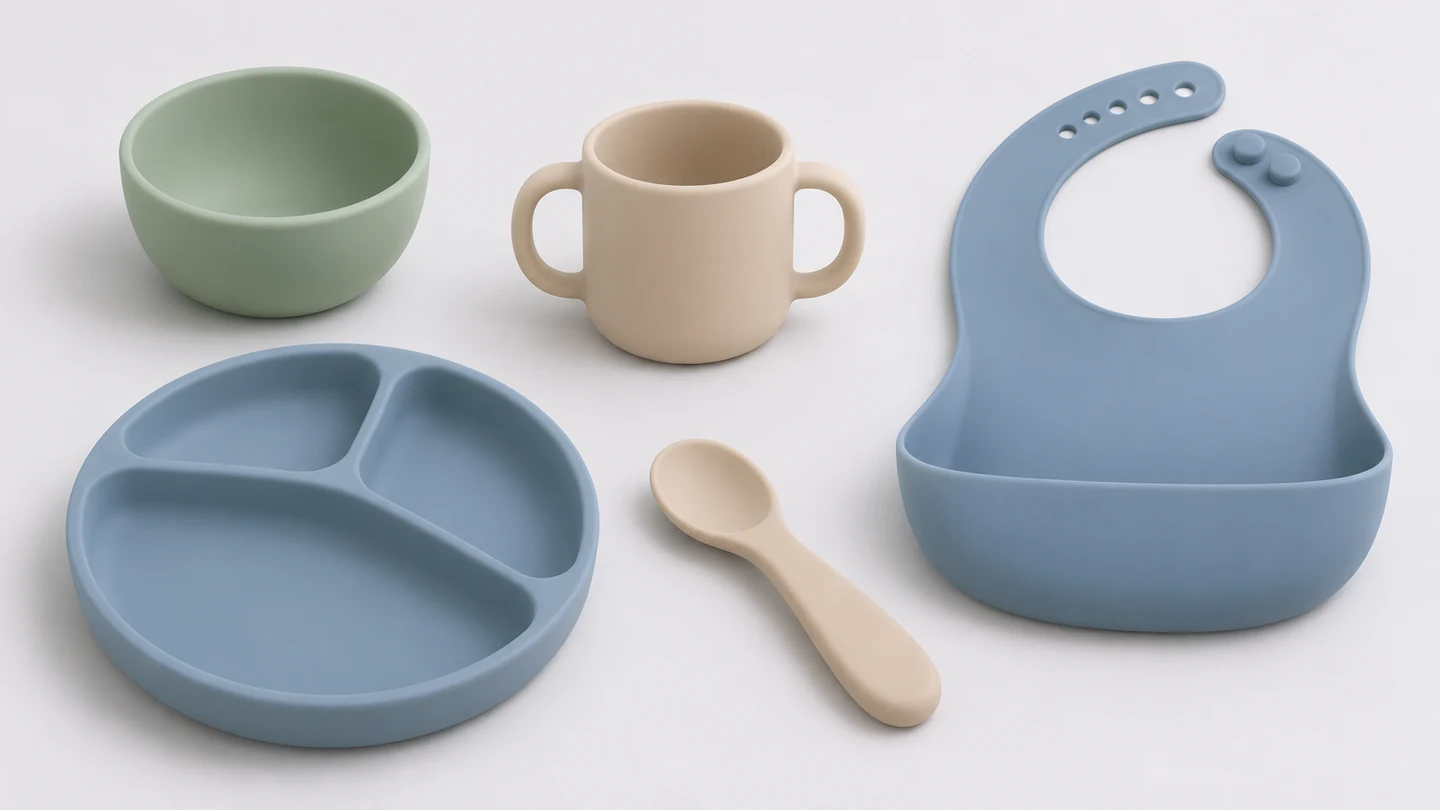
A set is a selection of objects, not another bowl or plate structure. Create a component list with quantities per individual item and per packed set. Add a bib, cup or storage piece where it serves the intended routine, and assign responsibility for packing and instructions. Keep their separate component and document requirements visible.

Compare the selected colors on actual parts under agreed viewing conditions. Check the sizes together, nesting or separation in packaging, and access when unpacking. Printed or molded markings need an agreed location, legibility and contact-use review.

Plate, bowl, spoon, open cup and bib

Turn the selected design into a clear sample plan

  1. Resolve the drawing relationships

    Bring the vessel outline, partitions, base, release feature and any lid or insert into one drawing revision. Record the target tray and intended handling actions. Mold design is internal; mold machining is outsourced.

  2. Choose the sample that answers the question

    Use a 3D print only if shape, size or assembly needs an early check. Use molded silicone to assess the chosen material, color, surface and the actual placement, scooping and lifting actions.

  3. Observe use, cleaning and the complete set

    Compare filled handling, access around partitions, release on the specified surface, and washing and drying access. Include mating components and packaging where they affect the project. Agree the conditions and record the observations.

  4. Approve the part and its project documents

    Confirm material identification, color references, drawing revision and the applicable finished-product checks for the intended use and sales market. Match available material documents to the selected grade and keep sample approval records.

Sample route, costs and timing are agreed for the project. An optional 3D print does not establish attachment, flexible behavior or product safety.

Sourcing & Tooling FAQ

Key Answers Before Tooling

Covering CAD readiness, custom MOQ evaluation, free 3D fit checks vs. T1 silicone samples, NDA protection and mold ownership.

Have a part-specific question?

Send your drawing or sample photo directly to Zhou Li’s engineering desk for a 24h DFM reply.

How do you engineer suction bases that hold on high-chair trays yet release cleanly for parents?

Suction performance depends on skirt lip taper, Shore A durometer, flat tray clearance and surface finish (gloss plastic vs. textured wood). We mold smooth high-contact suction skirts with discreet parent-side release tabs angled away from toddler reach, and benchmark hold-and-peel performance directly on 7–15 day T1 silicone samples.

What makes a divided toddler plate easy to scoop and dishwasher-friendly?

Tight vertical corners trap puree and frustrate self-feeding. During in-house mold design, we radius partition intersections to match your training spoon curvature, thicken outer rims so filled plates carry without flopping, and apply mold-in EDM matte finishes outside while keeping food wells easy to rinse.

Can you overmold baby spoons and forks onto stainless steel or PP/PA cores, plus add snap lids?

Yes. Rigid spoon/fork cores (customer-supplied stainless steel, PP, PA or PC) are treated with silane primer and overmolded in soft platinum-cured silicone to protect gums while keeping handles supportive. Companion storage lids are engineered with dedicated rim interference checks on T1 samples.

How do you verify odorless FDA, LFGB, EN14350 & CPSIA compliance for baby tableware?

Every batch uses platinum-cured food-contact silicone followed by ~200 °C × 4 h ventilated secondary post-curing so volatile weight loss stays ≤0.5% with zero soapy aftertaste. We provide batch CoA records and coordinate order-specific FDA 21 CFR 177.2600, LFGB, EN71/EN14350 or CPSIA lab reports via SGS, Intertek or TÜV (~10 days).

B2B Factory Direct · 24h Engineering & Tooling Review

Custom-Tool Your Baby Feeding Tableware Set

Share your bowl, plate, utensil and lid drawings or reference samples, high-chair tray footprint and target markets—receive DFM feedback within 24 hours.

✓ NDA available before CAD exchange✓ Eligible for 1–3 free 3D fit prototypes✓ Paid molds 100% owned by customer

Helpful RFQ Inputs

  • Selected forms and intended serving routine
  • Tray drawing, surfaces and removal access
  • Material, color and document requirements
  • Set quantities, mating parts and packaging