
Youbang · B2B Custom Silicone Manufacturing · Dongguan

Custom Silicone Soap Molds & Loaf Box Liners

Engineer private-label multi-bar soap trays and precision-fitted heavy-wall loaf liners for wooden or acrylic mold boxes—molded on our 200–250T HCR presses up to 650×650 mm with reverse-checked brand logo imprints, smooth corner release and compound evaluation for cold-process alkali and fragrance oils.

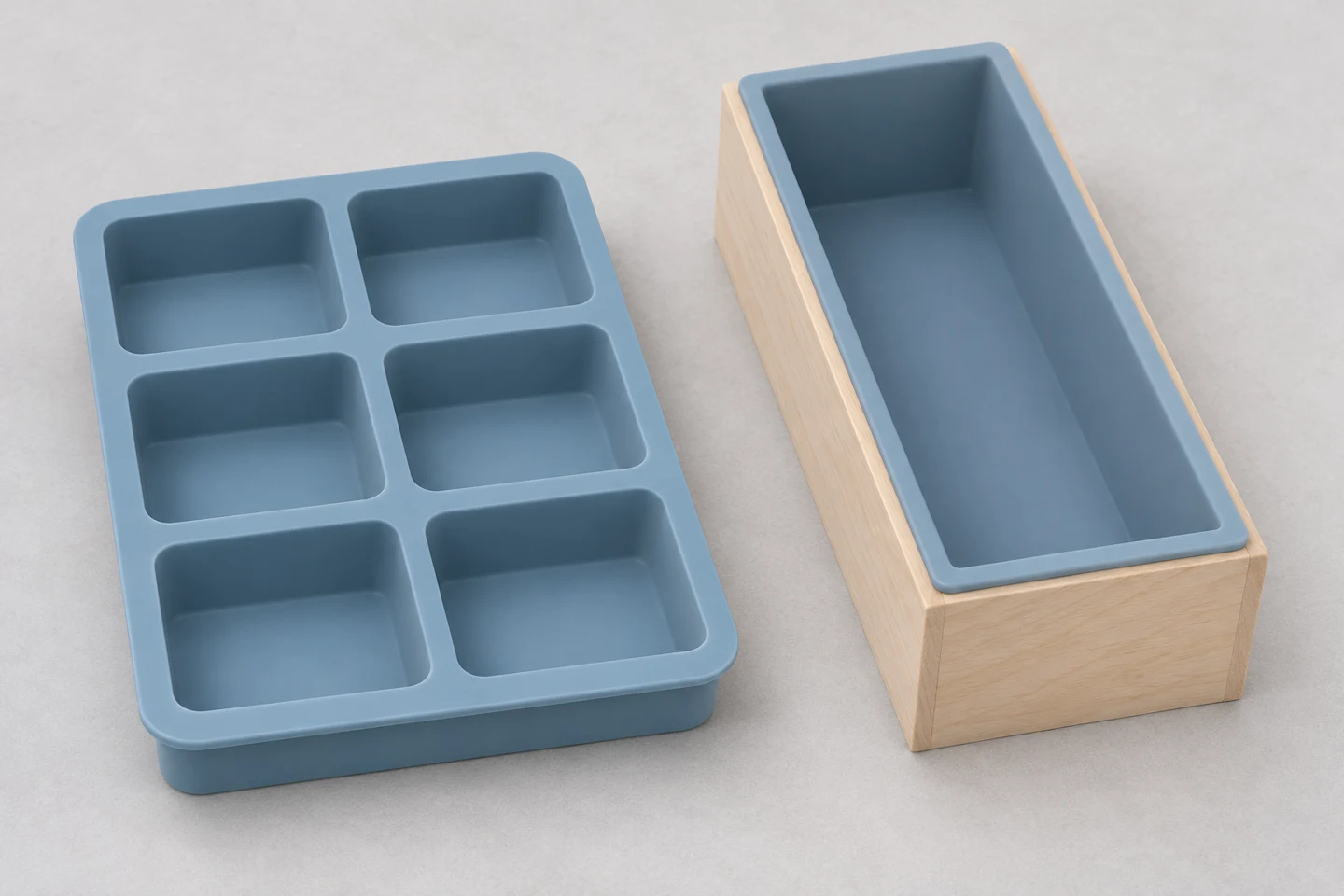
Individual bar cavities and a loaf liner seated in an external support box

Individual bar cavities

A single cavity forms one bar; a tray repeats several bars while keeping them in a shared layout. Outline, depth and relief determine the form, while space between cavities affects filling access and later cleaning.

For cold-process or melt-and-pour soap, describe the actual formulation and state at filling and removal, and how each bar is approached. A shallow relief face and a deep shaped cavity bring different release and cleanup tasks.

Soap loaf molds and liners

A long liner forms a larger block rather than separate finished bars. Its internal profile and supported working shape should be considered alongside the desired block and later cut arrangement.

Decide how the liner and block leave the support before discussing cutting. The mold, supporting box and any cutting fixture are separate components with their own drawings and supply responsibilities.

Match the liner to its support

Internal box profile

The box’s inside length, width, depth and corner shape define where the liner can sit. The liner rim and any removal space must be included.

Provide an internal-profile drawing or the actual box, not only outside dimensions.

Filling and lifting

State how the liner is placed, where the filled assembly rests and how it is lifted out. Include nearby surfaces and access to the rim.

Show the fill state, contact/support areas and intended handling sequence.

Supply and assembly

A wooden or rigid outer box shown alongside a liner is an external support option; specify upfront whether the box is customer-supplied or sourced separately.

Identify who supplies the box, liner and any cutting fixture, and who checks the assembled fit.

Specify the effect on the soap, then the mold face

A raised mark on the finished bar calls for the corresponding recessed mold feature; a recessed result calls for the opposite relationship. Also identify the viewing direction so lettering is not interpreted from the wrong side.

Provide the desired finished-bar artwork and locate it relative to the cavity. Compare detail access, the route out of the cavity and residue removal around the mark before approving the drawing.

Separate demolding, cutting and washing

  1. Remove the bar or block

    Describe the soap’s state at removal and the proposed way of separating the mold from it.

    Review access around relief roots, long ends and the liner rim.

  2. Cut the removed block

    For a long block, specify the intended cut arrangement independently from the liner geometry.

    Provide any cutting reference or fixture and its supplier; do not assume the silicone mold is a cutting guide.

  3. Clean and prepare for storage

    Trace the cleanup route around corners, marks and liner folds, then draining and drying.

    Provide the actual soap formulation or relevant contact specification and cleaning method for material assessment.

Agree the positive result, liner/support drawings, marking direction and sample observations before tooling. A geometry print can address outline or fit; the selected silicone and actual soap/contact conditions need their own molded-sample evaluation. Material documents apply to the chosen grade and stated scope.

Sourcing & Tooling FAQ

Key Answers Before Tooling

Covering CAD readiness, custom MOQ evaluation, free 3D fit checks vs. T1 silicone samples, NDA protection and mold ownership.

Have a part-specific question?

Send your drawing or sample photo directly to Zhou Li’s engineering desk for a 24h DFM reply.

Should our brand tool a multi-bar cavity tray or a heavy-wall soap loaf liner?

Multi-bar trays form ready-to-wrap individual bars complete with beveled edges and embossed face logos in a single pour; heavy-wall loaf liners produce crisp rectangular blocks for wire-cutter batching inside rigid wood or HDPE/acrylic support boxes. We tool both formats on our 650×650 mm HCR presses.

How do you guarantee a custom silicone loaf liner sits square inside our existing wooden box?

Ship one support box or send its exact inside length, width, depth and corner radius drawing. Our in-house mold design team engineers top-flange seating and zero-bow wall thickness, with optional 1–3 free 3D geometry prints (buyer pays shipping) before 7–15 day T1 silicone molding.

How do you keep embossed or debossed soap logos sharp without pulling soap corners?

Send your positive vector logo and specify raised or recessed relief on the finished soap face. We reverse-mirror the artwork in CAD, add micro-draft angles and root radii so saponified bars release cleanly without tearing fine typography, and verify impression sharpness on T1 samples.

How do your silicone soap molds hold up against cold-process lye heat and essential oils?

Cold-process saponification (high pH + gel-phase heat) and concentrated fragrance oils can swell or soften poorly matched elastomers over repeated pours. Share your soap base type and fragrance load so we select a tear-resistant HCR formulation and validate release and dimensional stability on T1 trials.

B2B Factory Direct · 24h Engineering & Tooling Review

Custom-Tool Your Branded Soap Tray or Loaf Liner

Share your bar dimensions or outer-box inner profile, logo artwork, soap process and order volume—our engineers reply within 24 hours.

✓ NDA available before CAD exchange✓ Eligible for 1–3 free 3D fit prototypes✓ Paid molds 100% owned by customer

Helpful RFQ Inputs

  • Bar or block shape, cavity and imprint drawings
  • Soap/contact conditions and removal state
  • Support-box profile, handling and supplier roles
  • Quantity, color, packaging and required documents