
Youbang · B2B Custom Silicone Manufacturing · Dongguan

Custom Silicone Chocolate, Praline & Gummy Candy Molds

Manufacture custom break-apart chocolate bar molds, filled praline trays and high-density pectin/gelatin gummy depositor sheets on our 650×650 mm HCR presses and LSR lines—delivering mirror-polished or EDM-textured cavities, crisp monogram engraving and odorless ~200 °C × 4 h post-cured platinum silicone.

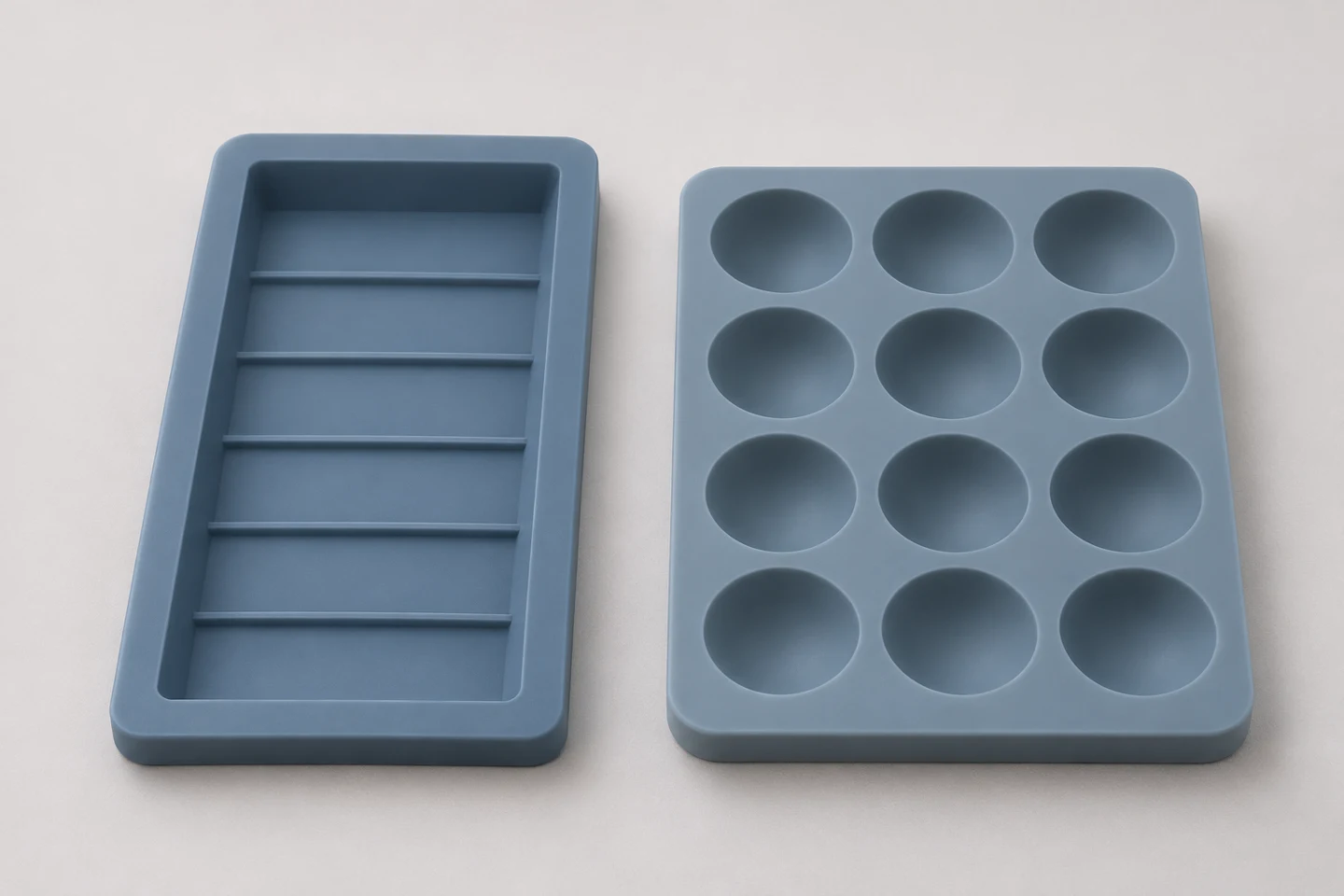
Continuous bar cavity with low divisions and a hemisphere-cavity layout

Engineer Bar Segments, Praline Shells & Gummy Cavities

Bars and divided bar shapes

One bar cavity holds a continuous piece. Recessed divisions, raised details or a deeper section change the result as well as the route for filling and removal. A picture of a finished bar does not describe the surrounding mold body.

Provide the desired bar outline, section and detail. Mark which features should be raised or recessed on the finished piece.

Small portions and praline cavities

Repeated small cavities organize separate pieces. Rounded, hemisphere or shaped portions differ in depth, opening and accessible detail; a filled praline also introduces a separate food-preparation sequence.

Show the intended piece, cavity arrangement and filling sequence. Include access at the cavity opening and around its deepest details. For lollipops, locate the stick, its cavity-entry relationship and any separately supplied holder.

Gummy and other candy forms

Simple shapes, relief and lettering can be combined with different tray layouts. The consistency and setting condition of the actual mixture affect what the filling and removal plan needs to address.

Specify the intended mixture state and desired result, then compare detail, access and residue removal. Do not select solely by a decorative silhouette.

Align Cavity Pitch to Hand Scraping or Depositor Nozzles

Lock in syrup viscosity, nozzle center-to-center pitch and carrier-tray datum pins upfront so multi-cavity sheets run cleanly in artisan kitchens or semi-automated confectionery lines.

Food state and process

Describe the mixture when it enters the cavity, its setting or cooling stage, and the condition at removal. Chocolate, gummy mixtures and hot-syrup recipes should not inherit one common process specification.

Provide the recipe or material specification needed for assessment and the intended contact conditions.

Cavity arrangement and working edges

Cavity centers, spaces between openings and the surrounding border affect access for filling, leveling and lifting. Keep usable cavity volume separate from the mold’s outside dimensions.

Provide a layout drawing, border and support areas, and the filling or leveling tools.

Tray or equipment fit

If the mold must fit an existing tray or dispensing arrangement, use that interface as a reference rather than assuming a standard commercial size.

Supply the mating tray or machine-interface drawing, positioning references and intended loading/unloading action.

Follow the piece out, then follow the residue

Describe when the formed piece is removed and how the mold is supported. Work through bar divisions, the roots of lettering and deep or narrow features. Agree the surface and appearance observations on the actual food and molded sample rather than assuming a cavity finish guarantees gloss.

For cleaning, identify where residues remain and which tools can reach them. Check wall junctions, cavity bottoms and spaces between cells, then draining, drying and storage.

Before tooling, bring the desired positive shape, cavity layout and handling references into one drawing revision. Optional geometry prototypes answer shape or fit questions; molded silicone samples are used for the selected material and agreed filling, release and cleaning observations. Match material documents and any finished-product checks to the actual food-contact scope.

Sourcing & Tooling FAQ

Key Answers Before Tooling

Covering CAD readiness, custom MOQ evaluation, free 3D fit checks vs. T1 silicone samples, NDA protection and mold ownership.

Have a part-specific question?

Send your drawing or sample photo directly to Zhou Li’s engineering desk for a 24h DFM reply.

How do you dial in exact piece gram weight for functional gummies or portioned chocolates?

Piece weight depends on both 3D cavity volume (accounting for meniscus fill height and cooling shrinkage) and your recipe’s specific gravity (pectin, gelatin or tempered cocoa mass). Share your target gram weight and recipe density so we size the CAD volume and calibrate real piece weights on 7–15 day T1 molded silicone samples.

Can you match multi-cavity gummy trays to our tabletop or semi-automatic depositor pitch?

Yes. Send your depositor manifold nozzle spacing, carrier-tray inner dimensions and corner datum pins—our 200–250T HCR platens (up to 650×650 mm) mold wide multi-row production sheets with consistent center-to-center pitch and flat squeegee borders.

How do you achieve high-gloss chocolate surfaces and crisp micro-logos?

Glossy chocolate snap requires both proper cocoa butter tempering and a mirror-polished steel mold core free of EDM pitting. Specify mirror vs. satin cavity zones and share vector logo files so we verify stroke width, draft angle and clean pop-out release on T1 samples.

Are your confectionery molds odorless and FDA / LFGB compliant?

Yes. All chocolate and candy molds use platinum-cured food-contact silicone post-cured in ventilated ovens at ~200 °C × 4 hours (targeting ≤0.5% volatile weight loss so delicate chocolate never absorbs rubber taint), backed by batch CoA records and optional SGS/Intertek/TÜV FDA 21 CFR 177.2600 or LFGB testing (~10 days).

B2B Factory Direct · 24h Engineering & Tooling Review

Custom-Tool Your Chocolate or Gummy Mold Sheet

Send your piece artwork/3D model, target gram weight, depositor or tray layout and order quantity—our engineering team responds within 24 hours.

✓ NDA available before CAD exchange✓ Eligible for 1–3 free 3D fit prototypes✓ Paid molds 100% owned by customer

Helpful RFQ Inputs

  • Desired food piece, artwork and cavity drawing
  • Mixture state, process and removal conditions
  • Tray layout, filling tools and mating interfaces
  • Quantity, colors, markings, packaging and documents