
Youbang · B2B Custom Silicone Manufacturing · Dongguan

Custom Silicone 3D Candle, Pillar & Vessel Casting Molds

Partner with our in-house mold design team to engineer tear-resistant silicone molds for ribbed pillars, slender tapers, deep-undercut 3D sculptural candles and concrete/jesmonite candle vessels—with precision wick-pin seats, tongue-and-groove split seams and 7–15 day T1 sampling.

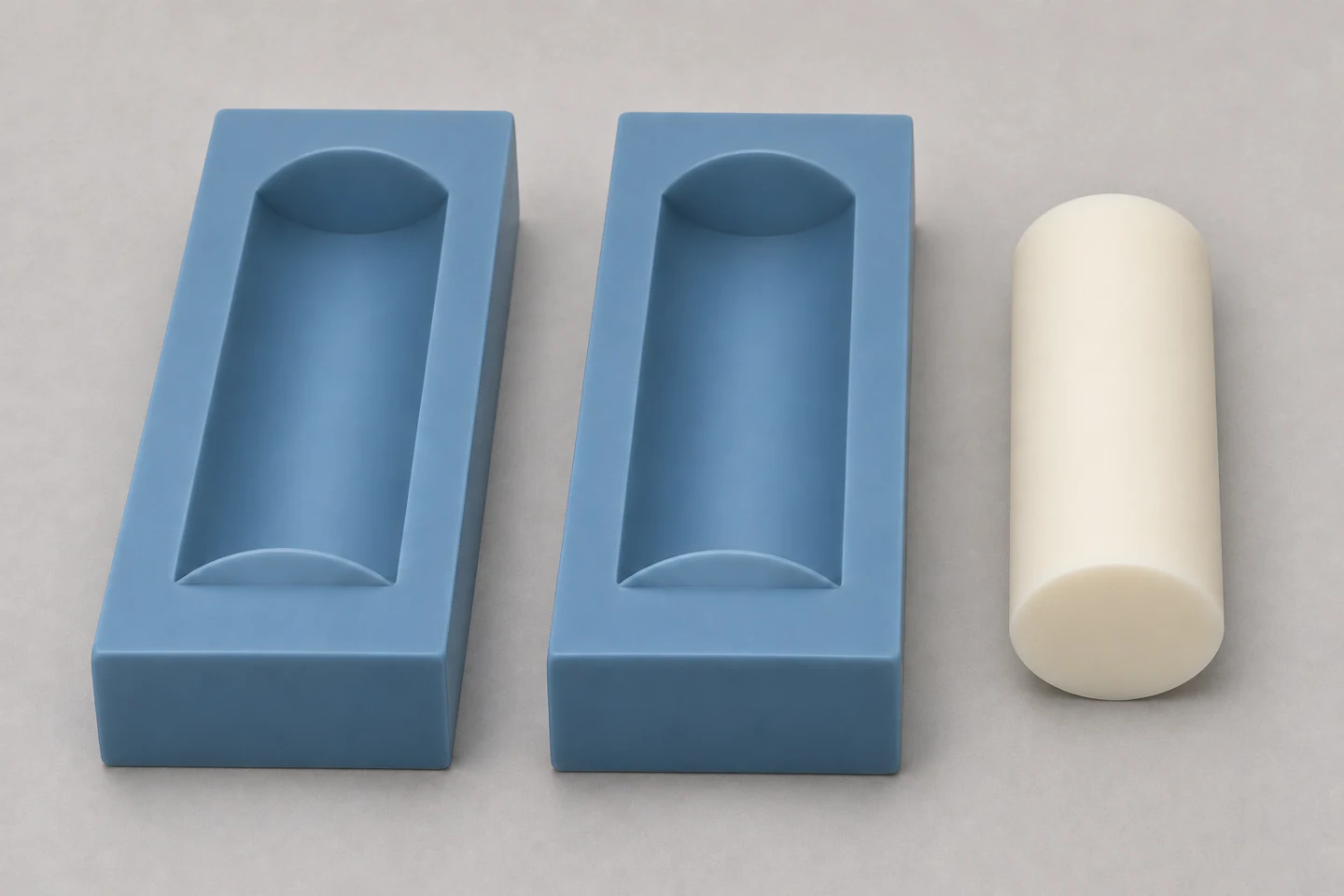
Cylindrical positive form and parted half-cavities

Start with the intended wax form

Pillar forms

A broad standing shape may be plain, ribbed or otherwise detailed. Smaller votive or tealight wax shapes differ from shallow, wick-free wax melts; identify whether a wick and a separate cup are involved. The opening, depth and detail determine what the formed wax must clear on the way out.

Provide the positive shape, main views and the condition of the wax at removal.

Slender and taper forms

An elongated form introduces a different access and support problem from a short pillar. Include its full length, end shape and how the assembly is placed during filling.

Show the intended orientation, opening and any external supporting arrangement.

Sculpted forms

Relief, projecting details and changes in section can obstruct a simple removal route. A one-piece or a parted arrangement is a design choice to assess, not a universal rule for all sculptures.

Supply a positive model or multiple views and identify fine details that must be preserved in the result.

Define the opening and parting route

The comparison view pairs a split mold cavity with the intended positive wax form. Open halves explain cavity access, while exact closure and demolding mechanics are defined per part drawing. Use the positive model and cavity arrangement to align where separation occurs.

A simpler form may use a different opening arrangement from a complex relief. Describe filling, support and separation in order, including any supplied components. Do not assume every wax shape needs a split mold or can be peeled out in one action.

Put wick position and support into the drawing

Wick-position reference

Mark the intended wick location and alignment on the positive-shape drawing. Any passage, entry/exit point and positioning tool need a defined relationship.

Provide the required position, orientation and the responsible supplier for any separate positioning tool.

External support

A tall or parted concept may need a separate working support. Its contacting surfaces and access can affect filling and removal.

Show the support, supplier and assembly references, including the way the mold is placed and removed.

Casting a container is a separate task

A mold for a wax pillar forms the wax object itself. A mold for a container forms a separate vessel that may later be used for a candle; its inner and outer profiles, base and opening create a different cavity arrangement.

State the actual casting medium and target vessel shape, then define supports, removal and cleanup. The resulting vessel material and its later use need their own assessment; they cannot be inferred from the silicone mold or from the pillar wax form above.

Approve the result, working sequence and documents

Bring the positive model, cavity/parting proposal, wick references and external components into controlled drawings. Youbang designs molds internally; mold machining is coordinated externally. If the selected construction uses overmolding, inserts are customer supplied and require primer; separate supports follow their own fit and supply agreement.

Choose prototypes for geometric or assembly questions, then the relevant molded samples for the actual material, casting conditions, separation and cleaning observations. Record the agreed checks, available material documents and project approvals. No generic mold drawing establishes candle-burning or vessel-use safety.

Sourcing & Tooling FAQ

Key Answers Before Tooling

Covering CAD readiness, custom MOQ evaluation, free 3D fit checks vs. T1 silicone samples, NDA protection and mold ownership.

Have a part-specific question?

Send your drawing or sample photo directly to Zhou Li’s engineering desk for a 24h DFM reply.

When does a 3D sculptural candle need a side-slit or two-part locking mold vs. a one-piece peel-out sleeve?

Moderate ribs and geometric pillars unmold cleanly from one-piece elastic sleeves when wall thickness and 25–45 Shore A stretch are balanced. Deep floral petals, figurines or fragile overhangs benefit from an engineered keyway side-slit or two-part tongue-and-groove mold with outer clamping ribs so soy or beeswax edges never snap during demolding.

Can we start custom candle mold tooling directly from a ZBrush/Blender STL or 3D-printed master?

Yes. Send your positive 3D mesh (STL/STEP/OBJ) and specify soy, beeswax, paraffin or pillar blend shrinkage expectations. Our in-house mold designers build the negative silicone shell, flat pour base and outer support collar within 24 hours, with optional 1–3 free 3D master checks (buyer pays shipping) before cutting steel tooling.

How do you build leak-free wick passages and centering guides into the mold?

Rather than forcing makers to pierce blind silicone bases by hand, we mold self-pinching micro-wick apertures or rigid wick-pin locating bosses at the exact axis of your positive wax model, plus top crossbar centering notches where needed.

How does a concrete/gypsum candle-jar mold differ from a freestanding wax mold?

A freestanding candle mold forms solid wax around a central wick; a vessel mold uses an inner core + outer sleeve to cast a hollow concrete, gypsum or resin jar with uniform wall thickness and bottom foot clearance—requiring stiffer anti-bulge outer walls and abrasive-release elastomer selection.

B2B Factory Direct · 24h Engineering & Tooling Review

Custom-Tool Your 3D Candle or Vessel Mold

Share your 3D wax sculpt or vessel CAD, wax/casting medium, wick setup and target order quantity—our engineering team responds within 24 hours.

✓ NDA available before CAD exchange✓ Eligible for 1–3 free 3D fit prototypes✓ Paid molds 100% owned by customer

Helpful RFQ Inputs

  • Positive wax shape or vessel design and main views
  • Opening, parting and intended removal sequence
  • Wick references, supports and component suppliers
  • Casting/contact conditions, quantity and documents